Share this page
Music
Your contact sheet needs a rhythm section.
Monk and Mingus offer listening exercises for repetition, surprise and space. No compulsory beret. No claim that grain is a musical genre.

Listen for the shape, not the mythology
Thelonious Monk's Brilliant Corners, released in 1957, is a good place to hear an idea that resists an easy square shape. Robin D. G. Kelley's Library of Congress essay describes the title composition's unusual 22-bar form and shifts of tempo. That is a specific formal decision, not a general instruction to be eccentric and hope the audience catches up.
Listen first without looking at photographs. Mark on paper where a phrase seems to return, where you expect an accent and where something surprises you. Then look at a contact sheet. Do you repeat one shape so often that the sequence becomes predictable? Does the interruption arrive when it can be felt? Our comparison concerns attention and structure. It does not turn a photograph into a literal jazz solo.
A framework can make room for people
Charles Mingus's Mingus Ah Um, from 1959, offers another useful starting point. John F. Goodman's Library of Congress essay describes the composer's Jazz Workshop method: musicians worked within a framework while retaining individual ways of playing. Explore Better Git It in Your Soul and Goodbye Pork Pie Hat as contrasting pieces within one album, rather than treating 'jazz' as one continuous mood.
A photo walk can have a framework too: one district, one focal length, one hour or one repeated shape. That restriction leaves room for different people and events. The point is not to force every frame into the same trick. If a strong photograph refuses your tidy theme, try changing the sequence before deleting the photograph. Even the best brief is allowed to discover that the street has better ideas.
Repetition needs a difference
Mark's Princes Dock Footbridge photograph gives us repeating arches and a person who interrupts their march. This is our visual study, not an illustration of Monk or Mingus and not evidence of their influence on the photograph. Track the intervals between the arches, then notice how the figure changes your reading of the structure.
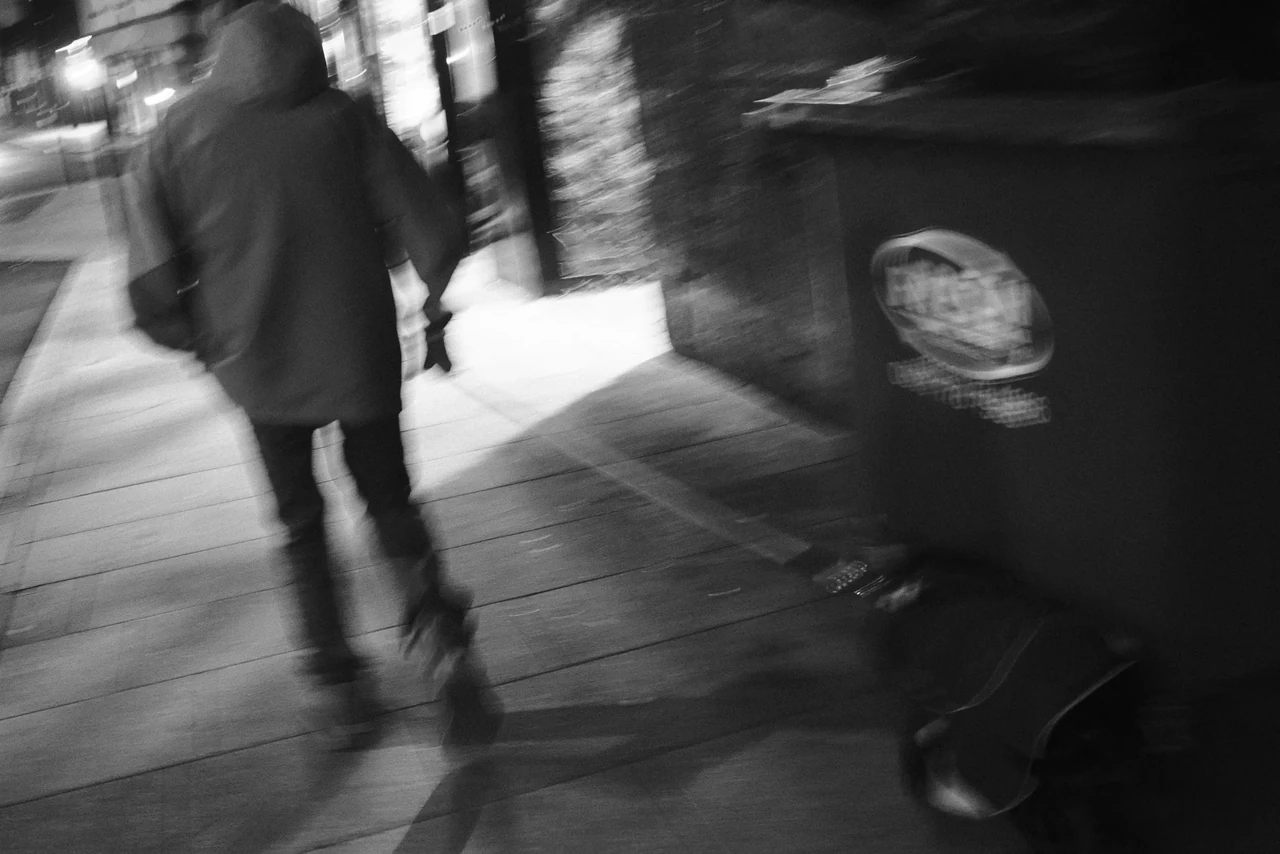
In Passing in a Blur, let the moving figure act as a contrast to the more stable surroundings. The exercise is to compare visual pace: an orderly sequence of shapes against a less settled presence. You can make a quiet picture and a restless one in the same street. Converting both to black and white will not automatically make them belong together. Their relationship has to earn its place in the edit.
Leave somewhere for the eye to rest
A six-picture sequence made entirely of your loudest images can feel like six people explaining themselves across the same studio table. Keep one quieter frame in contention. Fewer elements, a longer interval or an unoccupied patch can make the next photograph arrive differently. This is an editorial experiment, not a rule imported intact from music theory.
Listen through a chosen track, then put the music away and edit in silence. Otherwise the soundtrack may lend your pictures an emotion they have not earned. Ask another viewer to describe the pace without hearing the music or reading your statement. If they can identify a return, an interruption and a pause, you have made something visible. If not, move two pictures and try again. Tea can be the interval; it need not become the entire creative process.
Sources & further looking
- Library of Congress: Brilliant Corners — essay by Robin D. G. Kelley ↗
- Library of Congress: Mingus Ah Um — essay by John F. Goodman ↗
Sources checked 2026-10-22. Visual readings and proposed connections are our editorial interpretation.
Bring another connection.
Name the work and the detail. “It has a vibe” can be the beginning; it cannot be the whole argument.
Discuss art & influence ↗Your turn / photographs & ideas
Bring a frame. Leave a thought.
What did this make you notice? Bring your own photograph, try the exercise, or give us a considered disagreement. The camera bag can wait.
Sign in or make an account to post. Share your own work, credit your sources and keep the conversation generous. Reader photographs remain the work of their contributors.