Share this page
Art & print
The painters got there before your grid overlay.
Hokusai, Caillebotte and three useful questions: where does the eye travel, what does a body tell you, and what escapes the frame?
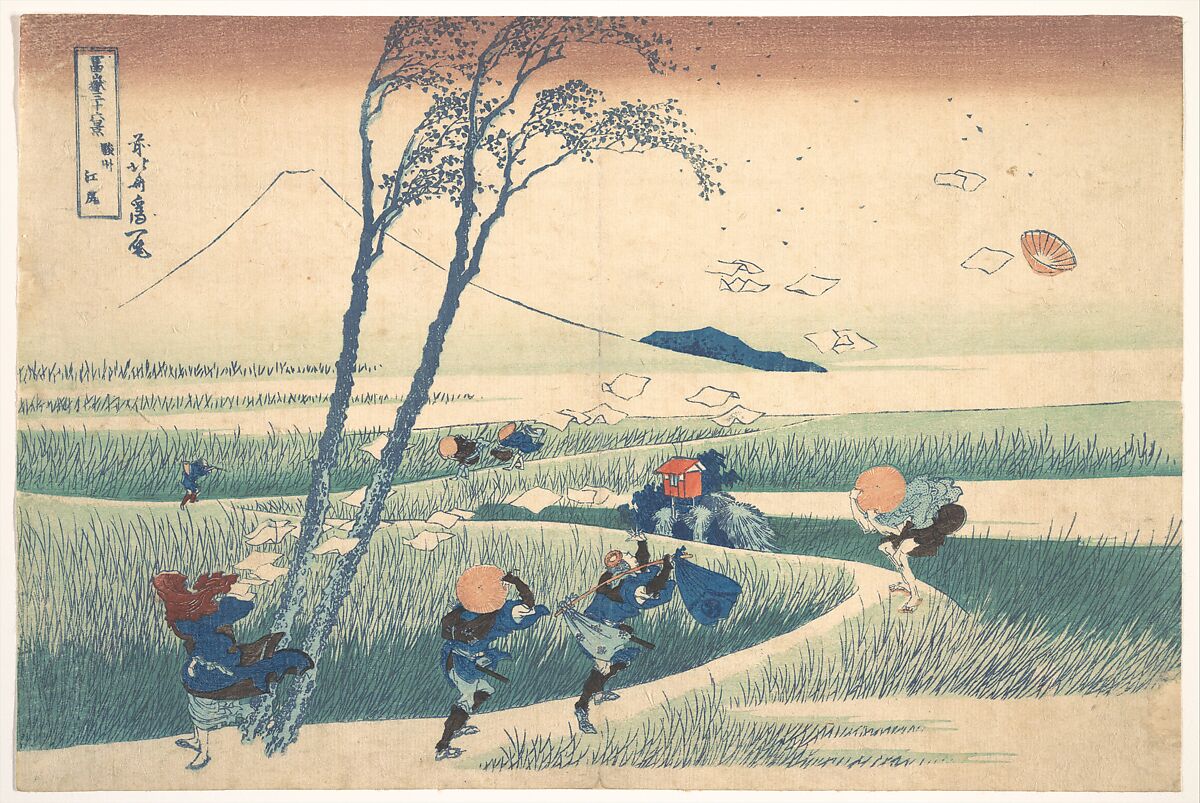
The Metropolitan Museum of Art, Henry L. Phillips Collection, Bequest of Henry L. Phillips, 1939, JP2953. Public Domain. · Public Domain / Met Open Access · Collection record ↗
A gust is a composition
In Hokusai's Ejiri in Suruga Province, made around 1830–32 for Thirty-six Views of Mount Fuji, paper and hats take flight while travellers hold themselves against the wind. The distant mountain barely seems bothered. The Met identifies this contrast between foreground commotion and background stillness. Start there, then follow the curved path through the picture. Your eye has a journey even before you decide which person matters.
For a street photographer, the useful comparison is movement against something stable. A gust catches a coat; a wall stays put. A bus interrupts a row of waiting figures. You do not need to manufacture an event. Find a structure that will make an ordinary event legible, then stay alert. The weather has supplied the choreography. It will not be submitting an invoice.
A body can carry the sentence
Caillebotte's Study of a Man with Hands in His Pockets is a black-chalk drawing from 1893. Cleveland identifies its sitter as Eugène Lamy and relates it to the painting Bank of the Seine at Petit Gennevilliers, Winter. The face is largely turned away. The bent elbows, jacket folds and weight over the feet do the work.
Look at the dark marks around the lower jacket, then at the spare outline of the legs. Detail is not distributed evenly. That is a useful lesson in photographic attention: you can make an expressive picture without extracting a stranger's face. A posture, a hand or a relation to another body may be enough. It remains a visible gesture, not a reliable diagnosis of somebody's inner life.
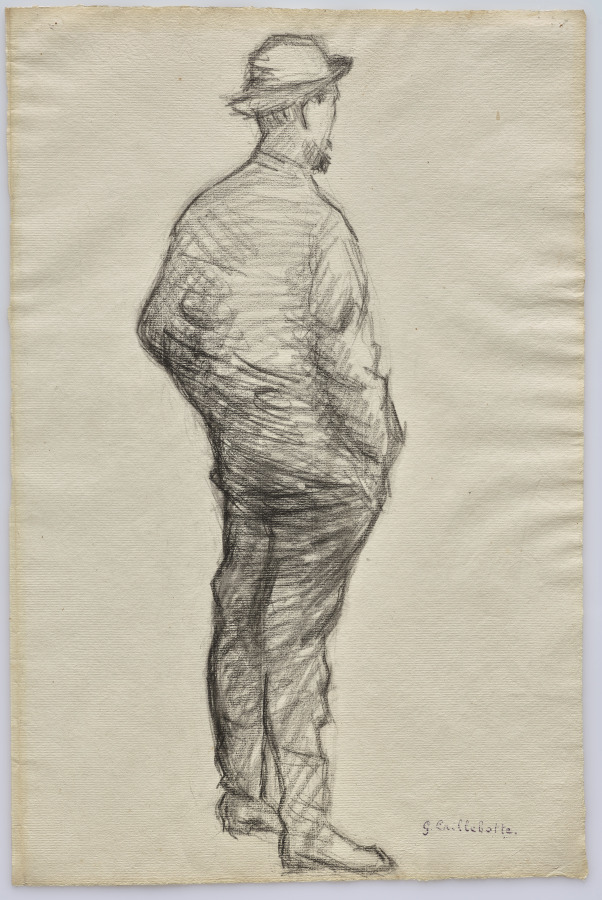
The Cleveland Museum of Art, John L. Severance Fund, 2020.260. CC0. · CC0 · Collection record ↗
The edge is part of the event
Now open Caillebotte's Paris Street; Rainy Day, painted in 1877, at the Art Institute of Chicago. Notice the figure interrupted by the right edge, the umbrellas and the large interval of wet pavement. The museum describes a carefully arranged scene of modern Paris, while allowing that its cropping may reflect photography. Keep that 'may': a comparison is not a signed confession of influence.
Try reading the painting as a set of distances rather than a list of people. Near figures feel almost within reach; smaller ones hold the far street open. In your own frame, ask whether every figure is stranded at the same distance. One nearer shape can give the whole street depth. You can practise that with a bollard before involving anyone else's afternoon.
Borrow a question, keep your own street
These works matter here because they make selection visible. The artist organises attention; the scene does not simply explain itself. A camera records more detail than a chalk drawing, but that does not mean all the detail deserves equal emphasis. Position, timing and the frame still decide what gets read.
Our proposed exercise borrows a problem from each work, rather than imitating a historical style: movement against stillness, a speaking posture, and an active edge. Make three photographs of today's place. Leave the sepia nostalgia in the cupboard with the decorative camera straps. Review what the pictures make a viewer notice first, and whether the next thing rewards looking longer.
Watch, then try
The Great Picture Book of Everything; Hokusai's Unpublished Illustrations | Curator's Corner S6 Ep8

Watch how a few marks make a figure move. On the street, look for one clear silhouette or gesture; leave enough space for the action to read before adding another element.
Sources & further looking
- Hokusai: Ejiri in Suruga Province — Met collection record ↗
- Caillebotte: Study of a Man with Hands in His Pockets — Cleveland ↗
- Caillebotte: Paris Street; Rainy Day — Art Institute of Chicago ↗
Sources checked 2026-10-22. Visual readings and proposed connections are our editorial interpretation.
Bring another connection.
Name the work and the detail. “It has a vibe” can be the beginning; it cannot be the whole argument.
Discuss art & influence ↗Your turn / photographs & ideas
Bring a frame. Leave a thought.
What did this make you notice? Bring your own photograph, try the exercise, or give us a considered disagreement. The camera bag can wait.
Sign in or make an account to post. Share your own work, credit your sources and keep the conversation generous. Reader photographs remain the work of their contributors.