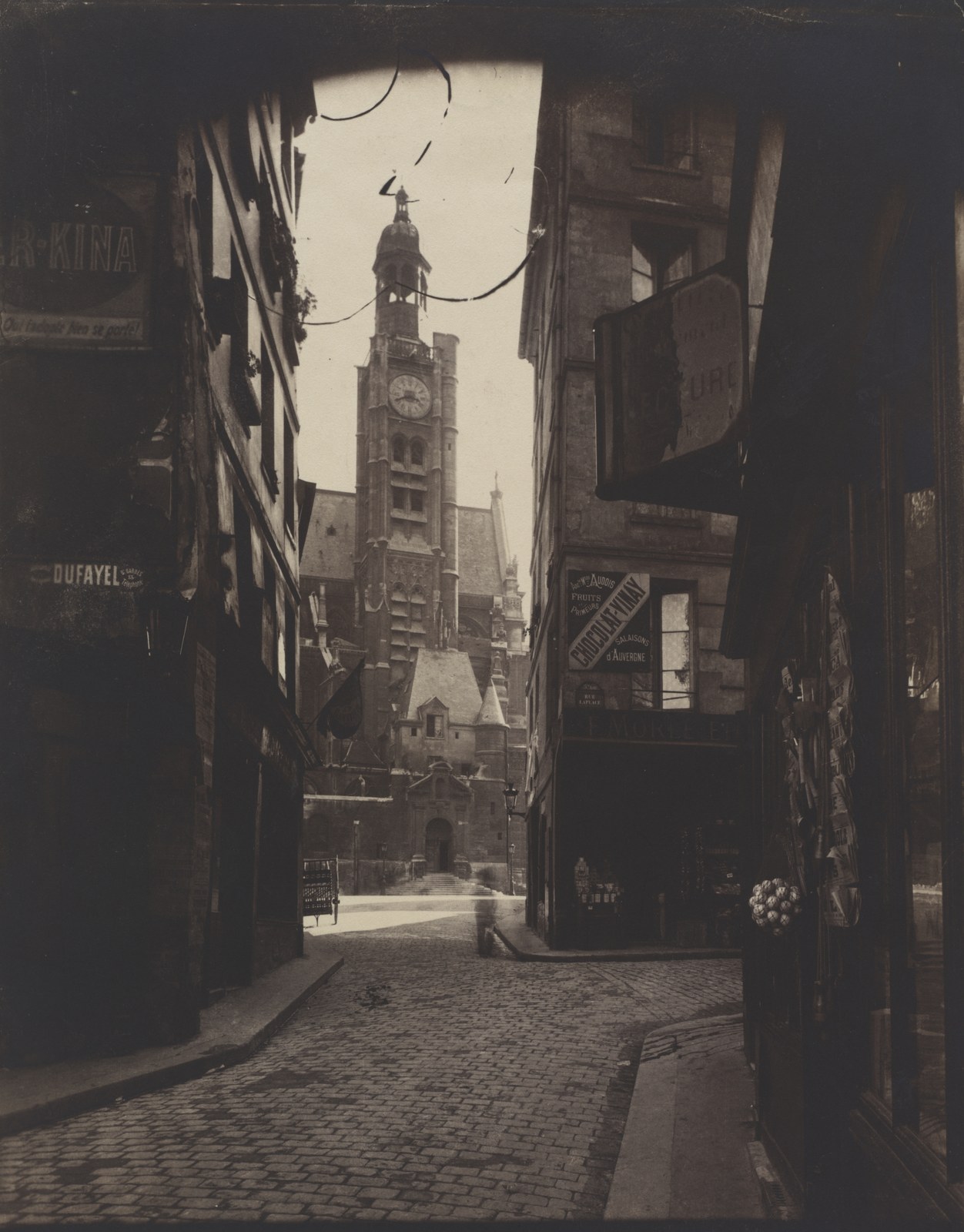
French photographer Eugène Atget (1857–1927) made extensive records of Paris, selling photographs as documents for artists.
A street can hold a life without showing a face.
Atget gives the foreground almost as much work as the church. Dark buildings press in from both sides; a little wedge of bright street pulls us through. Signs, wires and cobbles keep the picture particular. This is a place with businesses, habits and wear, rather than a postcard that has politely removed everything interesting. Look at how the irregular edge of the shadow interrupts the neat perspective.
His records of old Paris matter because documentation and personal vision turn out to be perfectly capable of sharing a camera. The Cleveland Museum describes his concern with streets and buildings facing demolition. That history changes the apparently quiet scene: it becomes evidence of a city in transition. For our purposes, the useful lesson is patience with ordinary places. A street photograph does not require a dramatic stranger on cue. Sometimes the street has already done the acting. Give it the frame.
Sources & further looking
Sources checked 2026-10-22. Visual readings and proposed connections are our editorial interpretation.
What does the picture make you notice?
Which tells you more about this place: the church, the shop fronts, or the worn street between them?
Discuss photography & art ↗