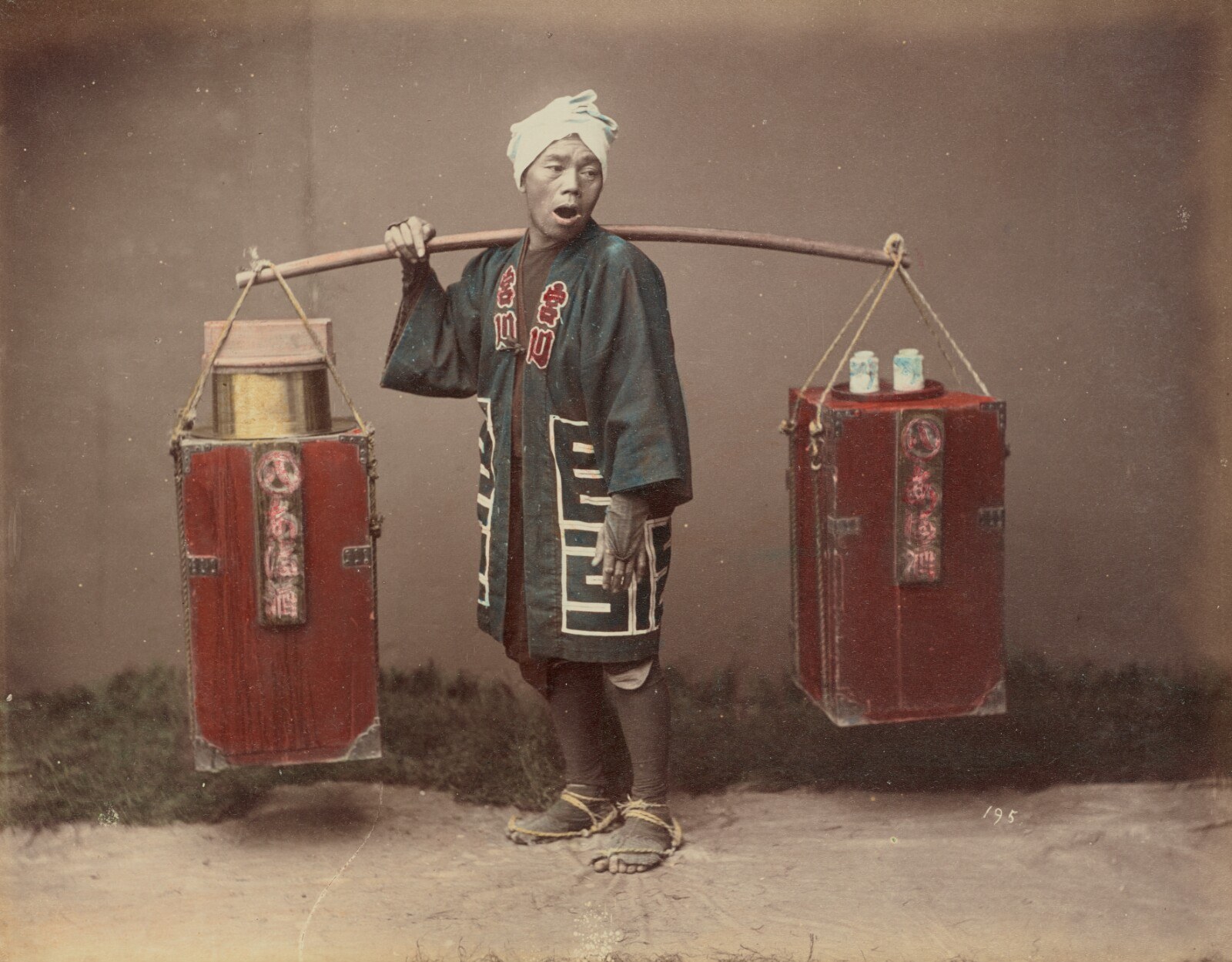
Japanese photographer Kusakabe Kimbei (1841–1934) worked in Yokohama; this Getty photograph is a hand-coloured albumen print of an amazake seller.
A picture of street life is not automatically a candid street picture.
The carrying pole makes a horizontal line across the sitter’s shoulders. The two red boxes balance each other, and the figure fills the space between them. Colour is applied to the photograph rather than produced by a modern colour sensor. The plain background and arranged pose are visible reminders that an image can describe an occupation through performance in a studio.
That is the valuable art-history discussion here. Photographs of everyday work are constructed through choices about setting, pose, clothing and presentation; a historical label does not turn every frame into an unmediated window. Kimbei’s picture belongs in a street-photography conversation precisely because it tests what we mean by street. An arranged portrait can communicate clearly, but it needs an honest description. The same principle applies to computational edits and AI today: let viewers know how an image came to be, rather than borrowing the authority of an unstaged encounter.
Sources & further looking
Checked 22 October 2026. Visual readings and proposed connections are our editorial interpretation.
What does the picture make you notice?
What changes when the same subject is photographed at work rather than posed with the tools?
Discuss photography & art ↗