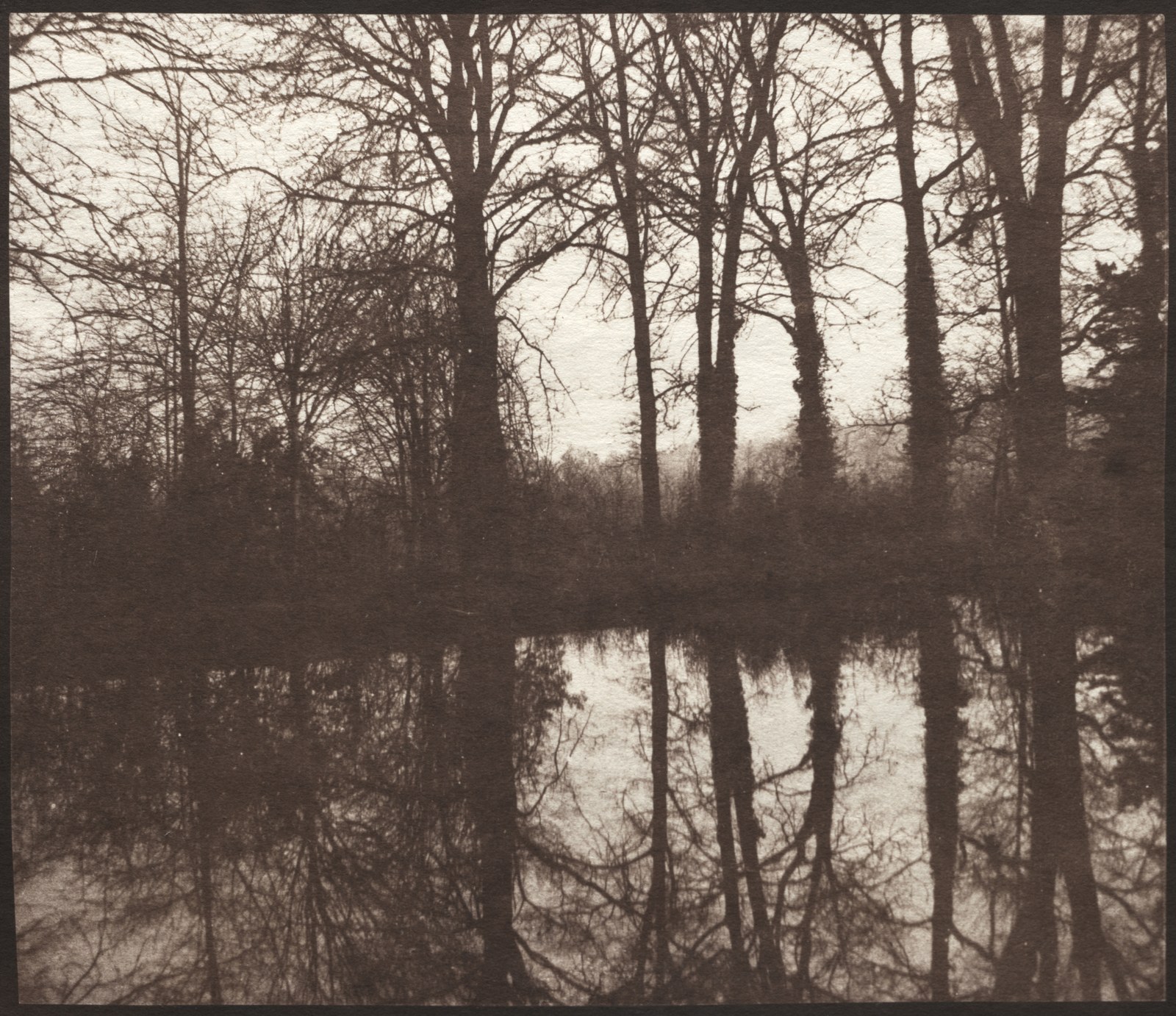
British experimenter William Henry Fox Talbot (1800–1877) developed a paper negative process that allowed multiple positive photographic prints.
Abstraction was there almost from the beginning.
Turn this picture upside down in your mind. The trees and their reflections nearly trade places, while the dark bank acts as a hinge. Thin branches make a restless mesh over the pale sky and water. The Cleveland Museum identifies the setting as a pond at Lacock Abbey. There is no spectacular mountain, no obedient sunset and no helpful person in a red coat. The arrangement of what is already there carries the photograph.
Talbot matters to photographic history for his negative-positive experiments, but this early image also shows how quickly a recording device could become a tool for visual abstraction. A real place can be both evidence and pattern. That distinction is useful when digital processing offers an endless supply of ready-made atmosphere. You can build strangeness by choosing your position and boundaries first. Try that before asking a preset to develop a personality on your behalf.
Sources & further looking
Checked 22 October 2026. Visual readings and proposed connections are our editorial interpretation.
What does the picture make you notice?
When does a recognisable place begin to behave like a drawing?
Discuss photography & art ↗