Print / Weather / Street
Hiroshige: the weather has changed the composition.
A bridge in Edo, a street in Guangzhou and twelve frames in the rain. Follow the routes before reaching for a moody preset.
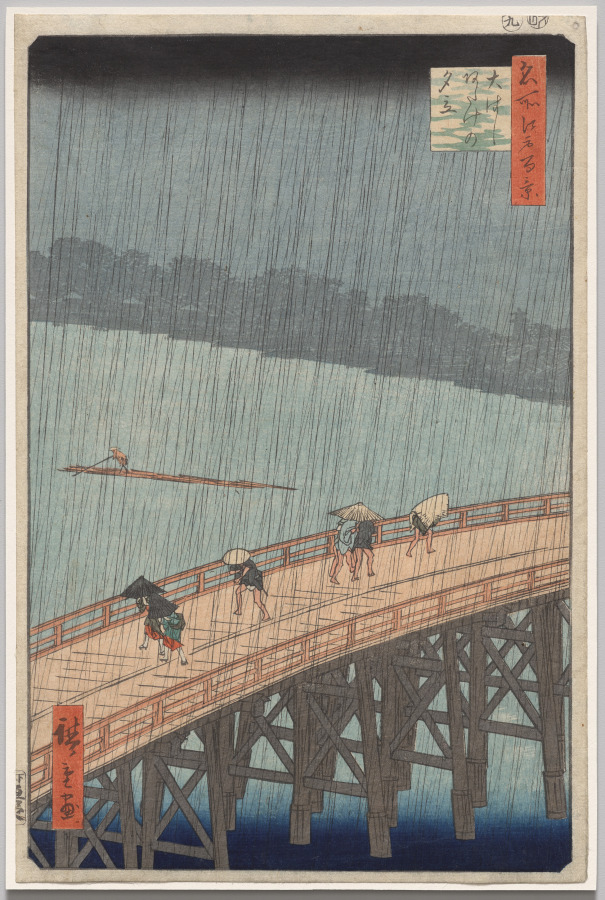
The Cleveland Museum of Art, Gift from J. H. Wade, 1921.318 · CC0 1.0 · Collection record ↗
A shower is an event, not an overlay
Hiroshige’s Sudden Shower over Shin-Ōhashi Bridge and Atake dates from 1857 and belongs to One Hundred Famous Views of Edo. The bridge cuts across the lower part of the print at an angle. Above it, dark cloud gives way to long strokes of rain. The distant bank appears through a pale, damp interval. The weather acts across the whole picture rather than sitting decoratively on top.
Look at the travellers. Their small shapes bend and bunch under cover while the bridge stays firm beneath them. Rain changes their posture and their relationship to space. A photograph of wet pavement can be attractive, but this print suggests a richer question: what does the weather make people do? Shelter, hurry, wait, share an umbrella, turn away. There is the beginning of a sequence.
Three directions, one frame
Trace the bridge first, the falling rain second, then the quieter band of the far bank. These directions meet without becoming the same rhythm. The raft below adds another small movement, separated from the larger crossing above. At the right, the bridge continues beyond the frame. We arrive partway through a route and leave before it ends.
Compare Lai Fong’s Guangzhou street, reproduced below. Its signs and walls establish a strong fixed structure while moving people disturb the near foreground. This is our studio comparison, not a claim that the photograph copies Hiroshige. In both works, a stable environment helps make temporary movement visible. Architecture provides the sentence; a body changes the punctuation.
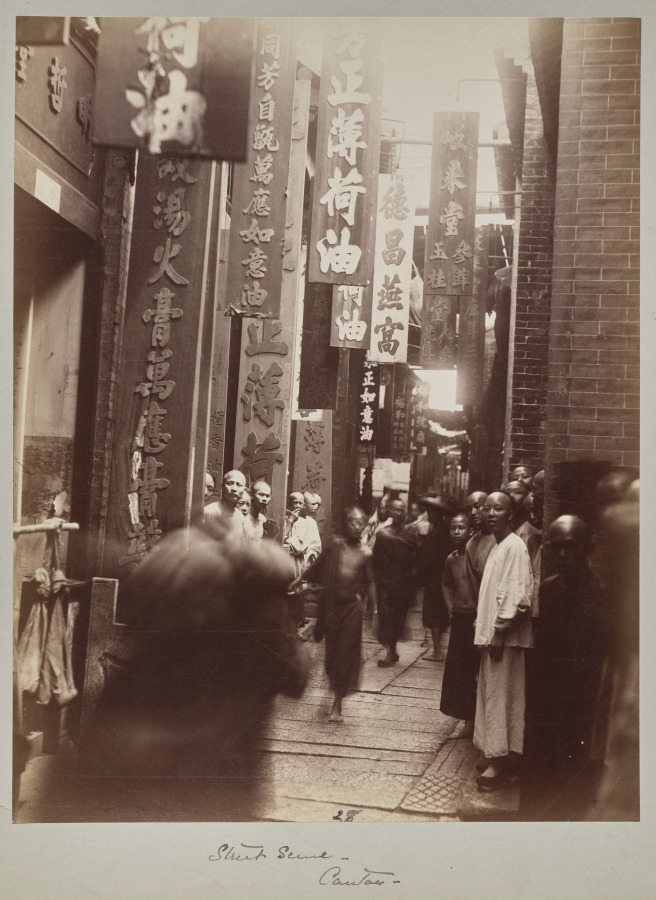
The Cleveland Museum of Art, Gift of Michael F. Resch, 2022.341 · CC0 1.0 · Collection record ↗
Keep the particular place
Cleveland identifies the bridge as part of Edo’s landscape following the destructive earthquake and fire of 1855. That context stops the print becoming simply “Japanese atmosphere”. This is a represented city with infrastructure and a history. The place matters as well as the elegance of the diagonal.
The supplied woodblock print remains in colour here. Its blue water, dark sky and warm bridge are part of its construction. For a monochrome photograph, translate relationships of light and dark through exposure and position; do not pretend that stripping colour from the original would reveal its true essence. Different media can ask related questions without becoming interchangeable.
Take the question into today’s street
From shelter, find a crossing or pavement that gives you a clear route across the frame. Stay where you are not an obstacle. Watch long enough to learn which movements recur. If your camera is not protected against rain, the doorway is a perfectly respectable artistic collaborator.
Try a frame before a person enters, a frame with a person crossing and a frame after they leave. Look for changes in posture and spacing. Then review whether the rain is actually visible or merely remembered because you were cold. The picture has no access to your damp socks. It must describe the event using what is inside the rectangle.
The shutter lesson supports the field exercise. The British Museum film is about Hokusai, a different artist: compare the handling of gesture and print, rather than treating it as a biography of Hiroshige.
Watch, then try
Take Better Photos Episode 2 - Shutter Speeds

Pause on the movement examples. Choose whether your own passing subject should freeze or smear before you choose the shutter speed.
Watch, then try
The Great Picture Book of Everything; Hokusai's Unpublished Illustrations | Curator's Corner S6 Ep8

Watch how a few marks make a figure move. On the street, look for one clear silhouette or gesture; leave enough space for the action to read before adding another element.
Sources & further looking
Sources checked 2026-10-23. Visual readings and proposed connections are our editorial interpretation.
Bring another connection.
Name the work and the detail. “It has a vibe” can be the beginning; it cannot be the whole argument.
Discuss art & influence ↗