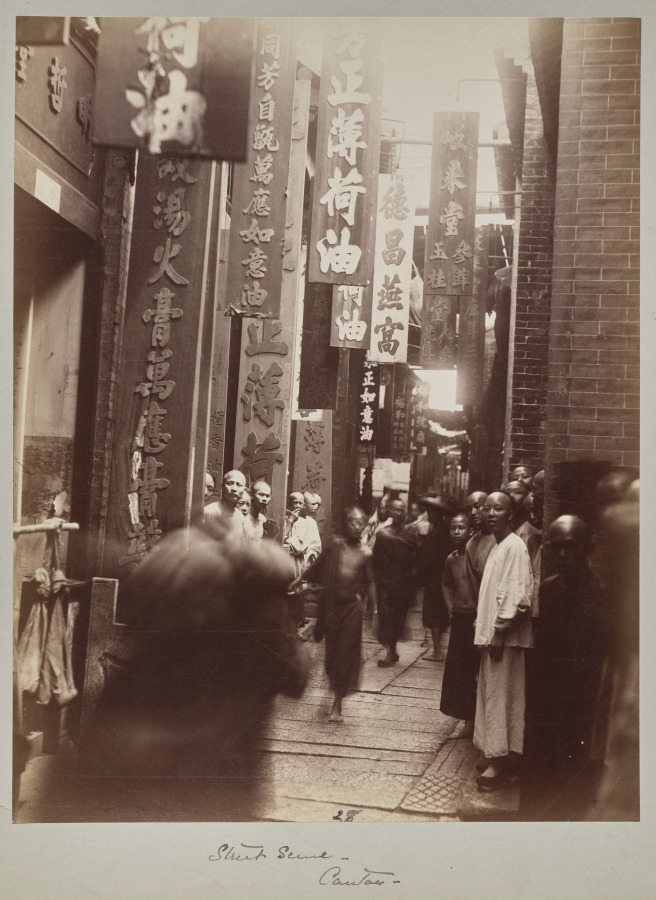
Lai Fong (c. 1839–1890) was a Chinese photographer associated with Afong Studio. This albumen print records a commercial street in Guangzhou, the southern trading city formerly known in English as Canton.
The street was moving before your burst mode arrived.
Start with the person who refuses to stay solid. A dark, blurred body crosses the lower left, interrupting the clear shop signs above. On the right, a pale robe and a row of faces hold their positions. Between them, the paving pulls us into a narrow passage. There is more than one kind of time in this photograph: the enduring shopfront, the person who pauses, the person already leaving.
The signs do something wonderfully awkward. They are information for the people using the street, but to a viewer who cannot read their characters they also become a dense sequence of light and dark rectangles. Do not reduce their language to exotic decoration. Notice what your own ignorance removes, then look at how their size and overlap give the street its depth. The city is not obliged to explain itself in your preferred alphabet.
The Cleveland Museum places the scene in Guangzhou’s long history of trade. That context matters: these are working premises and people occupying a commercial place. The photograph is also an encounter with a camera. Several figures look back. Their attention is visible evidence of the photographer’s presence, not a failure to achieve mythical invisibility. A picture can include the fact that somebody made it.
Why it belongs in a street-photography conversation
This is a useful corrective to a history made entirely from fast shutters and unobserved gestures. An older photographic process still produces a lively, complicated account of shared space. We cannot recover the precise exposure from the blur alone, and this is not a recipe for reproducing Lai Fong’s technique. What we can study is the productive difference between fixed architecture and unstable bodies.
Try covering the blurred foreground with your hand. The street becomes easier to inventory and less physically immediate. Put it back: now the camera seems to be standing among people. A technically tidier version might lose the very interruption that makes us feel the pavement. Sharpness has its uses. It need not chair every meeting.
Watch & practise
A related artist conversation or practical lesson to take back to this photograph.
Watch, then try
Take Better Photos Episode 2 - Shutter Speeds

Pause on the movement examples. Choose whether your own passing subject should freeze or smear before you choose the shutter speed.
Sources & further looking
Sources checked 2026-10-23. Visual readings and proposed connections are our editorial interpretation.
What does the picture make you notice?
Does the moving figure spoil the record, or tell you something a perfectly still street could not?
Discuss photography & art ↗