Print / Portrait / Identity
Kollwitz: a face made from decisions.
Marks, shadow, costume and the person holding the camera. Three self-portrait problems that do not require a beauty filter.
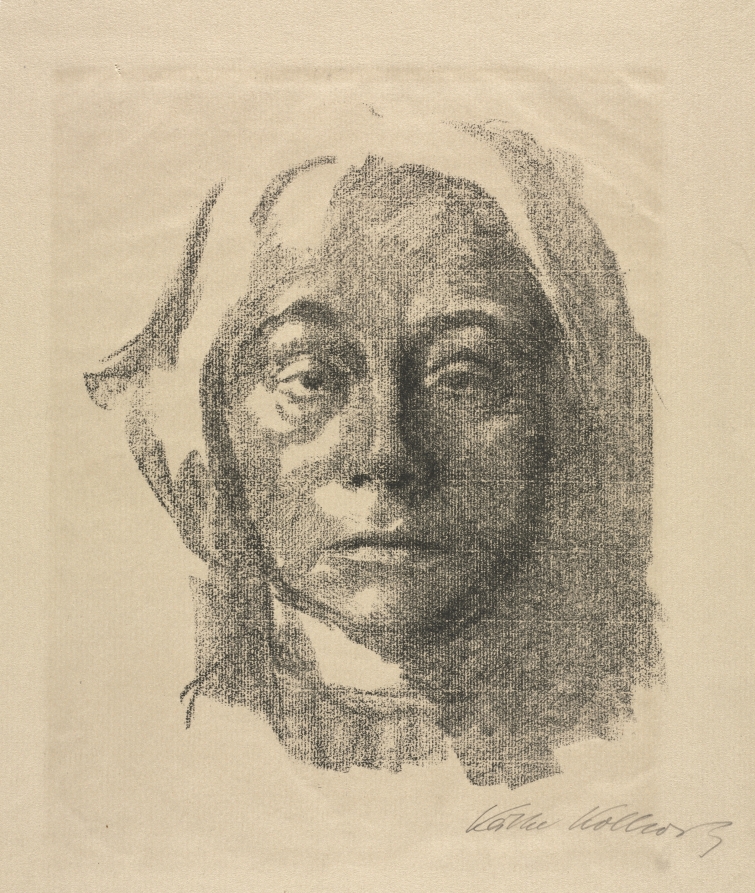
The Cleveland Museum of Art, Mr. and Mrs. Lewis B. Williams Collection, 1941.493 · CC0 1.0 · Collection record ↗
Look at the marks before diagnosing the face
Käthe Kollwitz’s 1915 Self-Portrait is a lithograph. A close head emerges from a field of grainy marks; one side of the face gathers into stronger shadow while the covering around the head is described more loosely. The eyes and mouth are concentrated, but the outer shape is allowed to remain less settled. Detail is deliberately unequal.
The temptation is to jump immediately from the mouth and eyes to an emotion. Resist it for a minute. Name the visible choices: where the darkest patch sits, where the paper remains open, which contour is repeated and which nearly disappears. You can feel the picture’s force without claiming access to the artist’s private thoughts at the exact moment it was made.
A print is not a photograph with grain added
The texture belongs to a lithographic image on paper. Its marks describe volume and keep their own material presence. Our photographic comparison is about the distribution of attention, not a claim that a high-ISO file or grain recipe recreates Kollwitz’s process. Different tools leave different evidence.
Now look at Johnston’s self-portrait below. Instead of concentrating on a face, she uses a full body, clothes, a false moustache and a bicycle. The wheel is a major compositional actor. One picture compresses the encounter; the other expands it into a performed scene. Both are made through choices. Looking solemn is not a certificate of greater authenticity.
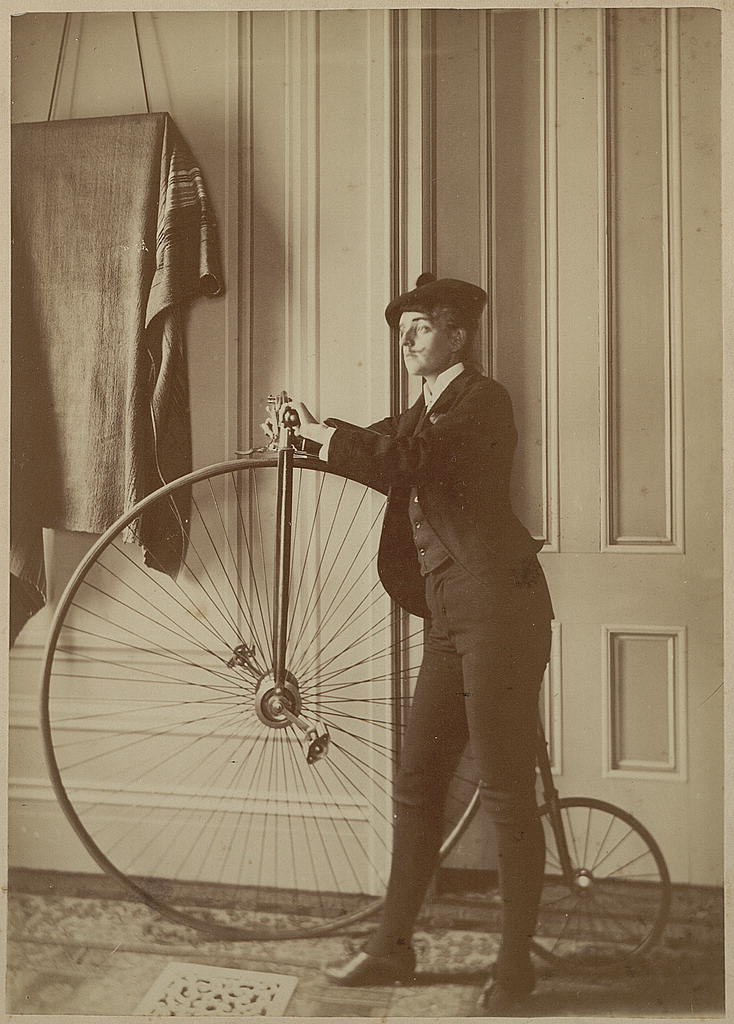
Library of Congress, Prints & Photographs Division, Frances Benjamin Johnston Collection, LC-DIG-ppmsc-04884 · Library of Congress: no known restrictions on publication · Collection record ↗
The camera is allowed in the room
Mark’s Landscape through Glass offers another route. The maker describes testing a slow shutter on a train and finding more: moving land, reflected hands, the camera lens, his eyes and his spectacles. Window glass, lens glass and glasses worn on the face all participate in the act of seeing. The picture does not hide the fact that a person is trying to make it.
These are three comparisons, not one theory of the self. Kollwitz’s lithograph, Johnston’s staged photograph and Mark’s reflection each make the author visible differently. Ask which parts of your own practice you usually remove from the frame. A reflection might be a distraction, but it might also be the point where the picture becomes yours.
Make a self-portrait that can answer back
A useful self-portrait exercise starts with a question more specific than “capture my soul”. Try: how does my hand rest when I work? What does this room make possible? How much of my face must be visible for the picture to feel like an encounter? Specific questions give you something to assess on the contact sheet.
Keep the twelve attempts, including the awkward ones. A frame in which your hand covers half the face might reveal a useful rhythm; it might simply be badly timed. Neither automatic perfection nor automatic imperfection is a judgement. Look at what the frame actually does. The camera can keep its motivational speech to itself.
Zanele Muholi’s own account in the Tate film brings a contemporary voice to self-representation. Listen to the artist’s purposes rather than treating the work as a general portrait recipe.
Watch, then try
Zanele Muholi – ‘In My World, Every Human is Beautiful’ | Tate

Notice who is being represented and who has a voice in that representation. With a willing participant, agree how a portrait will be used, make it together, and let them respond to your selection.
Sources & further looking
- Kollwitz: the 1915 lithograph ↗
- Johnston: catalogue and historical context ↗
- Mark C Grant: Landscape through Glass and maker account ↗
Sources checked 2026-10-23. Visual readings and proposed connections are our editorial interpretation.
Bring another connection.
Name the work and the detail. “It has a vibe” can be the beginning; it cannot be the whole argument.
Discuss art & influence ↗