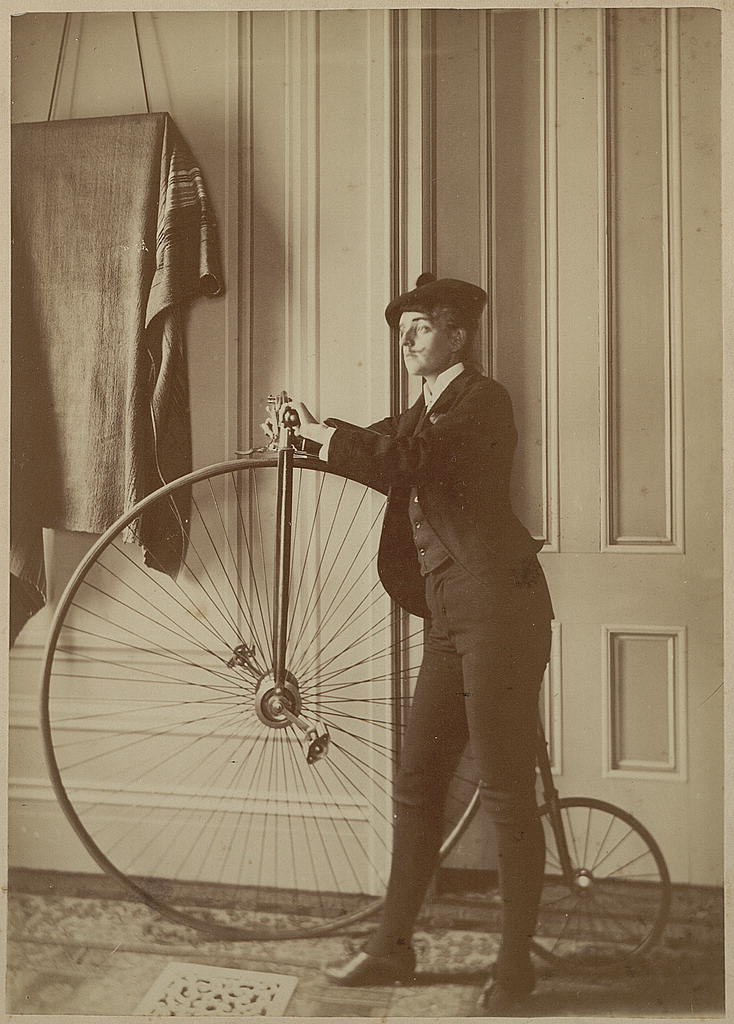
Frances Benjamin Johnston (1864–1952) worked across portraiture, photojournalism, architecture and gardens. The Library of Congress dates this self-portrait between 1890 and 1900 and identifies the false moustache, male attire and bicycle.
The photographer enters the performance.
The wheel is enormous. It fills the left side with a circle of fine spokes, while Johnston’s dark figure stands on the right. One hand rests near the handlebar; the face turns away from the camera. The small rear wheel echoes the big one below the coat. Behind everything, wall mouldings establish a tidy vertical order. Even before noticing the costume, we can see how a person and an object share the frame.
Then the false moustache changes the reading. This is a self-portrait that openly uses performance. The clothes, hat, stance and bicycle are part of a presentation, not incidental evidence from an unaware passer-by. The Library of Congress discusses the picture as a playful challenge to expected gender roles. We can study that visible performance without assigning a private identity or motive beyond what the evidence supports.
The room is allowed to remain a room. A hanging textile, floor pattern and small grate are still there. That makes the picture useful for anyone assuming a constructed portrait needs a seamless studio backdrop. An ordinary interior can provide both structure and friction. The wheel nearly overwhelms the person, yet the face keeps drawing us back. Props are helpful until they apply for the leading role.
Self-portrait as a set of choices
Compare this with Kollwitz’s close self-portrait in the influence room. One builds an encounter through face and mark; the other through body, costume and setting. Neither is automatically more truthful because it looks less theatrical. A self-portrait is a decision about how to appear, and its construction can be precisely what makes it interesting.
For a street photographer, this is a reminder to include the maker in the conversation. The reflected camera, a shadow or a deliberately performed portrait can acknowledge that somebody chose the frame. Mark’s Landscape through Glass does this through window, lens and spectacles. Johnston does it by taking charge of the whole scene. Both let the act of making remain visible.
Watch & practise
A related artist conversation or practical lesson to take back to this photograph.
Watch, then try
Zanele Muholi – ‘In My World, Every Human is Beautiful’ | Tate

Notice who is being represented and who has a voice in that representation. With a willing participant, agree how a portrait will be used, make it together, and let them respond to your selection.
Sources & further looking
Sources checked 2026-10-23. Visual readings and proposed connections are our editorial interpretation.
What does the picture make you notice?
Is the costume concealing the photographer, or giving her another way to appear?
Discuss photography & art ↗