A test that became something else
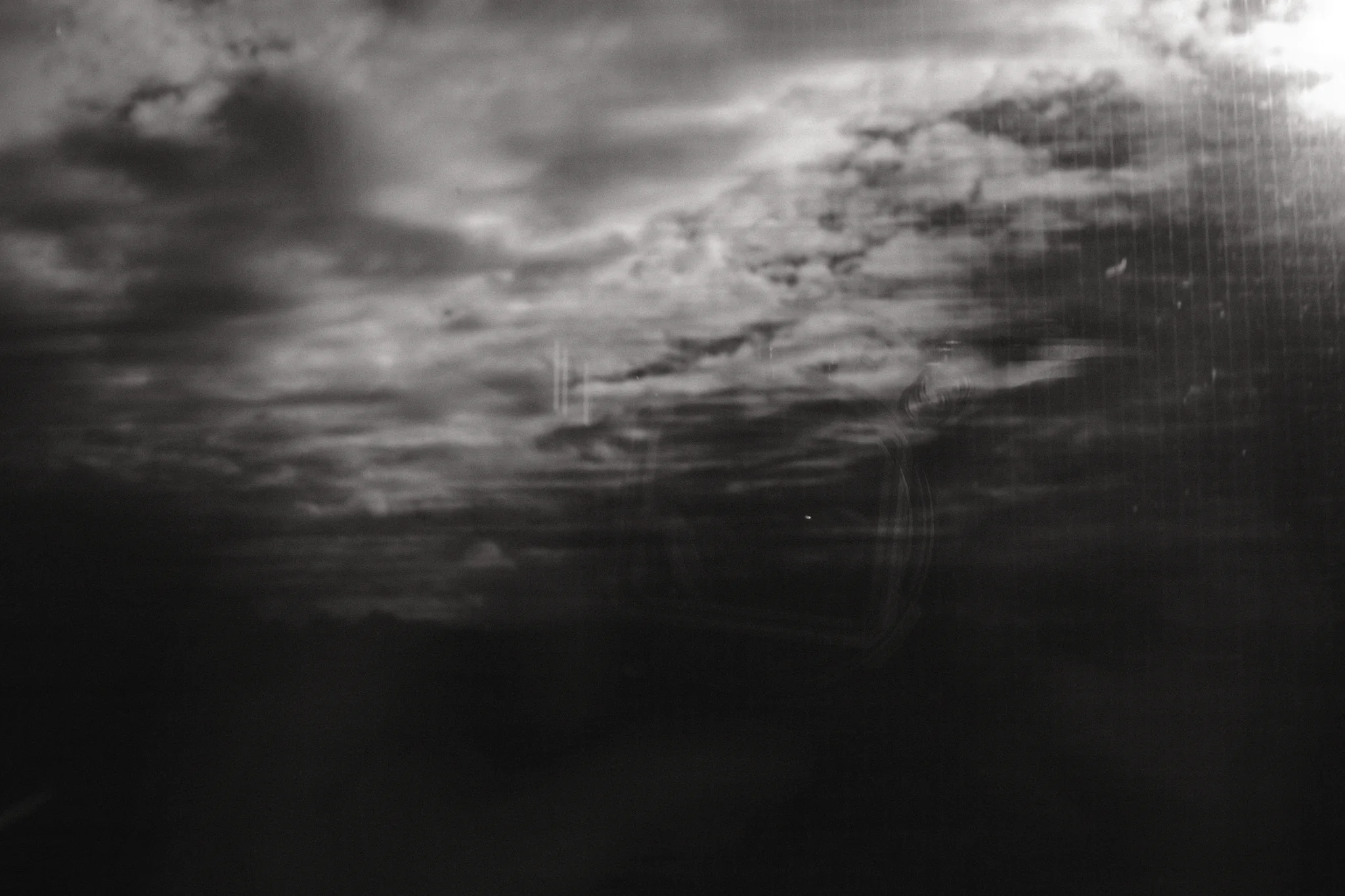
“This was me testing slow shutter on the train and getting something more.” That is Mark’s account of making Landscape through Glass. It matters because it leaves room for discovery. The experiment began with a technical question about movement; the photograph offered a more complicated answer, involving a landscape, a window and the person trying to see through it.
Look at the whole frame before hunting for the camera. The bright upper field gives clouds room to spread, while the lower half sinks towards darkness. Streaks cross the view, and a faint human presence appears within it. The picture takes time to resolve. It does not supply a crisp foreground object and a convenient arrow labelled Meaning. You have to stay for a moment.
Mark describes the landscape’s different distances, his lens and hands reflected in the glass, and his two piercing eyes above the camera, looking beyond it towards an imagined frame. He connects the result with childhood, memory, decay and a fading dream. Those are the maker’s reflections on the work. The reading below develops them without pretending that the picture proves a particular childhood event or that every viewer must feel the same thing.
One exposure, several rates of movement
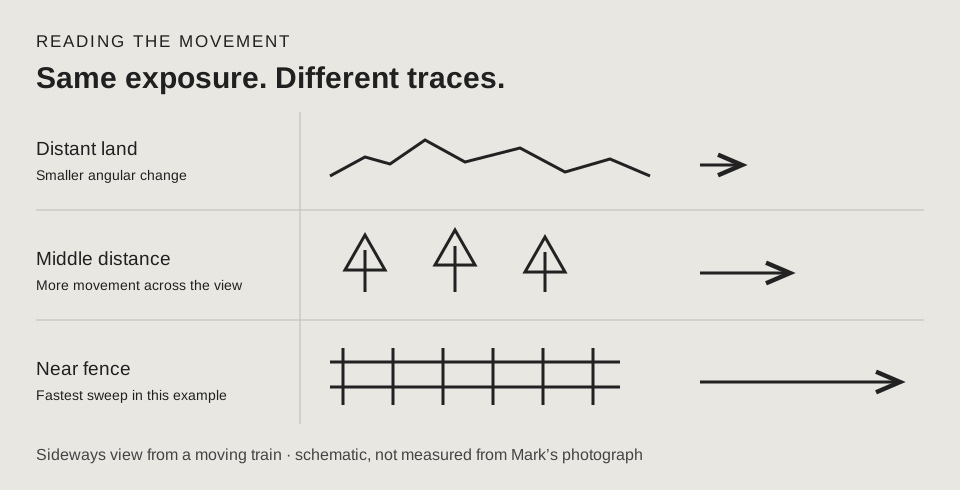
From a moving train, nearby objects generally sweep across your view faster than distant ones. In a roughly sideways view, with a steady camera, a close fence changes its angle to you rapidly; the distant land changes more slowly. During a longer exposure, those differing apparent speeds accumulate as differing lengths of smear. The landscape is not moving at one uniform visual speed.
That helps explain the merging Mark describes. Fence, trees and nearer land lose some of their separate edges as they pass. A farther ridge or field can remain more legible. The train’s motion turns depth into a difference in texture: near things hurry across the photograph; distance seems to linger. It is the rate of change in the view that differs, not a claim that distant objects physically move more slowly.
The exact result also depends on direction of view, focal length, exposure time, camera movement and vibration. Trees may occupy several distances; not every tree is closer than every fence. Clouds can retain broad shapes because they are distant, but this image does not establish how much of their softness comes from exposure, glass or the clouds themselves. A photograph gives clues, not a laboratory readout.
There is no verified shutter speed, aperture or ISO supplied for this frame here. We should not reverse-engineer an impressive-looking settings caption from the blur. For a future experiment, record those settings and compare actual frames. The value of this one survives perfectly well without a made-up fraction of a second.
Watch, then try
Take Better Photos Episode 2 - Shutter Speeds

Pause on the movement examples. Choose whether your own passing subject should freeze or smear before you choose the shutter speed.
The window keeps the photographer in the picture
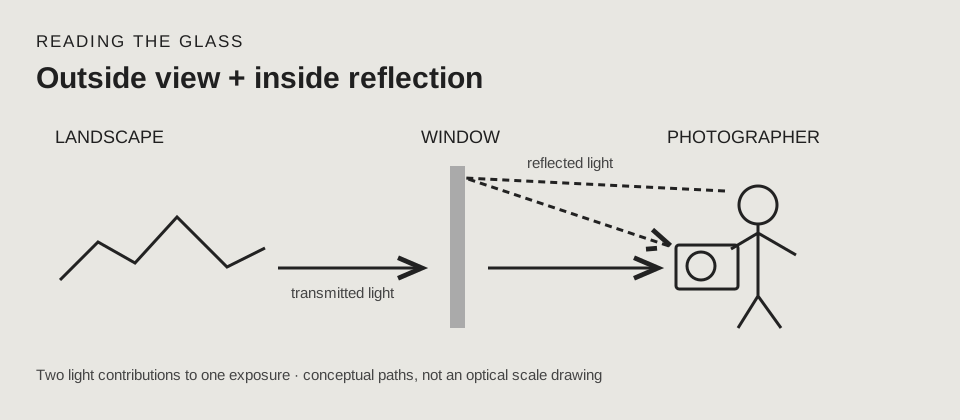
A window transmits light from outside and reflects some light from the carriage. The camera can therefore record the view beyond the pane and a reflected view of the person in front of it within the same exposure. This is a layered optical encounter. It does not require a second exposure or a later composite to produce the relationship Mark describes.
The reflected hands and camera are moving with the passenger and carriage, whereas the outside world is passing. If camera, body and pane remain relatively steady, the reflection can behave differently from the rushing foreground. It may still be soft through hand movement, vibration, focus or the glazing. Here it is enough to notice the contrast: a transient landscape and a quieter, incomplete account of the person looking.
Mark also points out his glasses, worn over the eyes. That gives the picture three kinds of glass: the train window, the camera lens and the spectacles through which he looks. They do different jobs. The pane admits the landscape and returns a reflection; the lens forms the camera’s image; the glasses belong to the person’s own act of seeing. We should not collapse those into a single literal light path, but their meeting gives the title another resonance. The hands make the act physical. This is not a view delivered from nowhere. Someone is holding a camera, deciding, testing, failing to be completely absent from the result.
You could suppress the reflection by changing the lighting relationship, angle or position. For this photograph that would also remove part of the subject. Before treating a reflection as contamination, ask what it contributes. The window has already done some of the composition. It has not read the manual, which may explain its confidence.
The eyes look beyond the machine
Mark draws attention to his two piercing eyes above the camera, seen through his glasses. Follow that instruction slowly, returning from the landscape to the faint reflected figure. The eyes do not announce themselves like a conventional portrait. Discovering them changes the kind of picture we think we are looking at: the landscape also contains a person imagining a photograph. The spectacles are a small, personal reminder that seeing is already mediated before a camera enters the conversation.
His description of looking towards an imagined frame is particularly useful. The camera is visible, but the gaze is not exhausted by the machine. There is a difference between the rectangle being recorded and the picture being sought. The reflected body sits within the first while the eyes seem to reach towards the second. That is an interpretation grounded in his account, not a claim that we can read a stranger’s mind from a glance.
The self-portrait remains porous. Outside forms and inside reflections share the same tones, so the person is neither fully separated from the landscape nor cleanly erased by it. It makes the act of looking part of the place being looked at. What began as a test of shutter speed becomes a picture of attention under way.
Childhood, decay and the memory that will not sit still
Childhood is Mark’s association, not a date encoded in the scenery. A train window can offer a view that arrives before we can properly name it and is gone before we can recover it. The photograph holds that passing while refusing to make every part available. It can resemble the unevenness of remembering: one broad light shape persists while adjacent detail slips away.
The word decay here need not mean chemical damage to a negative or deterioration of a digital file. It can describe the visual loss of boundaries, the way a fence stops being a list of posts and becomes a band, or a person seems to fade into the world around them. That distinction matters. We are describing an emotional and formal reading, not diagnosing a material fault.
A fading dream works because some things remain. The clouds, dark land and reflected apparatus give us enough to recognise an encounter. Complete unreadability would be a different experience. This photograph lives in the negotiation between recognition and disappearance. The visible fragment is what allows us to feel the loss of the rest.
Nor is blur automatically profound. Compare this frame with a missed exposure whose softness contributes no relationship at all. The useful question is what the uncertainty makes possible here: depth becomes movement; reflection makes the observer visible; the gaze leaves room for an imagined picture. Imperfection earns its place by doing something.
Twelve frames through glass
Work as a passenger, keeping your seat and the shared carriage comfortable. A bus or train with a clear side window will do. Choose a stretch where near objects and distant land can both enter the frame. If travelling is not available, use a stationary window with passing pedestrians or traffic; the reflection study still works, though the depth-and-motion comparison is different.
Frames one to four: try a shutter ladder such as 1/500, 1/125, 1/30 and 1/8 second. These are suggested exercise settings, not Mark’s settings. Keep focal length and viewing direction broadly consistent. Let aperture or ISO compensate within the camera’s limits, and check that bright areas are not simply blown out. Different scenery and changing train speed make this a field comparison rather than a controlled test.
Frames five to eight: choose one usable shutter speed and investigate the reflection. Move a little nearer or farther from the pane and alter the angle slightly. Notice what happens to the visible hands, camera, eyes and outside view. If you wear glasses, notice their rims and any highlights too: do they reveal the gaze or interrupt it? Keep the same monochrome rendering. Do not introduce flash; it changes the experiment and is unhelpful to everyone sharing the carriage.
Frames nine to twelve: stop chasing the setting and make relationships. Look for an outside shape that overlaps a reflected part of you, a horizon that passes through the camera, or a light area that briefly makes the eyes legible. Do not repeat Mark’s composition as a target. Find where the particular journey and your particular position become inseparable.
Make a sheet; keep three different answers
Keep all twelve frames and make a full-composition contact sheet in capture order. Choose one for the clearest difference between near and far movement, one for a productive meeting of reflection and landscape, and one for an emotional quality you can explain by pointing to something visible. They may be three different photographs. They do not have to agree with your first favourite.
For each selection write three short lines: what is visible; what you know about how it was made; what it makes you think or feel. “Childhood” is a starting word, not a complete analysis. Name the faded edge, the unlocatable gaze or the patch of light that produces the association. Then ask another person to look before showing them your notes.
Finish with a three-picture sequence and a brief account of what surprised you. If the most interesting frame breaks your prediction, keep the discrepancy. A test is useful when it teaches you more than the thing you intended to test. Mark went looking for slow shutter and found a photograph in which the photographer was looking back.
Watch, then try
Take Better Photos Episode 7 - Composition

Look for relationships between elements rather than a grid to obey. Pause on a frame and name what changes if one object touches the edge.
Sources & further looking
Facts checked 22 October 2026. The practical exercises and critical readings are this publication’s editorial interpretation.
Take this to the discussion.
A question, an example, a picture that proves us wrong. Specific beats loud.
Open the conversation ↗