Print / Music / Night
Whistler: leave some room between the notes.
A lithograph, a musical title and a quieter way to photograph after dark. Night need not arrive dressed as a crime thriller.
The Cleveland Museum of Art, Bequest of Charles T. Brooks, 1941.89 · CC0 1.0 · Collection record ↗
A city almost withheld
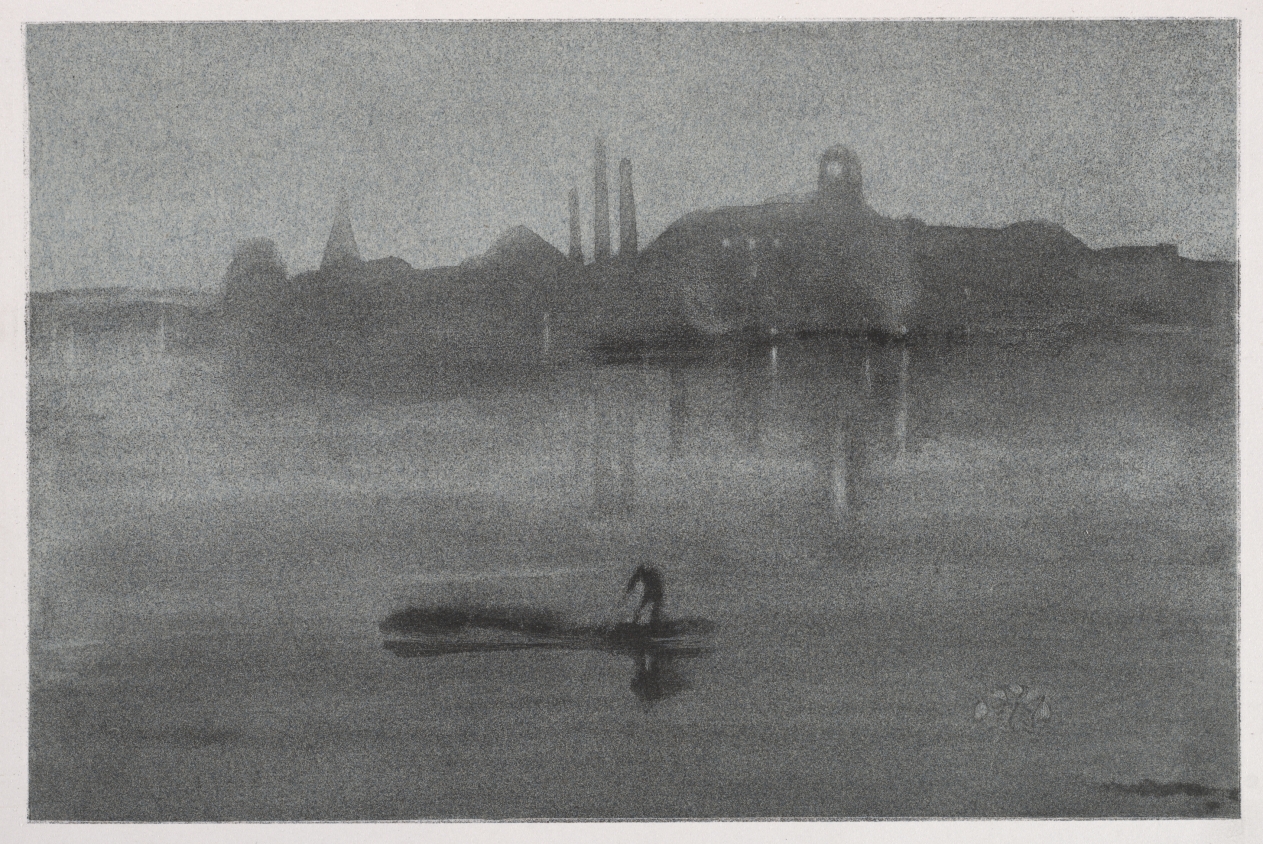
In Whistler’s Nocturne of 1878, a low boat and a small bending figure occupy the near water. Beyond them, roofs, a dome and tall chimneys emerge through close greys. Tiny points of light are allowed to register without turning the whole scene into a light show. The river holds a large interval between our position and the city.
The print asks us to tolerate incomplete information. We can recognise a built skyline without identifying every window. We can read the boat without a catalogue of its fittings. This is not a failure to describe the place. It is a choice about which relationships deserve emphasis. A photograph can make that choice too, though its marks are made differently.
Why call a picture a nocturne?
Cleveland’s collection account connects Whistler’s musical titles to an emphasis on colour, line and form. It also identifies his patron Frederick Leyland, a keen amateur pianist with a liking for Chopin, as the person who suggested the title Nocturne. The connection to music is documented; a claim that this print illustrates a particular Chopin score would go further than that evidence.
Our practical comparison concerns intervals. A melody depends on spacing, duration and recurrence, not just a pile of attractive notes. A picture can similarly give a few lights meaning by surrounding them with quieter tones. If every shadow is opened and every edge sharpened, the result may describe more objects while leaving less for the eye to discover.
The Cleveland Museum of Art, Bequest of Edgar A. Hahn by exchange and Director's Contingent Fund, 1983.206 · CC0 1.0 · Collection record ↗
Two boats, different kinds of quiet
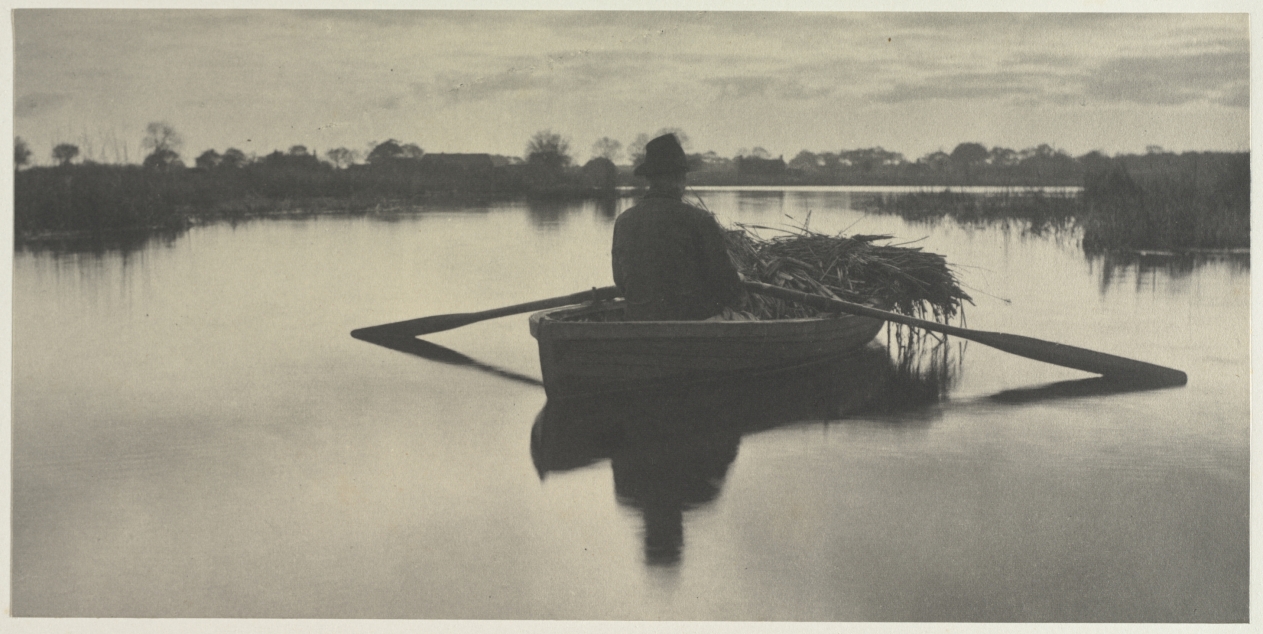
Emerson’s Rowing Home the Schoof-Stuff, shown below, offers a useful companion. The oars stretch across brighter water; the rower and load keep a working activity present. Whistler’s boat is smaller within a wider tonal atmosphere. Compare how much each foreground figure has to tell us. This is an editorial pairing, not an assertion of influence between these particular works.
For a modern photograph, protecting a broad dark area can be a positive decision. It need not mean deliberately losing useful evidence. Ask what the shadow contributes: an interval, a boundary, a sense of distance? The answer may be different in a personal nocturne and in a picture intended to document a place clearly. Exposure serves the purpose of the photograph.
A small score for the evening walk
Choose one familiar place at dusk. Before shooting, name three things you want the frame to retain: perhaps a lit window, a figure and a reflected strip of sky. Everything else does not automatically deserve equal brightness. Keep the camera steady when stillness is your subject; allow movement only where it has something to say.
When editing, lay out a bright frame, a dark frame and a middle-toned frame. Change their order. Notice how the same photograph feels different after a quieter neighbour. This is a useful musical analogy for sequencing, not a scientific equation between sound and grey. Nobody needs to announce that their shutter speed is in B-flat.
Watch, then try
Take Better Photos Episode 2 - Shutter Speeds

Pause on the movement examples. Choose whether your own passing subject should freeze or smear before you choose the shutter speed.
Sources & further looking
Sources checked 2026-10-23. Visual readings and proposed connections are our editorial interpretation.
Bring another connection.
Name the work and the detail. “It has a vibe” can be the beginning; it cannot be the whole argument.
Discuss art & influence ↗