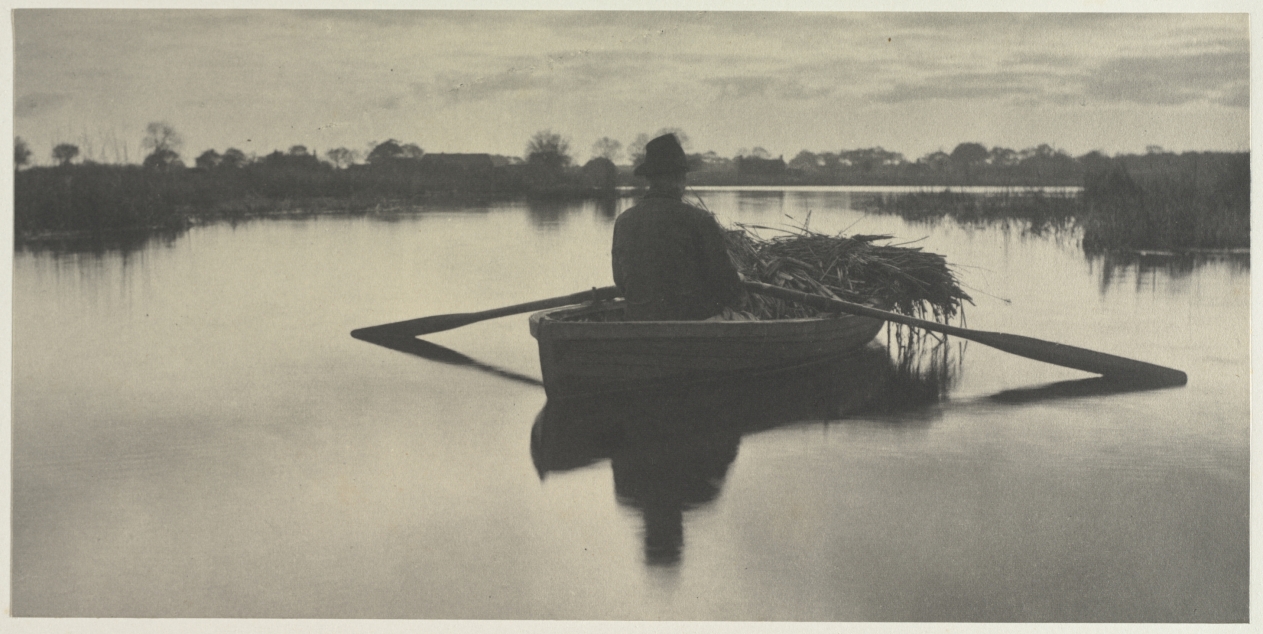
Peter Henry Emerson (1856–1936) photographed life in East Anglia. Rowing Home the Schoof-Stuff was included in Life and Landscape on the Norfolk Broads in 1886. Cleveland’s object is a platinum print.
Quiet pictures can still be full of work.
The oars make a pair of open arms across the water. Their reflections almost close the shapes below, while the boat and its dark reflection anchor the middle. The rower faces away. A bundle of harvested plants extends beyond the boat, its fine stalks cutting against the pale water. The low line of trees keeps the far distance present without competing with the nearer act of rowing.
There is little obvious drama. That is not the same as little structure. The broad horizontal frame permits the oars to spread; the rower provides a dark upright; the bundle makes the two halves unequal. If everything were mirrored, the image might become a diagram. The irregular load keeps it connected to an activity. Someone is transporting something, not demonstrating the rule of thirds for a tutorial.
Cleveland explains “schoof” as the sheaf of marsh plants gathered for drying and storage. The title turns an apparently leisurely boat scene into a return from work. Emerson sought a more naturalistic photography than the theatrical tableaux he opposed. That historical ambition helps us read his selection of everyday activity; it does not mean the camera simply removed itself from the process.
Softness is a relationship
Notice how little the distant trees need to tell us individually. They establish a bank and a horizon. Their collective shape matters more here than an inventory of leaves. This is a useful way to think about photographic detail: what does each part of the frame have to do? A distant field may need to support the foreground rather than enter a sharpness competition with it.
Our comparison with today’s digital camera is about attention, not a claim that an old platinum print behaves like a particular film recipe. A JPEG setting can simplify tones; it cannot decide where the oars should fall. Before adding texture, solve the distances and the balance. If the image works only after an industrial quantity of grain, the grain may be doing unpaid overtime.
Watch & practise
A related artist conversation or practical lesson to take back to this photograph.
Watch, then try
Take Better Photos Episode 7 - Composition

Look for relationships between elements rather than a grid to obey. Pause on a frame and name what changes if one object touches the edge.
Sources & further looking
Sources checked 2026-10-23. Visual readings and proposed connections are our editorial interpretation.
What does the picture make you notice?
Would a perfectly clear distant bank make this photograph better? What job is the distance doing?
Discuss photography & art ↗