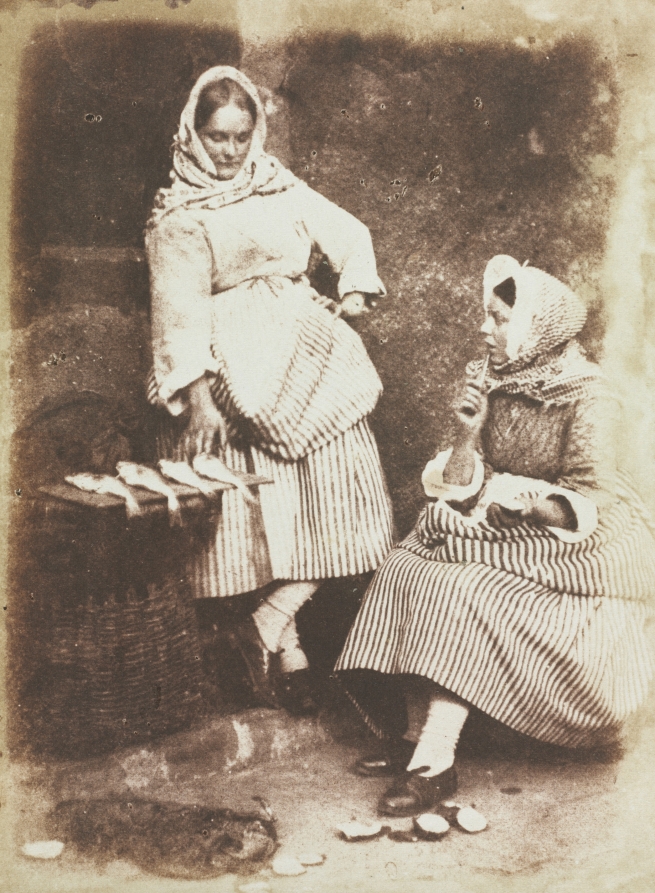
David Octavius Hill (1802–1870) and Robert Adamson (1821–1848) worked together in Edinburgh. This 1845 salted paper print from a calotype negative names its sitters: Jeanie Wilson and Annie Linton, fish sellers from Newhaven.
Two people, two names. Start there.
The standing figure bends the arrangement into a loose triangle. Her light sleeve and apron draw the eye down to the striped skirts; the seated figure turns the movement back across the picture. At the left, fish lie on a large basket. Below, a small scatter of shells brings the working ground into view. These objects are not interchangeable rustic decoration. They make the activity of selling a catch specific.
Both women occupy substantial space. Their clothes carry much of the picture’s pattern, while the dark background gives the pale fabric room to register. Look at the seated figure’s hands and the standing figure’s arm. The poses create a relation without requiring either person to stare into the lens. A group portrait can hold an exchange rather than deliver two separate passport photographs.
Cleveland places this picture within Hill and Adamson’s wider study of contemporary life around Edinburgh. Its account describes women preparing fish and carrying it to the city for sale. Just as significant, the record preserves names. “Fishwives” is a historical occupational title here; Jeanie Wilson and Annie Linton are individuals within it. The title should not swallow the people.
A process is not a filter
The soft detail and broad masses belong to this particular paper-negative and paper-print object. They should not be treated as a digital preset called Olden Days. Look at how the picture remains readable even where small detail falls away: the turn of a head, the light apron, the basket’s large dark form. Recognition depends on relationships as well as resolution.
The lesson travels to modern cameras, but the history stays attached to the original process. You can practise giving two people a shared space without adding scratches, brown stains or false plate borders. Keep their names and their participation as carefully as you keep the file. A photograph of work becomes more useful when the maker has done some listening too.
Watch & practise
A related artist conversation or practical lesson to take back to this photograph.
Watch, then try
Dorothea Lange: Words & Pictures | MoMA EXHIBITION

Compare the photograph before and after its caption. Name what the words establish, what they suggest, and what remains unknown. Then try two clearly distinguished captions for one of your own pictures.
Sources & further looking
Sources checked 2026-10-23. Visual readings and proposed connections are our editorial interpretation.
What does the picture make you notice?
What changes when a historical photograph gives you names instead of leaving its sitters as anonymous types?
Discuss photography & art ↗