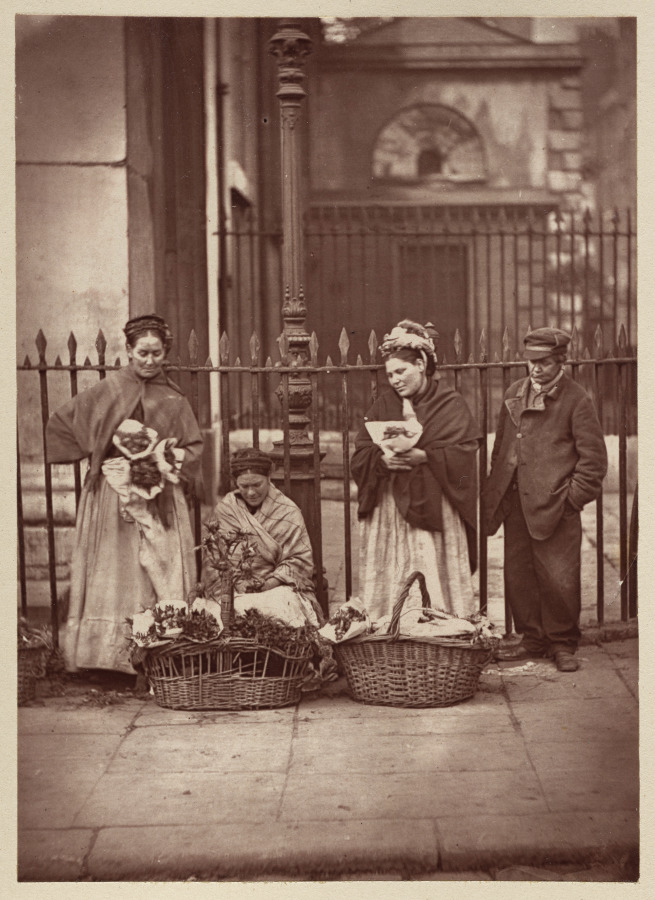
John Thomson (1837–1921), born in Edinburgh, collaborated with writer Adolphe Smith on Street Life in London. Covent Garden Flower Women dates from 1877; this reproduction shows a woodburytype in Cleveland’s collection.
A flower is pretty. Selling flowers is work.
The baskets sit almost on our side of the frame. Their woven curves and crowded contents form a low barrier across the pavement. Above them, three women occupy different heights: standing, seated, standing. A man at the right completes the group without becoming its centre. Behind everyone, the iron railings repeat a hard vertical rhythm. The picture has an arrangement, even before its caption gives it an argument.
Look at the flower bundles in the women’s hands, the child held on the left and the flowers gathered near the seated figure. Work and care occupy the same small space. Those are visible relationships. They do not authorise us to invent a private feeling for each person. The lowered faces may tempt a ready-made story about sadness; describing a gesture is more reliable than pretending the camera has supplied a diary.
The accompanying historical project joined photographs to writing about London’s working lives. Cleveland’s record notes the long hours and slight earnings of the flower trade. That information is not measurable from the beauty of the print. It has to be researched and supplied. This is one reason words matter beside photographs: a handsome arrangement can conceal the economics of what we are admiring.
The caption is part of the edit
Thomson’s picture gives us a productive difficulty. It is carefully organised and it concerns actual labour. Those qualities can coexist. A photograph need not pretend to be an unnoticed fraction of a second in order to count as a serious encounter with a street. But its staging and its explanatory text shape the account, and should remain open to discussion.
For a present-day photographer, the useful inheritance is to attend to a place repeatedly and learn what is happening there. Ask a willing stallholder about the work before deciding what the picture means. A market is not a free casting agency for gritty authenticity. The kettle, the loading trolley, the cash float and the clearing-up may tell you more than the most picturesque face.
Watch & practise
A related artist conversation or practical lesson to take back to this photograph.
Watch, then try
Dorothea Lange: Words & Pictures | MoMA EXHIBITION

Compare the photograph before and after its caption. Name what the words establish, what they suggest, and what remains unknown. Then try two clearly distinguished captions for one of your own pictures.
Sources & further looking
Sources checked 2026-10-23. Visual readings and proposed connections are our editorial interpretation.
What does the picture make you notice?
What changes when you read this as a record of selling and caring, rather than a picturesque arrangement of flowers?
Discuss photography & art ↗