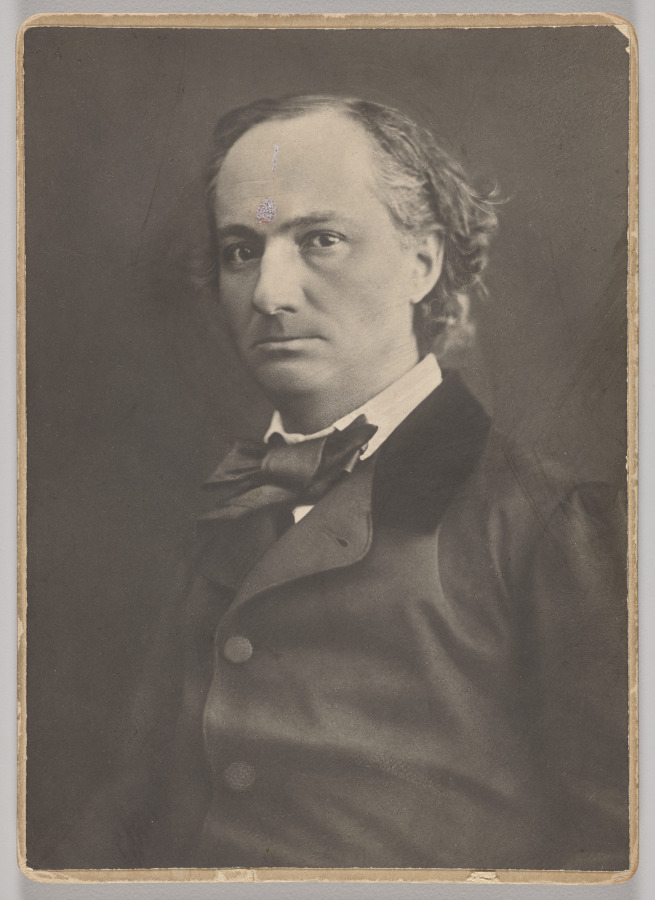
Nadar (Gaspard-Félix Tournachon, 1820–1910) made this portrait of the poet Charles Baudelaire. Cleveland dates the image to 1856–58 and catalogues its object as an albumen print on a cabinet card.
A famous face is still an arrangement of light.
Try looking before saying “poet”. A pale forehead and collar emerge from a close field of greys and browns. The head turns slightly while the eyes return towards us. The dark bow and broad lapels hold the lower half together. There are no books, pens or theatrical clouds of genius. The face has to carry the encounter, with help from the coat.
The gaze is direct enough to feel personal but gives us no reliable account of what Baudelaire was thinking. Once we know the sitter’s writing, it is easy to see defiance, melancholy or modernity looking back. Those are readings we bring. Start with the visible evidence instead: the angle of the head, the shadow beside the nose, the compressed mouth, the way the lighter collar separates neck from jacket.
The physical object matters too. Cleveland’s record identifies a cabinet card, a format collected for celebrity portraits. The museum dates the portrait image to 1856–58 while noting the later popularity of that card format. Image-making and the circulation of a particular print are different histories. The rounded corners and worn surface shown here belong to the object we are looking at, not to Baudelaire’s character.
Presence without a prop department
This photograph is useful to street portraiture because it keeps attention on a small set of decisions. What happens if the sitter turns a few degrees? Where does the background stop being separate from the jacket? Does eye contact change the balance of power between picture and viewer? You can ask those questions with a friend beside a window; no nineteenth-century studio costume required.
Then put the camera down and read a short prose poem. A portrait and a piece of writing offer different kinds of access to a person. Neither has to serve as a password for the other. Our linked Baudelaire room explores how an observer can turn a glimpse into a story—and why a photographic caption ought to admit where that story is invented.
Watch & practise
A related artist conversation or practical lesson to take back to this photograph.
Watch, then try
Zanele Muholi – ‘In My World, Every Human is Beautiful’ | Tate

Notice who is being represented and who has a voice in that representation. With a willing participant, agree how a portrait will be used, make it together, and let them respond to your selection.
Sources & further looking
Sources checked 2026-10-23. Visual readings and proposed connections are our editorial interpretation.
What does the picture make you notice?
How much of the “poet” in this portrait comes from the photograph, and how much from knowing the name?
Discuss photography & art ↗