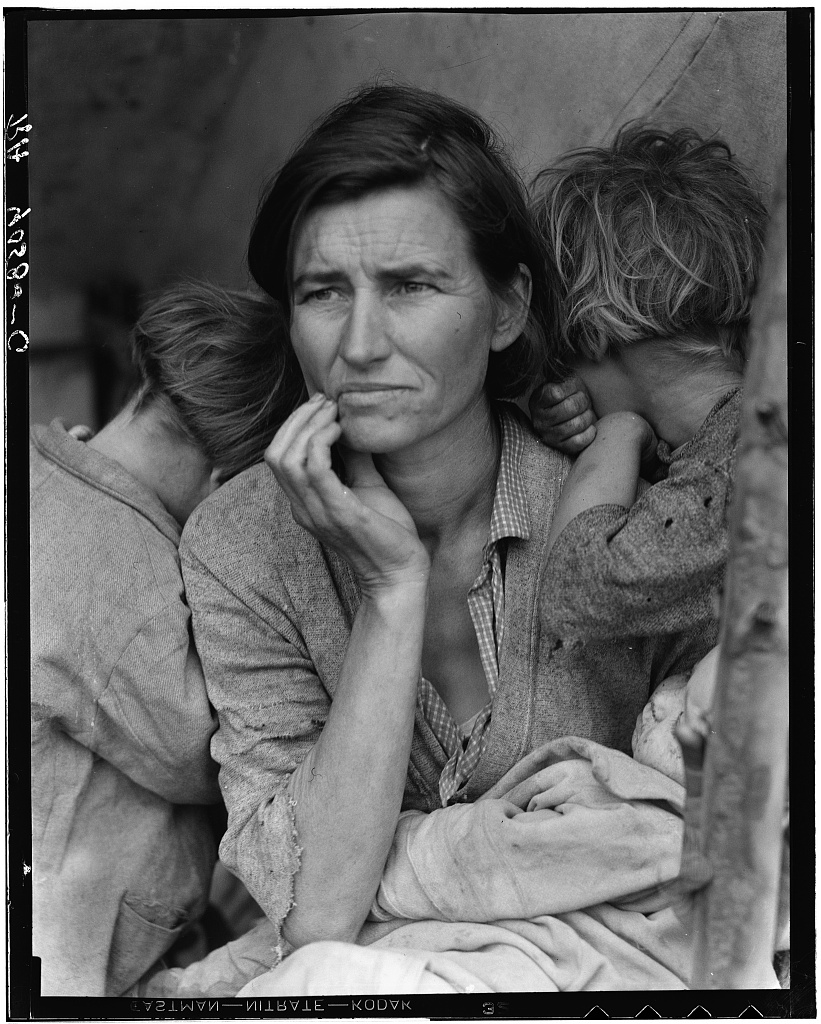
Dorothea Lange (1895–1965) photographed Florence Owens Thompson and her children at Nipomo in March 1936 while working for the Resettlement Administration. This is the Library of Congress scan of the negative associated with the image now widely called Migrant Mother.
The famous frame was one choice, not the whole encounter.
Begin at the hand. It rises to the cheek, bringing us to the face, then the gaze carries us out of the picture. On either side, children turn inward and conceal their faces. Their heads form an enclosing shape around the mother. The baby lies across the lower frame. This is a remarkably concentrated arrangement of looking and not looking: one face appears to meet the world while the others turn away.
The worn fabric matters as much as the outline. Sleeve, collar and blanket have different textures, giving the close grouping a physical specificity. Yet the composition is also easy to recognise at a small size. That combination helps explain the photograph’s visual force without requiring us to claim that a facial expression contains a complete history of poverty or motherhood.
MoMA records seven exposures made during the encounter. The celebrated image was a selection from a sequence, and the sitter later disputed parts of Lange’s recollection. That does not make looking pointless. It makes looking more demanding. A frame, a contemporary caption, a photographer’s later memory and a subject’s account are different forms of evidence. They should not be flattened into one seamless anecdote.
Even this icon has an editing history
The Library of Congress notes that the negative was retouched in the 1930s to remove a thumb at the lower right. Its record links a surviving print that retains it. The reproduction here comes from that altered negative, not from an untouched camera original. This distinction is especially useful beside our no-edit digital challenge: the history of documentary photography is more complicated than a simple opposition between honest old film and manipulated new files.
Look at the earlier print through the collection link, then return to the frame here. Does the changed corner alter the photograph’s emotional force, its documentary status, or both? Those are different questions. A practical exercise can forbid editing to sharpen your decisions without pretending every admired historical photographer followed the same rules. The contact sheet has more to teach us when it is allowed to complicate the legend.
Watch & practise
A related artist conversation or practical lesson to take back to this photograph.
Watch, then try
Dorothea Lange: Words & Pictures | MoMA EXHIBITION

Compare the photograph before and after its caption. Name what the words establish, what they suggest, and what remains unknown. Then try two clearly distinguished captions for one of your own pictures.
Sources & further looking
- LOC: negative record, date and retouching note ↗
- MoMA: Lange, the sequence and contested recollections ↗
- LOC: surviving print before removal of the thumb ↗
Sources checked 2026-10-23. Visual readings and proposed connections are our editorial interpretation.
What does the picture make you notice?
When one frame becomes an icon, what happens to the other frames—and to the person who lived beyond them?
Discuss photography & art ↗