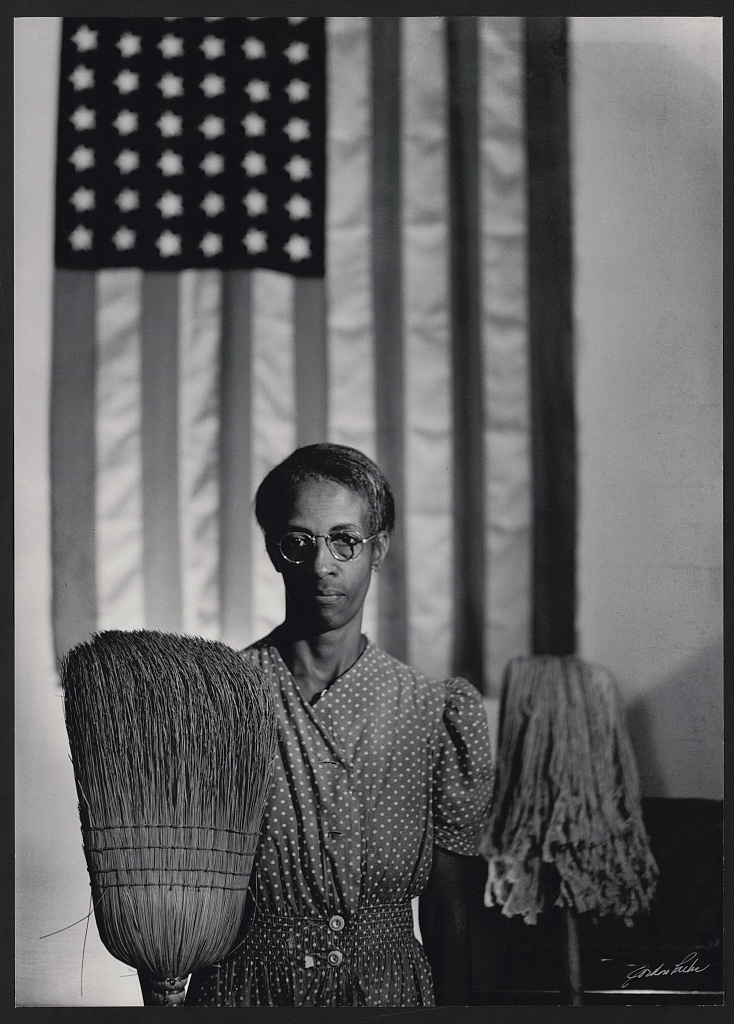
Gordon Parks (1912–2006) made this portrait of government worker Ella Watson in Washington, D.C., in 1942. It belongs to a wider collaboration recording her work, home and community during his Farm Security Administration fellowship.
A symbol is stronger when you remember the person.
The broom enters like a second figure. Its dense bristles fill the left foreground, while a mop occupies the right. Between them, Ella Watson’s face sits below the great hanging flag. The stripes continue behind her, but they are less sharply described than the working tools. The picture makes an argument through relationships: a worker, the implements of her labour and the nation whose offices she helps maintain.
Her dotted dress introduces a smaller rhythm against the broad flag stripes. The broom’s bound fibres supply another. These patterns do more than decorate a political subject; they organise how we move through it. The face remains a point of return amid repeated marks. If you only read the photograph as a slogan, you can miss the precision with which it holds your attention.
The title American Gothic refers to Grant Wood’s 1930 painting. The National Gallery of Art discusses Parks’s deliberate arrangement of Watson, tools and flag in segregated Washington. This is an authored portrait with a social purpose. Its force does not depend on pretending the camera stumbled upon a ready-made allegory. Photographers can construct an encounter and still address actual conditions.
Do not let the icon become the whole life
The Parks Foundation presents the photograph within a much larger account of Watson’s daily world, including family and church. That wider sequence resists reducing her to a custodian in front of a flag. It is worth following the source link and spending time with those other pictures. An iconic frame may open a story while also becoming so familiar that it obstructs everything around it.
The practical lesson is to work beyond the single emblem. If you photograph someone through their occupation, ask what else they want the account to contain. A portrait, a gesture, an environment and a detail can complicate one another. You are not collecting visual proof for an opinion already written. The person in front of the camera may have a better idea of what matters.
Watch & practise
A related artist conversation or practical lesson to take back to this photograph.
Watch, then try
Dorothea Lange: Words & Pictures | MoMA EXHIBITION

Compare the photograph before and after its caption. Name what the words establish, what they suggest, and what remains unknown. Then try two clearly distinguished captions for one of your own pictures.
Sources & further looking
- LOC: exact print and rights ↗
- National Gallery of Art: Daniel Bernard Roumain and American Gothic ↗
- The Gordon Parks Foundation: Ella Watson and the wider series ↗
Sources checked 2026-10-23. Visual readings and proposed connections are our editorial interpretation.
What does the picture make you notice?
What do you gain from the flag—and what might you miss about Ella Watson if this is the only photograph you see?
Discuss photography & art ↗