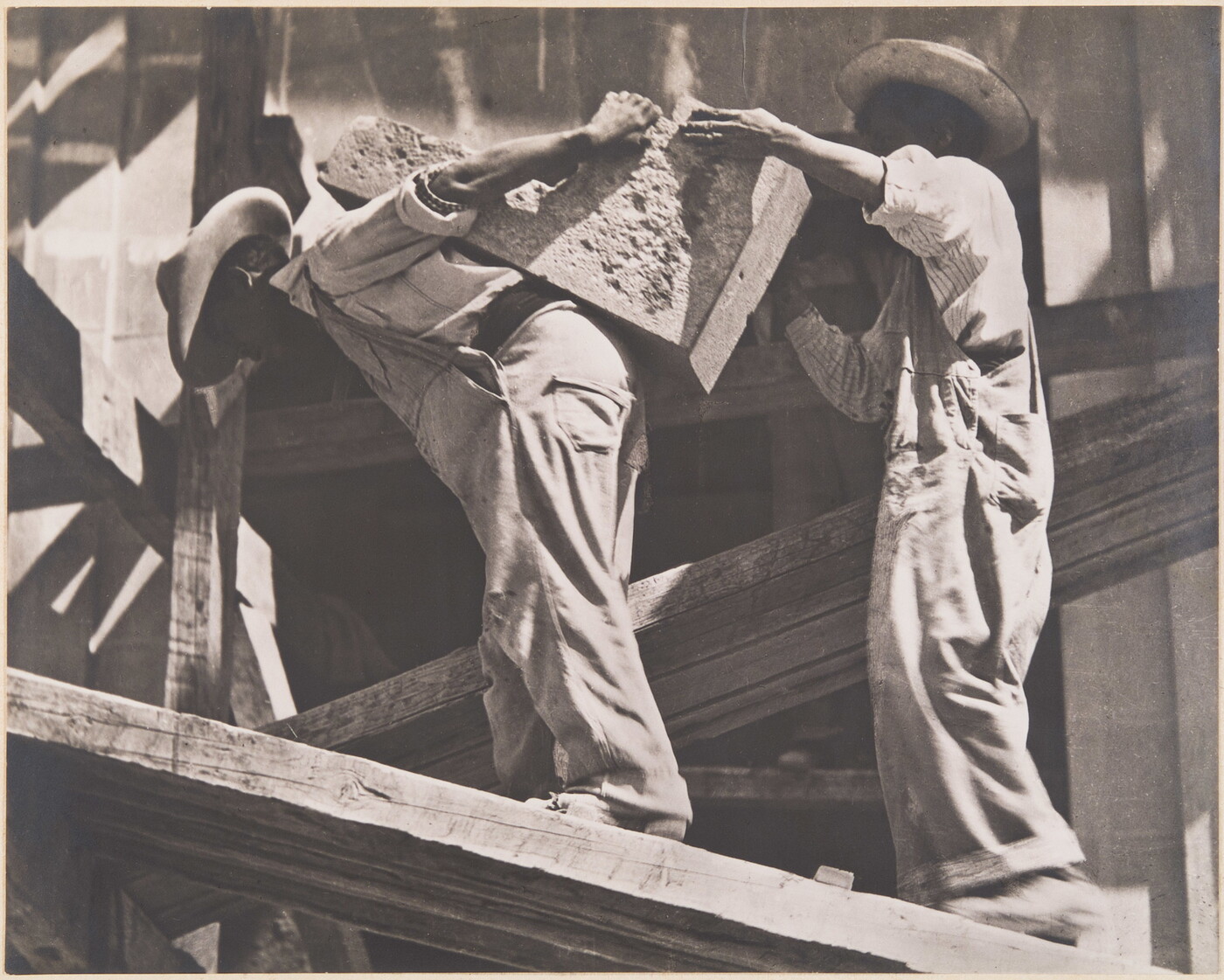
Tina Modotti (1896–1942), born in Italy, made most of her photographic work in Mexico during the 1920s. Her formal experiments and political commitment are both part of the work’s history.
The shape has weight.
The block meets several hands near the top of the frame. Follow that meeting down through the bent back on the left and the upright body on the right. These directions organise the picture, but they also describe physical work: one person bears weight while another makes contact with the load. The precise stage of the action remains uncertain in a single frame.
The bright clothing stands apart from darker timber. A diagonal plank runs across the foreground, partly cutting off the lower scene; posts and boards continue behind the figures. The photograph is clear without eliminating every obstruction. Notice which overlapping lines help you read support, balance and effort.
Do not hurry past the bodies on the way to praising the geometry. Their relation to the stone gives the shapes a purpose. Nor should we invent names, thoughts or working conditions from the image. The museum identifies workers and dates the print broadly. Those limits belong in a careful reading.
Watch & practise
A related artist conversation or practical lesson to take back to this photograph.
Watch, then try
Tina Modotti — curator Isabel Tejeda (Spanish)

Spanish-language curator talk. Watch in sections; captions and translation depend on the player. Pick one photograph discussed by Tejeda and separate a visible formal decision from a historical claim. Read the linked exhibition introduction if the language is a barrier.
Sources & further looking
Sources checked 2026-10-26. Visual readings and proposed connections are our editorial interpretation.
What does the picture make you notice?
Where does your eye meet the weight: the block, the hands or the bent back?
Discuss photography & art ↗