Start with the weight
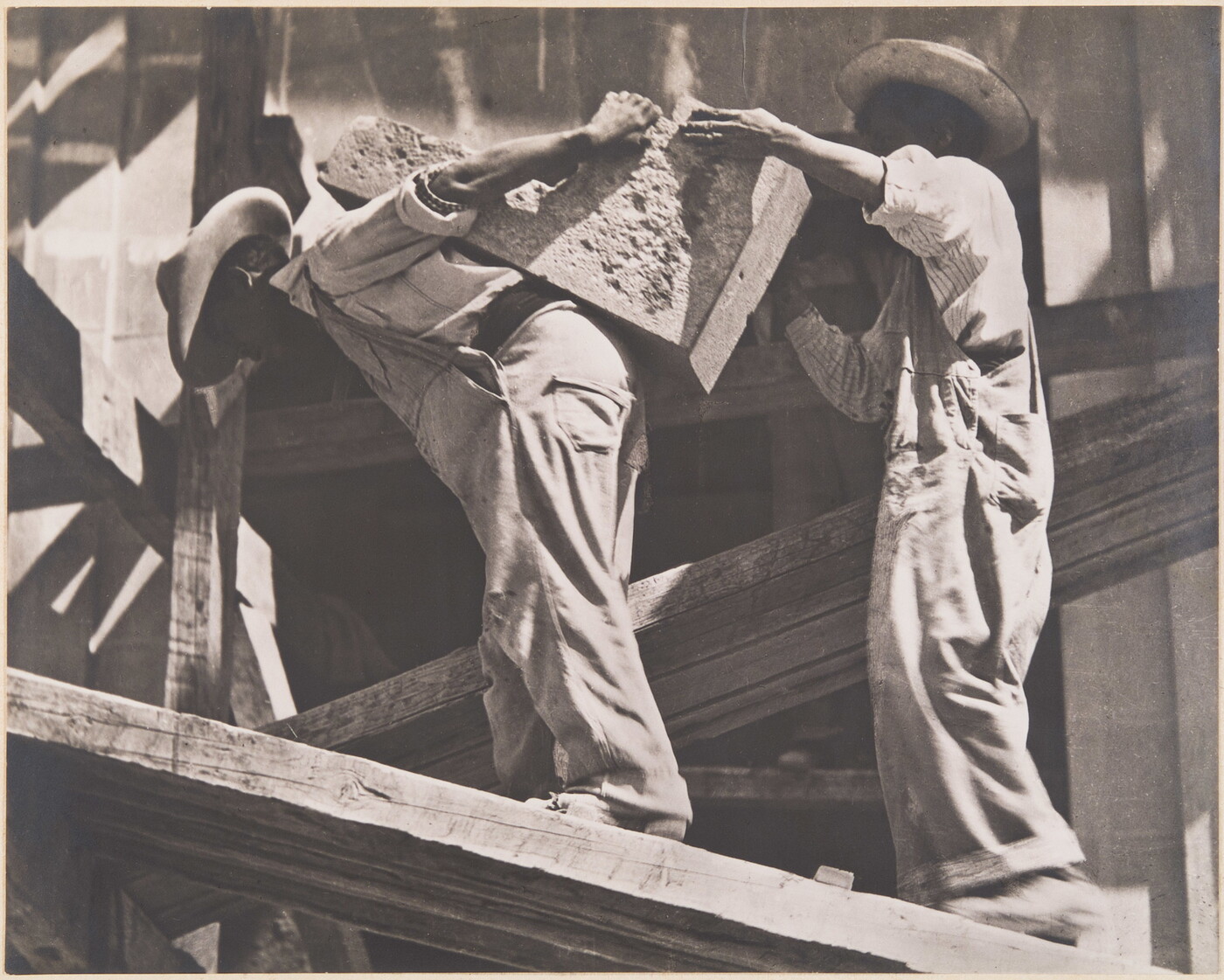
Look at the block before looking for a face. Its rough surface occupies the centre of Tina Modotti’s [Workers, Mexico], a gelatin silver print dated around 1926–1930 by the Amon Carter Museum. A man bends underneath it; another reaches towards it from the right. Hands, shoulders and stone form a meeting point near the top. The arrangement is legible almost immediately. Understanding the complete action takes longer.
The photograph gives us enough to recognise physical effort, but it does not provide a sequence showing what happened next. Is the load arriving, leaving, or being steadied at this instant? The still image does not settle every part of the movement. Keep that uncertainty. A photograph can make work visible without issuing a complete incident report.
Notice the pale trousers and shirt against darker timber. Then follow the diagonal plank along the bottom. It supports the composition visually while the bodies describe an actual problem of support. This is not a geometrical exercise into which two people have wandered. The geometry helps us read what the people are doing. There is a difference, and it is rather more useful than knowing whether the lens had pleasing corners.
The person behind the famous biography
Modotti was born in Italy in 1896 and died in Mexico in 1942. Her photographic work in Mexico during the 1920s joined exact formal decisions to an increasingly explicit political commitment. MoMA describes both her early abstract compositions and her attention to workers; Fundación MAPFRE’s retrospective places the photographs within her antifascist and revolutionary activity. These contexts belong with the pictures, rather than being optional atmosphere.
She learned photography with Edward Weston, but a profile that stops at the relationship has barely arrived at her work. UNAM’s account of its Modotti archive warns that fascination with her personality and life can obscure the photographs. That is a useful correction to the familiar habit of treating a woman artist as an interesting chapter in somebody else’s career.
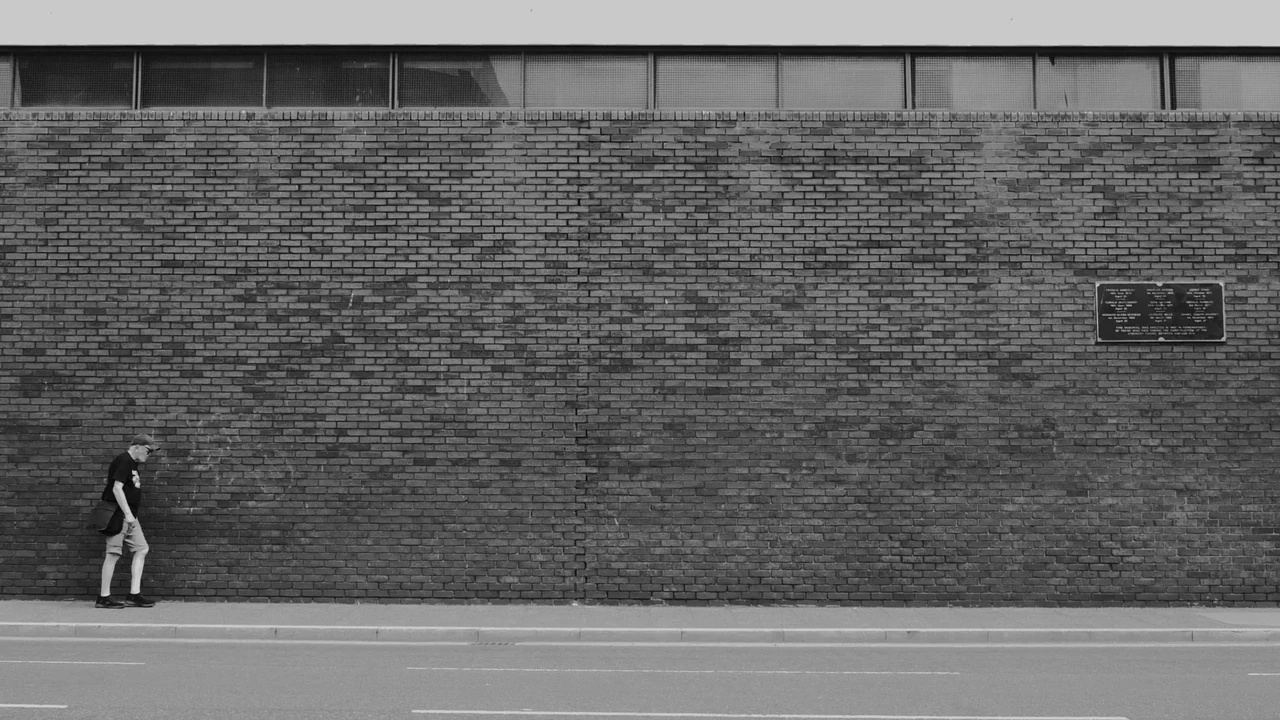
Our question here is smaller than a complete biography: how can a photograph organise bodies, materials and light without losing their social meaning? We will look closely at one work, consult other works through their museum records, and use Mark’s photographs as separate contemporary comparisons. Those comparisons are ours. They are not evidence that Modotti influenced Mark, or that a Liverpool pavement and post-revolutionary Mexico are interchangeable.
Watch, then try
Tina Modotti — curator Isabel Tejeda (Spanish)

Spanish-language curator talk. Watch in sections; captions and translation depend on the player. Pick one photograph discussed by Tejeda and separate a visible formal decision from a historical claim. Read the linked exhibition introduction if the language is a barrier.
The triangle is not the subject
Return to the workers. The extended forearms meet near the top of the stone, while the bent back carries the eye down towards the left. The right-hand figure offers a more upright counterweight. Between them, the block is both an angular shape and a heavy thing. Read it only as a triangle and you miss the effort. Read it only as evidence of labour and you miss how the photograph makes that effort intelligible.
The hats conceal much of the faces. This does not empty the picture of human presence: elbows, grip, cloth and the angle of a torso give us plenty to read. It also limits what we can claim. We cannot name these men from this record, know how they felt about being photographed, or turn their posture into a private biography. The caption identifies workers; it does not give us their thoughts.
The foreground plank partly cuts off the lower scene. Behind the figures, several directions compete: upright posts, sloping boards, bright patches. The frame is ordered without being sterilised. This matters to a street photographer. You do not have to remove every crossing line. Ask which overlaps clarify an action and which make it harder to see. The world is entitled to leave a few tools out.
Wires connect somewhere
Open Modotti’s Telephone Wires, Mexico through the MoMA source link below. The museum currently dates its palladium print to 1924. Thin lines fan across pale sky towards a structure crowded with crossbars. MoMA’s artist introduction places the picture among her abstract studies. Its strong visual pattern remains attached to something used: a communications network, built and maintained in the world.
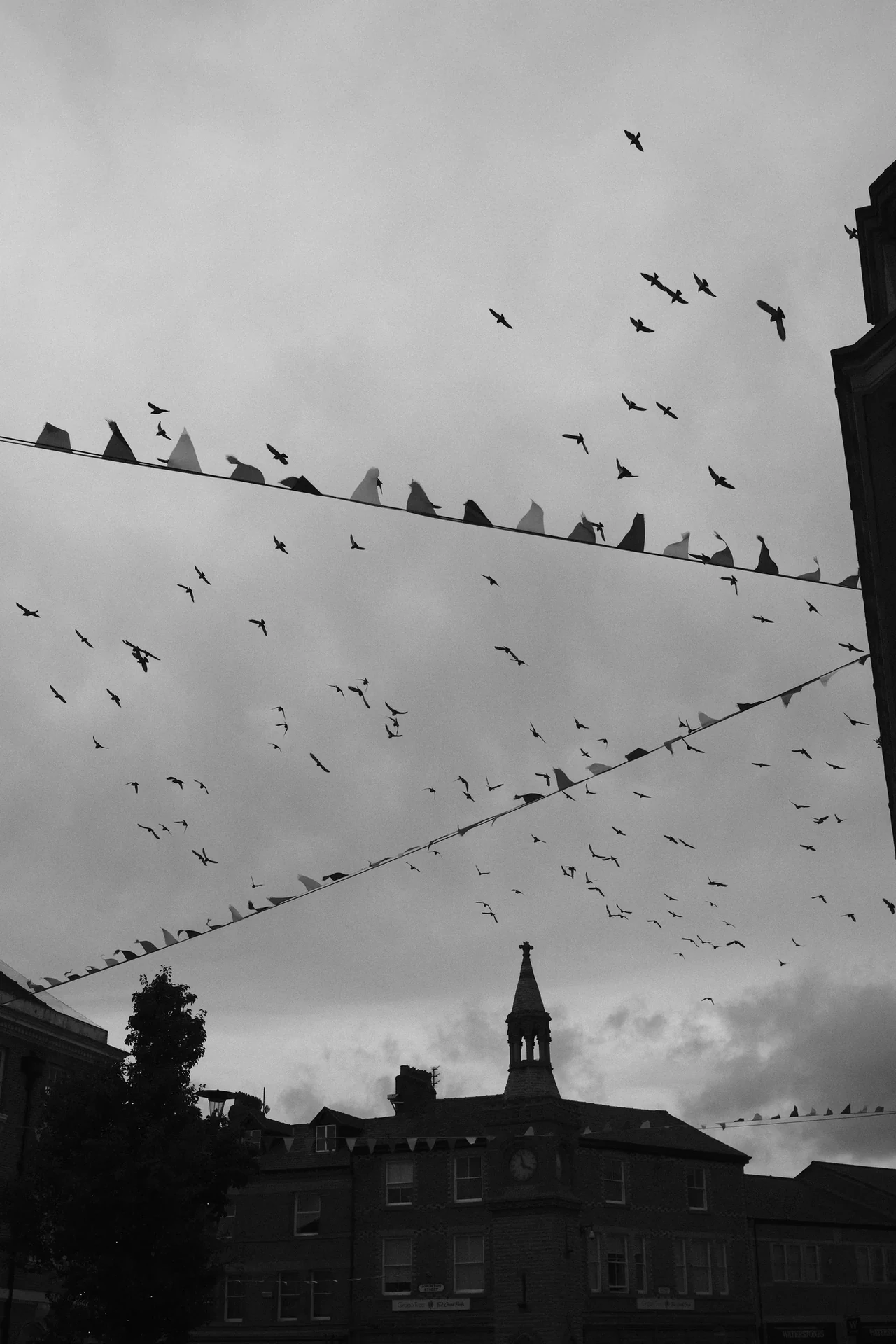
Now look at Mark’s Wires across the Sky, Wigan Road. Lines spread from a pole above a dark roofline; the sky gives them separation. The two works offer a productive comparison of direction and density. They are different photographs, made in different places and periods. We are borrowing a question about infrastructure, not awarding a century-late certificate of influence.
On your next walk, notice the structures that allow ordinary activity to happen: railings, thresholds, loading doors, cables, benches. First make their shape clear. Then ask what that shape lets somebody do, prevents them doing, or reveals about use over time. An empty doorway can describe circulation. A polished edge can suggest repeated contact. A decorative line becomes more interesting when it has somewhere to go.
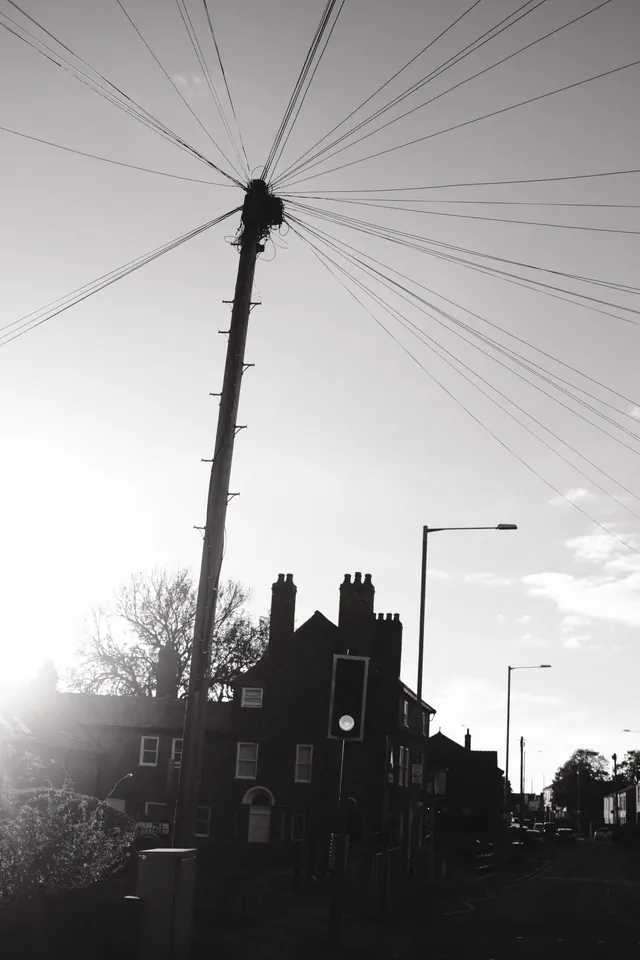
Wires across the Sky, Wigan Road
Follow the lines towards their meeting point, then read the roofs beneath. A contemporary comparison, not a claim of historical influence.
Photograph © Mark C Grant · Photograph page ↗View Modotti’s Telephone Wires at MoMA ↗
A grid meets a person
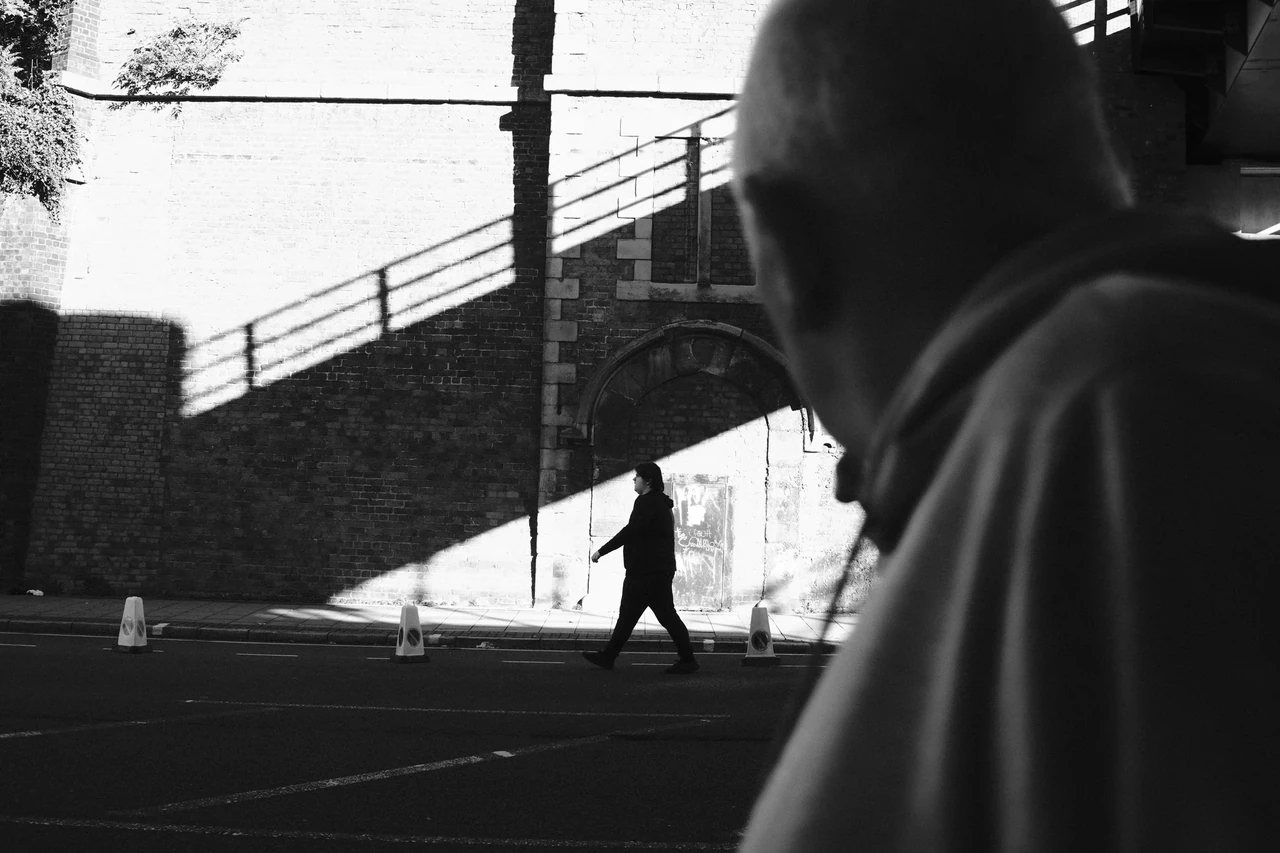
In Mark’s Between the Railings, the standing fence and its shadow create related patterns. The body interrupts them. B&W brings clothes, stone, metal and sunlight into a shared tonal arrangement, but the person is not merely the irregular bit that improves a grid. Look at what remains specific: where the figure stands, the direction of the head, the spaces that stay open around the body.
Try mentally moving the camera sideways. A face or hand might merge with a bar; one gap might close while another opens. That is a practical use for the rangefinder lesson on distance and edges. You need not buy a rangefinder to do it. The important part is noticing relationships before the shutter, rather than explaining them afterwards with enthusiastic arrows.
A clean silhouette is useful when it clarifies gesture. It becomes a mannerism when every person is reduced to the same dark token against a bright wall. Make one frame where the surrounding structure dominates and another where a particular action changes the frame. Compare them before deciding which is the more successful photograph.
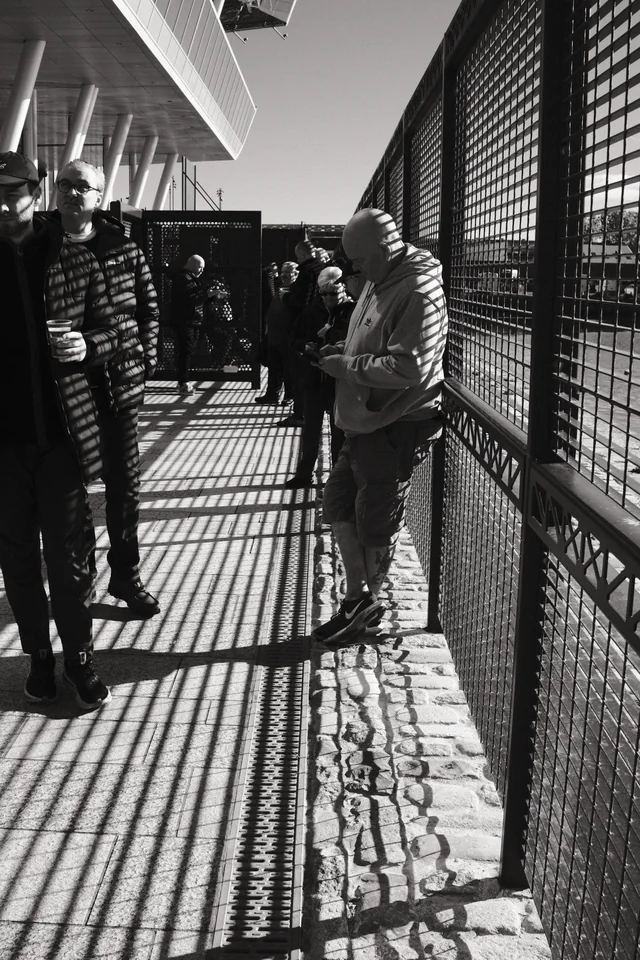
Between the Railings
The body interrupts the grid. Check the gaps around head, arms and fence before calling the photograph merely a pattern.
Photograph © Mark C Grant · Photograph page ↗Connection is something you do, too
A study of working life should start with consideration for the people working. If you want a close view of someone’s hands, tools or task, ask and explain the intended photograph. Accept a refusal. Do not distract a person operating equipment, enter a work area, or ask someone to repeat an unsafe action for a tidier composition. A photograph is not an access pass.
For the exercise below, a willing friend repairing a bicycle or arranging a table is enough. Describe that collaboration honestly. Do not stage an activity and caption it as an unobserved street encounter. If nobody wants to participate, photograph the traces and spaces of work instead: an empty chair, a worn handle, the way objects have been put aside. No person is required to complete your homework.
The Graciela Iturbide film offers a second Mexican photographic voice, separated from Modotti by time and by a distinct practice. Watch for what she says about being surprised. We pair the films to widen the conversation, not to propose a single national style. After watching, write one question that might help you meet a place with less certainty.
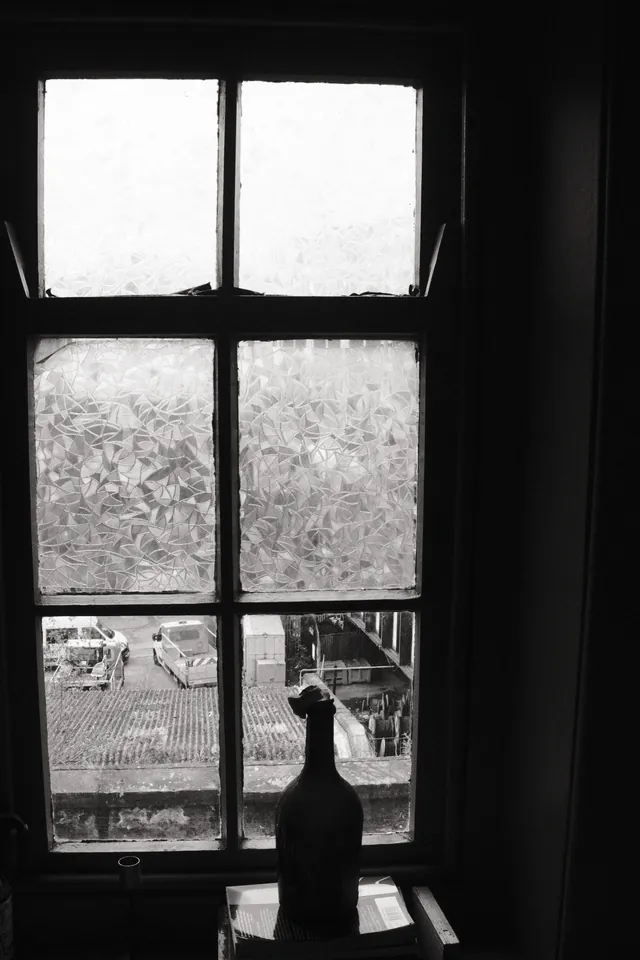
The Window and the Bottle, Egg Cafe
An object and a used space can carry an exercise without recruiting a stranger. Look at the bottle silhouette against the divided light.
Photograph © Mark C Grant · Photograph page ↗Twelve frames: form, use, relation
Choose one accessible place and one focal length. Work for thirty minutes, with a maximum of twelve single exposures. Keep a consistent B&W rendering, adjusting exposure and focus as the light requires. Record all twelve in capture order; do not delete the awkward ones. This is a small investigation, not a hunt for twelve strangers to illustrate an idea you brought from home.
Frames one to four: structure. Make four different arrangements of lines, planes or repeated shapes. Frames five to eight: use. Show what happens there, with permission for a close collaborative picture, or through objects and wear when people are absent. Frames nine to twelve: relation. Bring structure and use into the same photograph. Move your feet when it helps, stay out of the way, and keep enough space to understand the action.
The next day, make a contact sheet of all twelve full frames. Choose three: one that establishes the place, one that shows a particular action or trace, and one that changes how the first two read. Write captions containing only what you know. Keep observation separate from interpretation: “a hand rests on a spade” is different from “a man despairs of his work”. The second sentence needs evidence the first does not supply.
Review the person, not just the preset
Show the three pictures without explaining your theory. Ask a viewer what the place seems to be used for, which relationship they notice first, and what remains uncertain. Then compare their answers with your intention. If the sequence is beautifully arranged but says nothing particular, return to the location with a better question. Increasing contrast is unlikely to complete the research.
If you use the Studio editor, keep an original copy and make a restrained alternative. The new before-and-after sharing option pairs the same crop and horizon, so readers can compare tone and grain fairly. Add a sentence about the decision: what became clearer, what disappeared, and whether the edit helped the subject. A shared recipe is a starting point, not a substitute for the light or the encounter.
Modotti’s photograph keeps pulling us back to the meeting of hands and stone. Its construction helps us feel a task shared by two bodies. That is the useful challenge to take outside: make form carry a relationship. The street has enough immaculate rectangles already. Give us something that happens between them.
Download the twelve-frame field card ↓
Try a tonal comparison in Studio ↗ · The Modotti collection study ↗
Watch, then try
Graciela Iturbide – 'I Take Photos of What Surprises Me' | TateShots

Watch how surprise and time with people sit together. Return to one familiar place, have a conversation if welcome, and make one picture whose meaning depends on what you learned.
Sources & further looking
Facts checked 26 October 2026. The practical exercises and critical readings are this publication’s editorial interpretation.
- Amon Carter Museum: [Workers, Mexico], P1988.6, public-domain record ↗
- MoMA: Tina Modotti, artist introduction ↗
- Fundación MAPFRE: Tina Modotti exhibition, 2023 ↗
- UNAM: Colección Tina Modotti, Archivo Fotográfico Manuel Toussaint ↗
- MoMA: Telephone Wires, Mexico, collection record ↗
- Fundación MAPFRE: curator Isabel Tejeda on Tina Modotti ↗
- Tate: Graciela Iturbide, artist film ↗
Take this to the discussion.
A question, an example, a picture that proves us wrong. Specific beats loud.
Open the conversation ↗