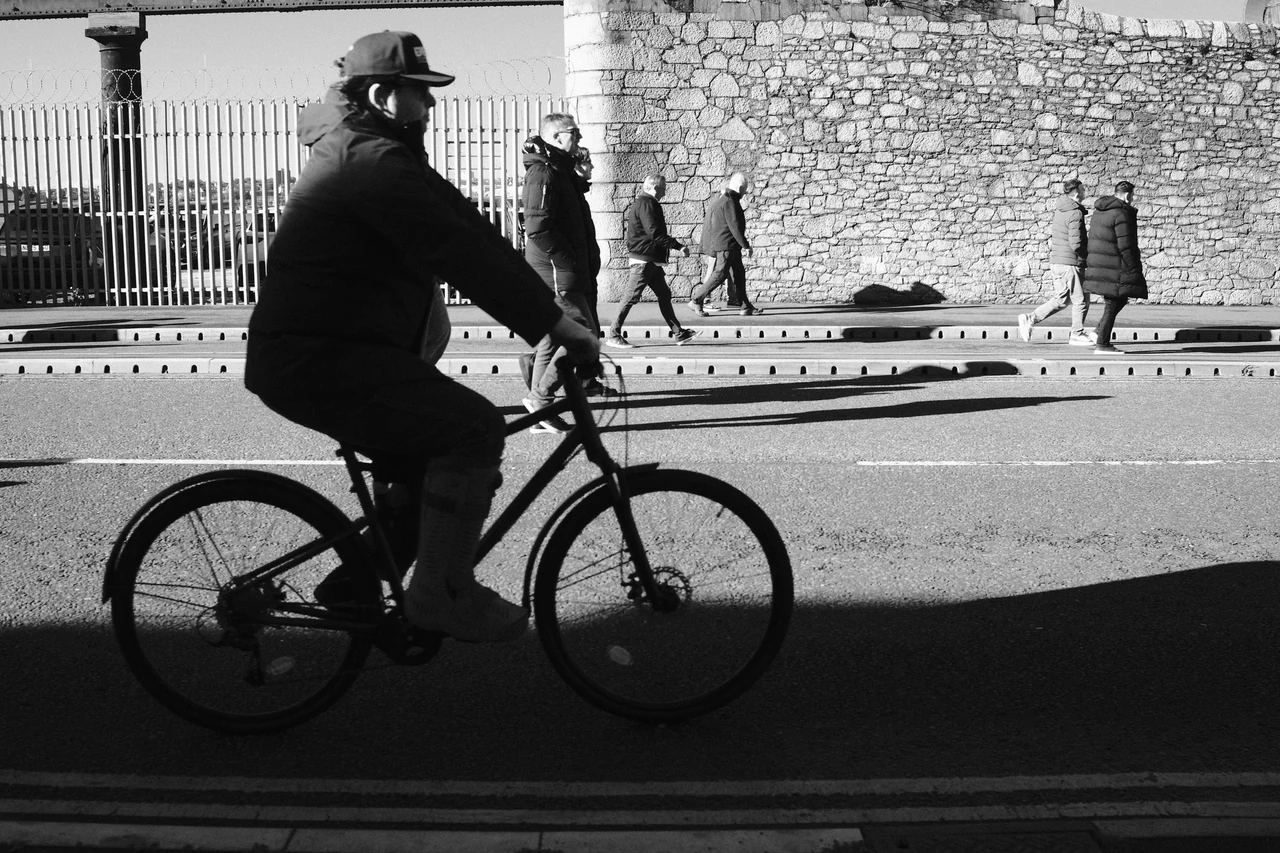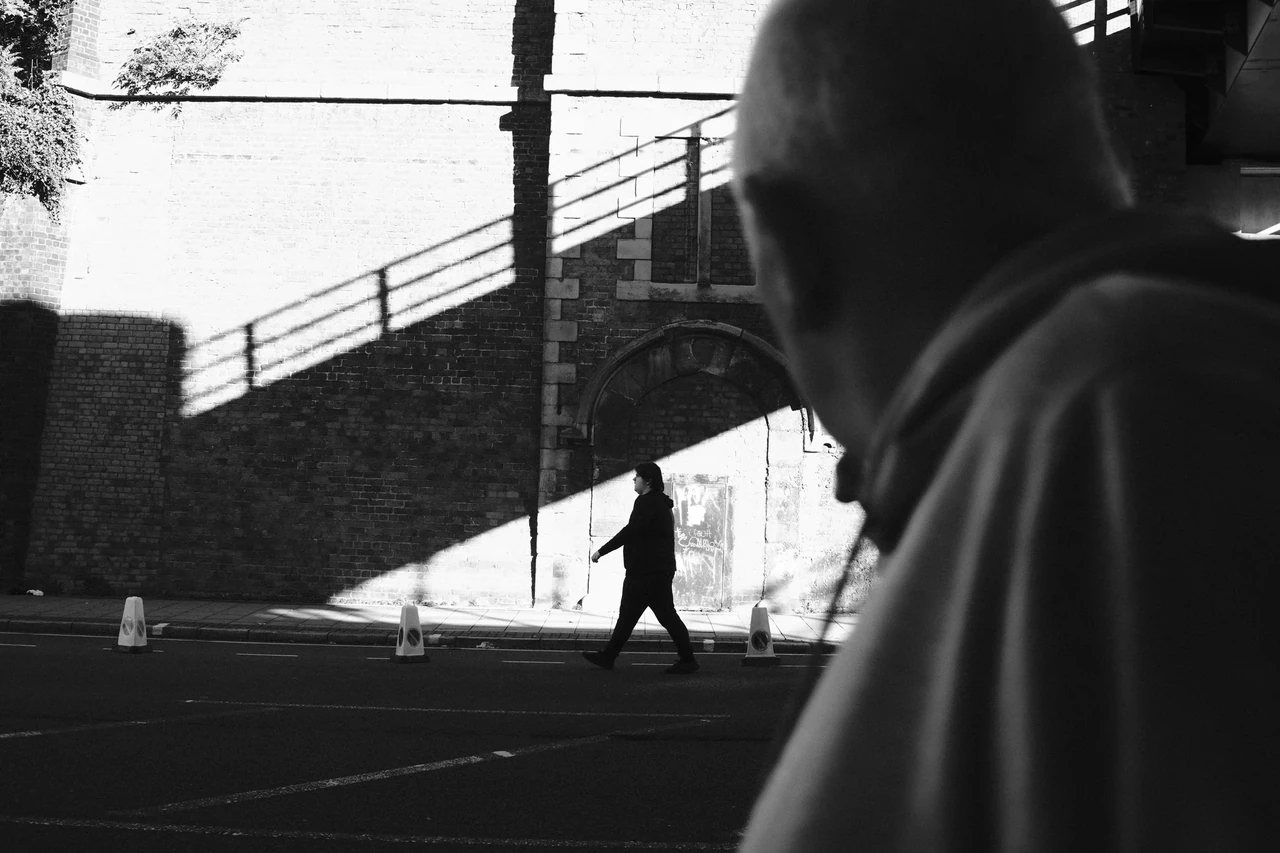
Separate the walk from the edit
Leave some time between taking photographs and choosing them. Immediately afterwards, the weather, the conversation and the effort are all still attached to the files. Those memories matter to you. A reader only receives what the frame contains.
Make small, similarly sized previews and see the whole set together. Start by marking the images that hold your attention before you inspect sharpness. Then check the technical details that actually matter to those selections. A perfectly focused nothing is still a nothing.
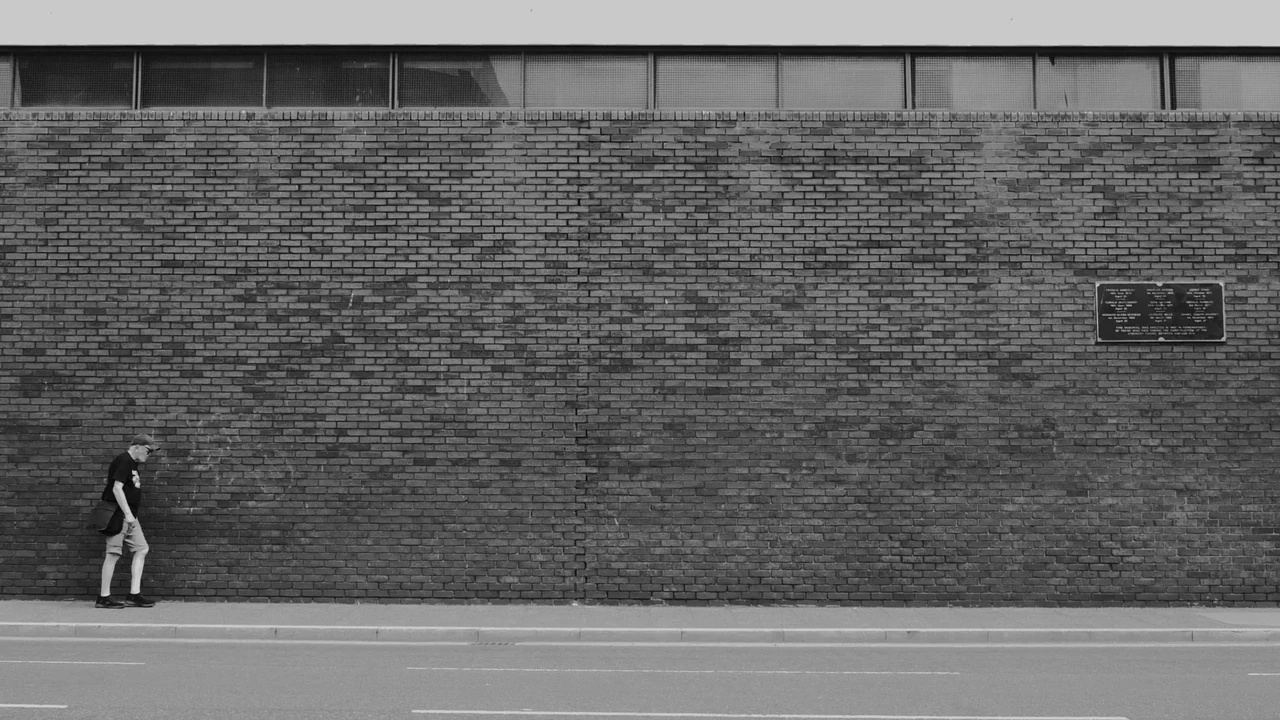
Let the wall be enormous
The pedestrian occupies very little of the picture. That is the point: the brickwork carries weight and the small figure measures it. A tighter crop would produce a more obvious subject, but it would also remove the relationship that makes this frame worth looking at.
Along the Brick Wall · Photograph © Mark C GrantFind the repeated decision
Look for patterns in your own behaviour. Do you always stand too far away? Is the strongest moment usually one frame after the one you chose? Do you centre every figure and forget the edges? A contact sheet reveals habits more reliably than a single triumphant image.
Compare near-duplicates next to each other. Ask what changes: gesture, overlap, spacing, eye line, the person at the edge. “This one feels more cinematic” is not an answer until you can point to something in it. Choose one, then put the rejected frame somewhere recoverable. Editing is a decision, not a bonfire.
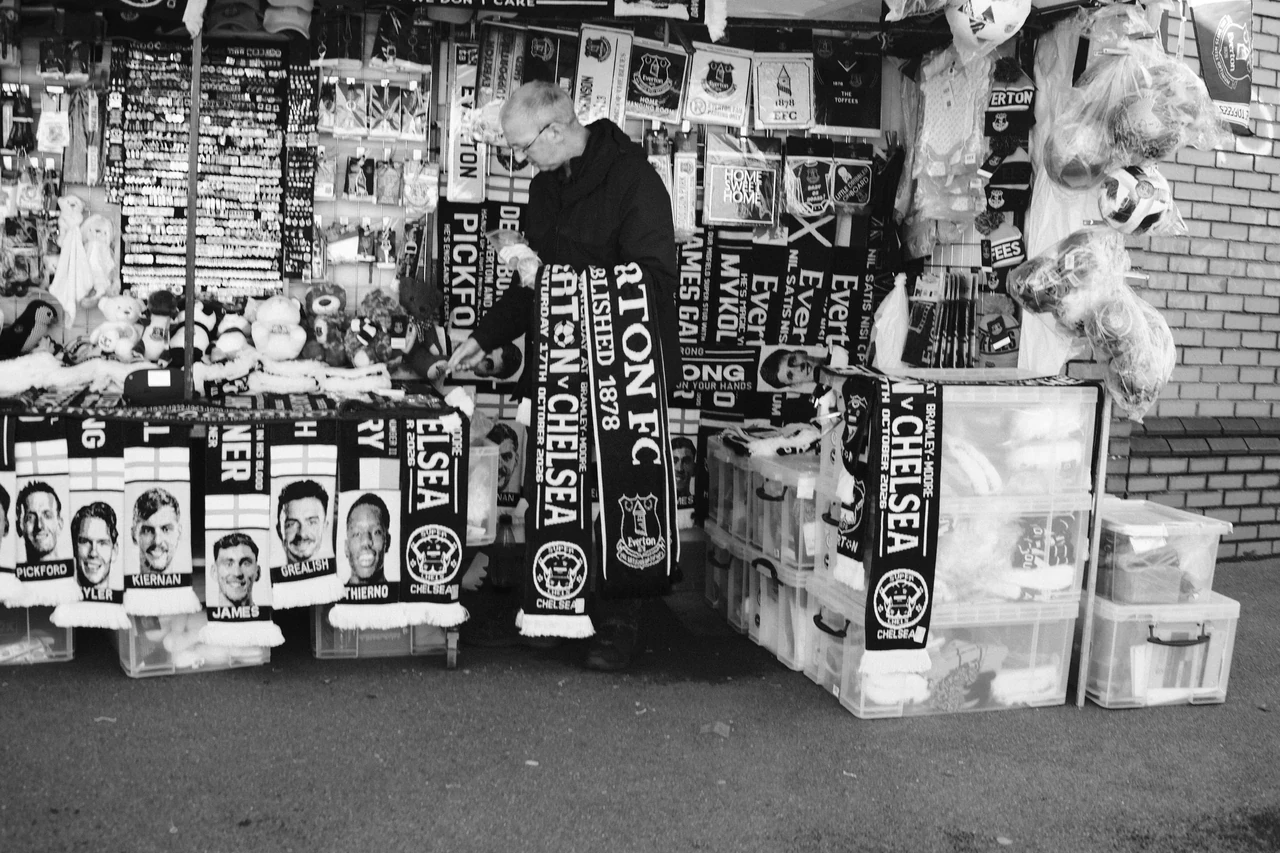
A frame full of things looking back
Printed faces and repeated scarves pack the stall with competing points of attention. Rather than searching for a single isolated subject, follow the repetition. Where does one face break the pattern? Dense pictures need relationships too; they just refuse to give you an empty wall as a favour.
Scarves and Faces · Photograph © Mark C GrantSix frames need a relationship
Build a small sequence around a shared question: distance, waiting, reflections, thresholds, the route home. A sequence of your six loudest photographs can be exhausting. Give it a quieter frame where the eye can breathe. Let changes of scale and direction carry the reader onward.
Try an opening that establishes the world, a middle that complicates it and an ending that leaves an echo. That is an exercise, not a law. Lay the images out in another order and ask what the new order implies. Sequencing makes meaning, so own the meaning you make.
Keep the awkward one under review
There may be a difficult image that does not fit the current set but will matter later. Keep a separate “not yet” group. You do not have to promote every interesting frame immediately, and you do not have to delete it to prove you are ruthless.
Ask someone to describe what they see before you explain your intentions. If the explanation is doing all the work, it might be a good story accompanied by a weak photograph. Both can be useful. They just are not the same thing.
Practical guidance from Captured Moment. Starting points to test in your own work, not universal camera settings.
Take this to the discussion.
A question, an example, a picture that proves us wrong. Specific beats loud.
Open the conversation ↗