In Hyères above, cover the cyclist briefly. What changes when the structure loses its passing figure?
Open the source ↗Join the conversation
Share this page
Photographers
Cartier-Bresson: the background is doing half the shift.
Timing gets the headlines. Geometry was already at work.
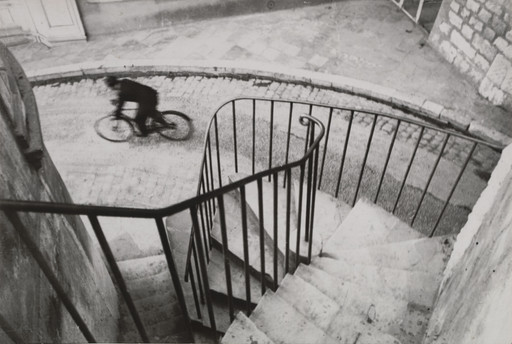
Gelatin silver print, printed 1930s. The Museum of Modern Art, New York. Purchase, 42.1942.
© 2026 Henri Cartier-Bresson/Magnum Photos, courtesy Fondation Henri Cartier-Bresson, Paris
Image source: MoMA ↗ · Reproduced here for critical discussion.
Look at the original work
Look with a question.
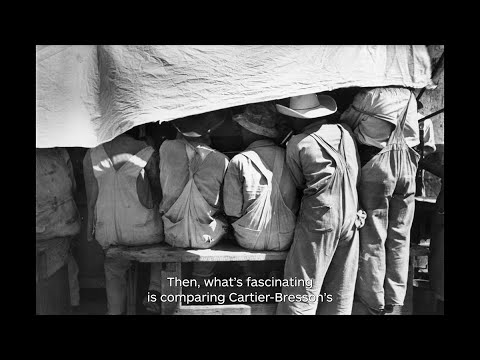
Open Vendeuses de journaux, Calle Cuauhtemoctzin, Mexico, 1934–1935 on the Foundation page. Follow your eye through the sellers, newspapers and frame edges. Which relationship holds the scene together?
Open the source ↗Compare the Foundation's paired Mexico pictures. How does each photographer make the people feel close without turning the city into a postcard?
Open the source ↗Look closely: Hyères, France, 1932
The photograph above makes the argument visible. From a high viewpoint, a handrail cuts across the foreground and curves down towards the street. The steps repeat its movement in lighter blocks. Beyond them, the kerb bends around the opposite side of the scene. Before noticing the rider, your eye has already been given several routes through the rectangle.
The cyclist occupies the pale opening at the upper left. Its dark, softened shape is a different kind of mark from the crisp ironwork. The bicycle supplies an event; the stairs supply a structure against which that event can register. The rider’s blur is not simply a technical deficit. It separates passing movement from the architecture that holds the picture together.
Cover the cyclist with a fingertip on the screen, without altering the image. The curves remain lively, but the photograph becomes a different proposition: a study of a place rather than a meeting between a place and a passing body. Uncover it and look at the space between the wheels and the rail. The gap matters as much as either object. A slightly different overlap would change the reading.
This is evidence of what the finished photograph contains, not proof of how long Cartier-Bresson waited or exactly what he anticipated. MoMA dates this image to 1932 and this gelatin silver print to the 1930s. For your exercise, borrow the dialogue between fixed structure and movement. You do not need a French staircase or a cyclist recruited for the role.
Try the idea in Liverpool. The following practice studies are Mark C Grant’s photographs, with our editorial readings.
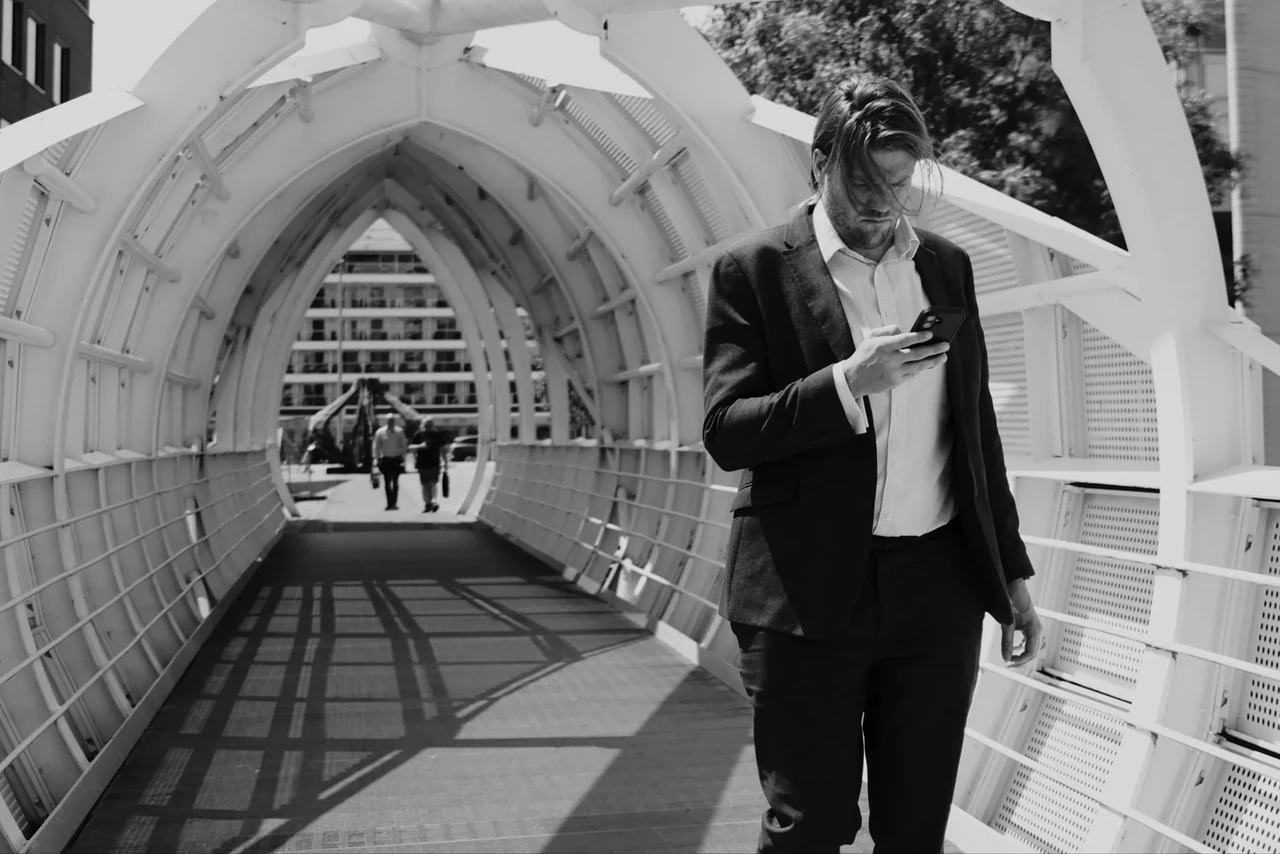
A frame inside a frame
The repeated white arches pull towards the centre, while the foreground figure refuses to sit neatly at the vanishing point. Look at the difference in scale between that person and the smaller figures behind. Depth is being described by bodies as well as architecture.
Princes Dock Footbridge · Photograph © Mark C GrantA few bearings
Henri Cartier-Bresson studied painting with André Lhote in 1926 and bought his first Leica in the early 1930s. He co-founded Magnum Photos in 1947. Images à la Sauvette, published in 1952, became known in English as The Decisive Moment.
Those are useful coordinates, but a famous phrase can become a distraction. If you only hunt for the spectacular fraction of a second, you can miss the structure that lets the fraction mean something.
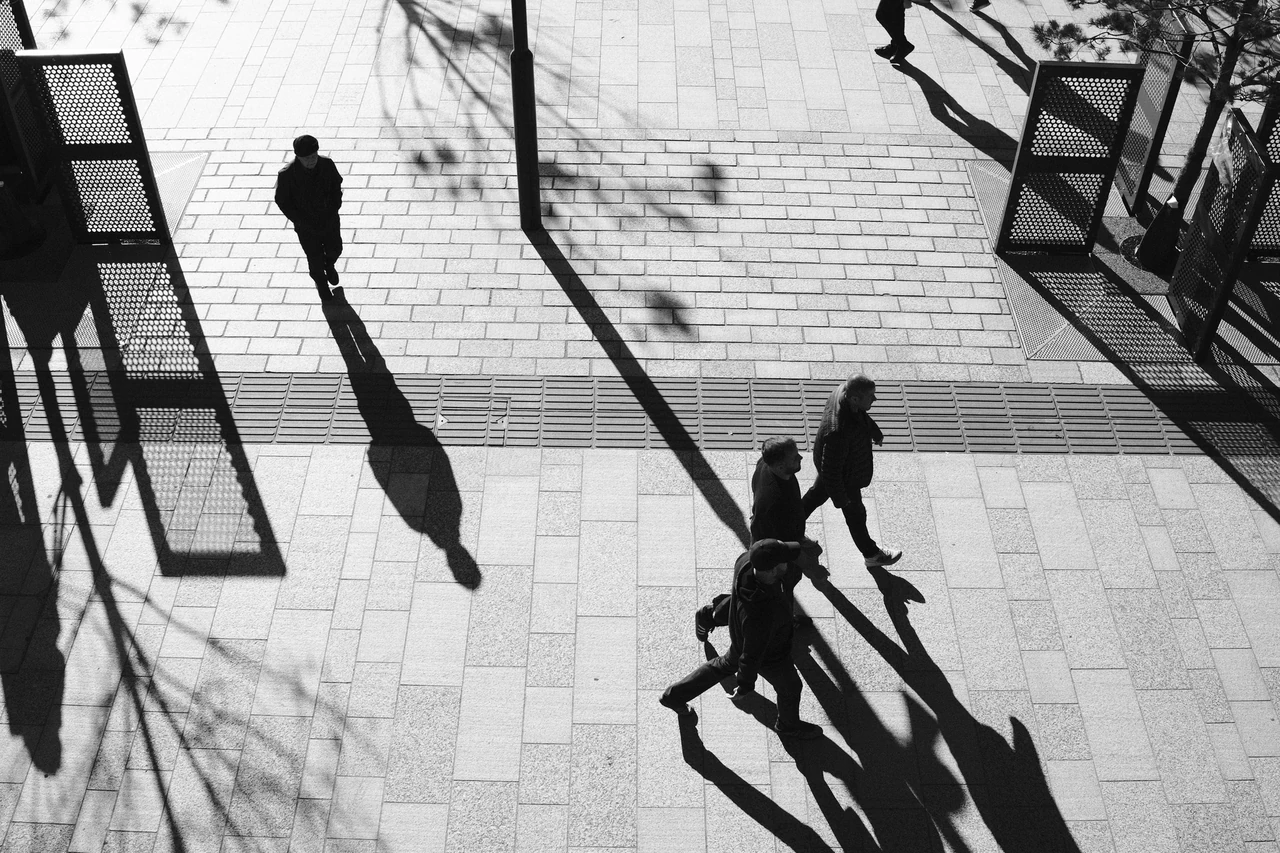
The figures draw on the paving
From above, people and their shadows become linked marks across a grid. The grid holds still; the bodies introduce directions and differences in scale. Follow a shadow back to its owner. The relationship is more interesting than calling the whole scene simply high contrast.
Long Shadows on the Concourse · Photograph © Mark C GrantMake a place for the event
Study the relationships between lines, empty space and bodies. Notice how a person’s gesture can complete a shape or interrupt it. The background is not wrapping paper around the interesting human. It is part of the event.
A practical way into this is to choose a composition before anyone arrives. Watch its edges and decide where a figure would matter. Wait long enough to see how ordinary movement changes it. This is our exercise inspired by looking at his work, not a claim that every photograph he made followed one formula.
Timing without mythology
You will miss moments. You will make frames where the structure is right and the human element is lifeless. The contact sheet is where those distinctions become visible. Treat a successful picture as the outcome of attention, position and circumstance rather than proof of some permanent gift.
A rangefinder can help you watch outside the frame lines. It cannot choose which relationship matters. Before another discussion about the perfect 50mm lens, spend twenty minutes on a corner with the lens you already know. It may be less entertaining than camera shopping. That is occasionally how learning announces itself.
Sources & further looking
Facts checked 22 October 2026. The practical exercises and critical readings are this publication’s editorial interpretation.
Take this to the discussion.
A question, an example, a picture that proves us wrong. Specific beats loud.
Open the conversation ↗Keep looking
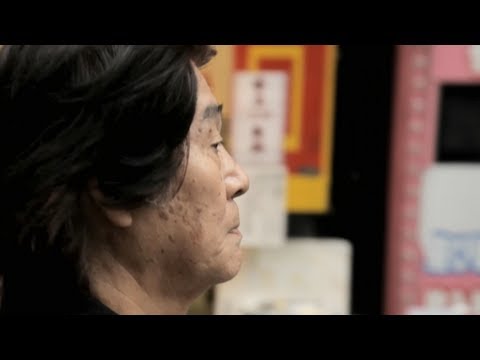
Film preview / Tate
Photographers
Daido Moriyama: the pavement does not care what your camera cost.
Fragments, proximity and a restless eye. Start with the looking; the grain can wait.
Read the piece : Daido Moriyama: the pavement does not care what your camera cost.Film preview / Fondation Henri Cartier-Bresson
Photographers
Helen Levitt: ordinary life is already performing.
Small gestures, second characters and the theatre you do not need to direct.
Read the piece : Helen Levitt: ordinary life is already performing.Your turn / photographs & ideas
Bring a frame. Leave a thought.
What did this make you notice? Bring your own photograph, try the exercise, or give us a considered disagreement. The camera bag can wait.
Sign in or make an account to post. Share your own work, credit your sources and keep the conversation generous. Reader photographs remain the work of their contributors.