What the finder is doing
In a coupled optical rangefinder, the view through the finder is separate from the taking lens. A patch shows two views that coincide when the focusing mechanism is aligned for the subject distance. On a Leica M, turn the lens’s focus ring until the relevant contours line up. Frame lines guide the composition; the finder is not a live preview of the lens image.
That separation has consequences. You can often see movement outside the frame lines, which helps you anticipate an entrance. You do not see depth of field, lens flare or exposure through the optical finder. At close distances the finder’s viewpoint differs from the lens’s: parallax. Frame compensation helps, but close compositions still deserve attention.
A frame inside a frame
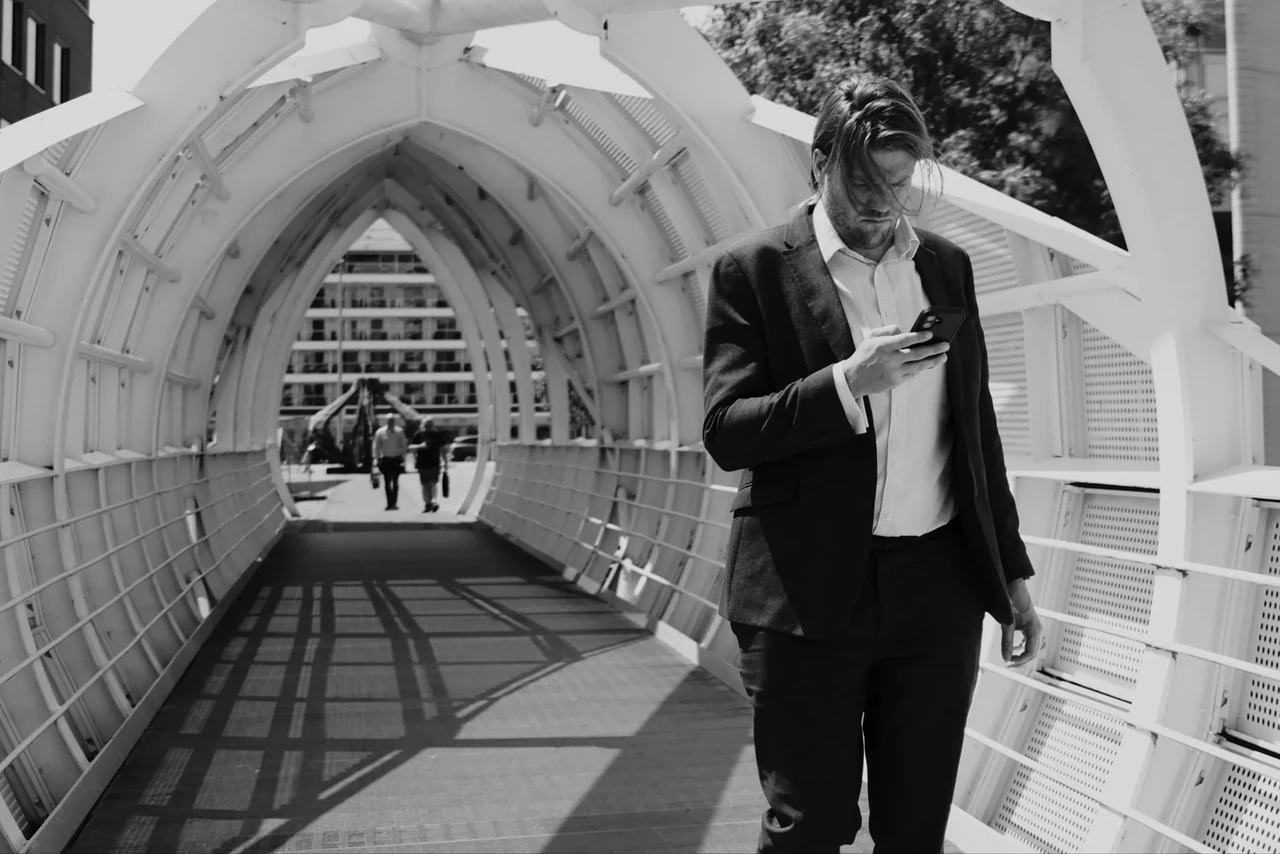
The repeated white arches pull towards the centre, while the foreground figure refuses to sit neatly at the vanishing point. Look at the difference in scale between that person and the smaller figures behind. Depth is being described by bodies as well as architecture.
Princes Dock Footbridge · Photograph © Mark C GrantDo not focus on the wrong plane
Pick a clear edge at the distance you want sharp. Align it, then compose without swaying forward or backward. At close range and a wide aperture, a small movement matters. Practise on stationary subjects until the focus movement becomes familiar; the street is an expensive place to discover you have been lining up the background.
If repeated careful tests disagree with the recorded image, investigate technique, the lens and calibration. Do not immediately attack a rangefinder adjustment with a screwdriver because a stranger on a forum sounded confident.
The foreground interrupts
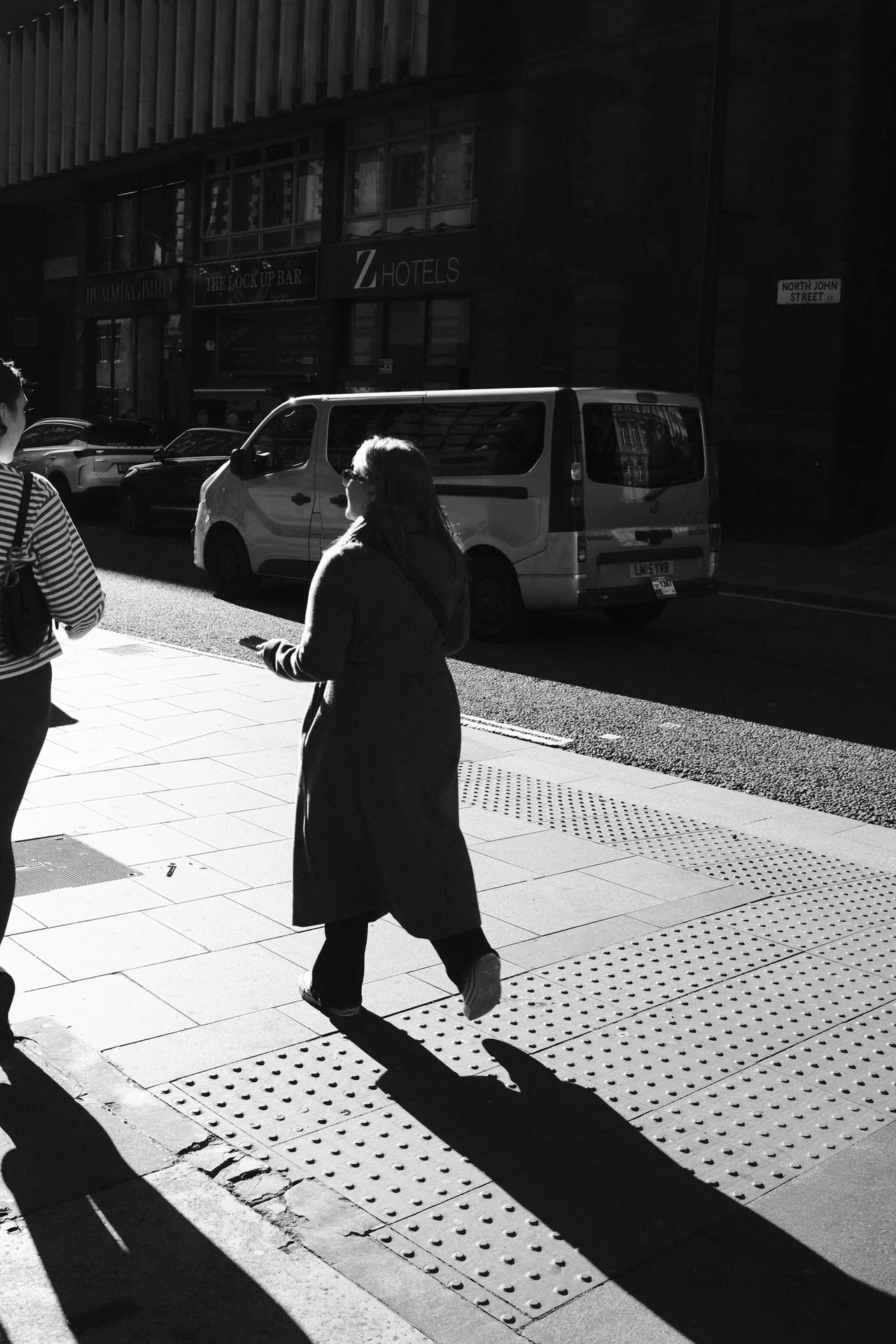
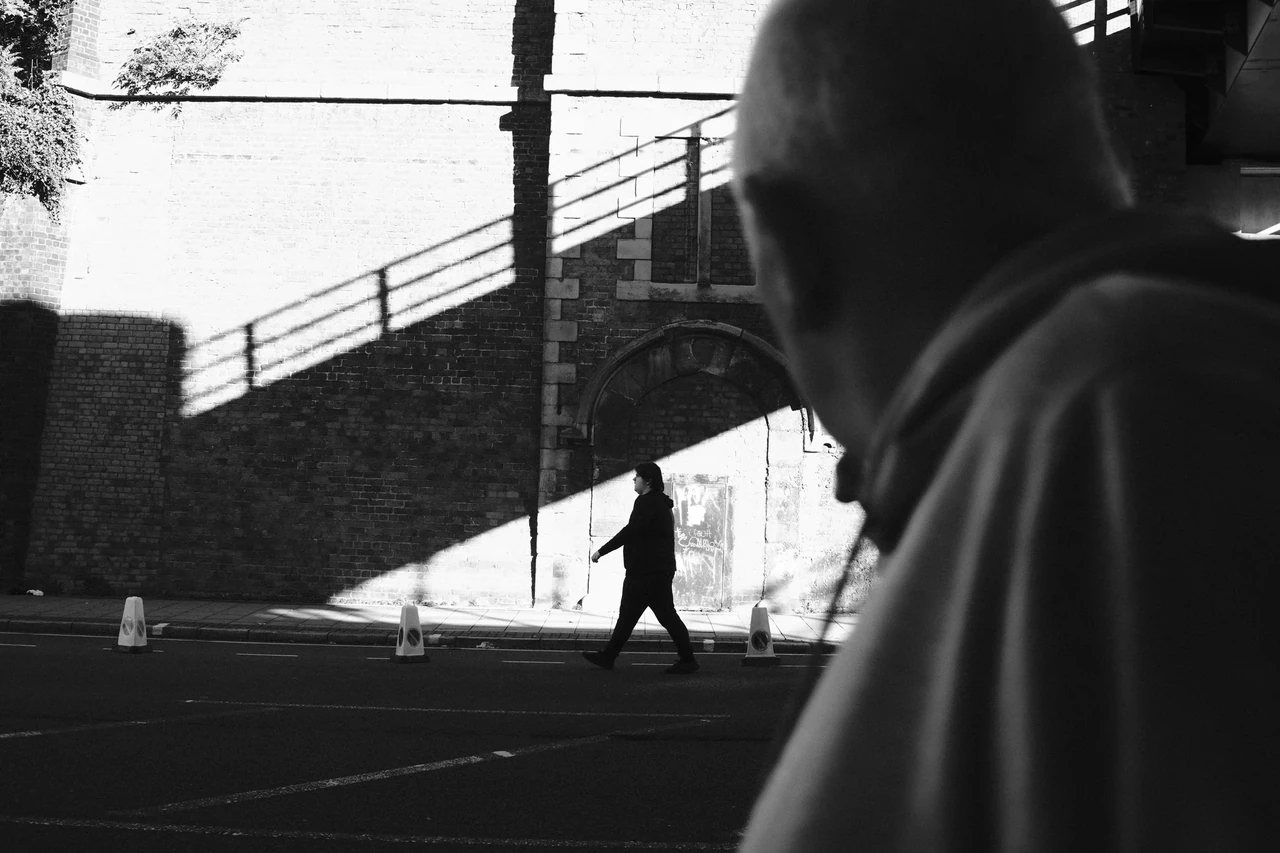
A large, partly cut-off passer-by occupies the near edge while a smaller figure crosses the bright wedge beyond. Your eye has to negotiate two distances. The interruption makes the view feel occupied. Cover the foreground briefly and notice how much tidier—and less layered—the picture becomes.
Passing through the Frame · Photograph © Mark C GrantThe X100 distinction
Fujifilm’s X100VI has a hybrid optical/electronic finder and can show a small electronic rangefinder display. Its optical viewing style invites a similar way of composing, but it is not the Leica-style mechanically coupled optical focusing patch. It has autofocus and electronic manual-focus aids. “Rangefinder-style” is the useful distinction.
A compact camera with an electronic screen can still teach the same habits: pre-visualise a frame, understand your working distance, watch what is about to enter it. The camera shape does not issue a certificate of seriousness.
Learn the compromise you bought
Spend a walk using one focal length and one focusing method. Review where you missed and why. Was focus behind the subject, was the shutter too slow, or was the picture simply dull? These are different problems. Only one of them has a chance of being solved by a different lens.
Enjoy the mechanism if it makes you want to go out. That is a perfectly good reason to like a camera. Just do not confuse enjoying a brass object with doing the work.
Sources & further looking
Facts checked 22 October 2026. The practical exercises and critical readings are this publication’s editorial interpretation.
Take this to the discussion.
A question, an example, a picture that proves us wrong. Specific beats loud.
Open the conversation ↗