Look at the shape of the bottle above, then read its title and date. How does the historical identification change your first reading?
Open the source ↗Join the conversation
Share this page
Photographers
Shomei Tomatsu: the street has a memory.
Objects, surfaces and the history that a quick glance can flatten into texture.
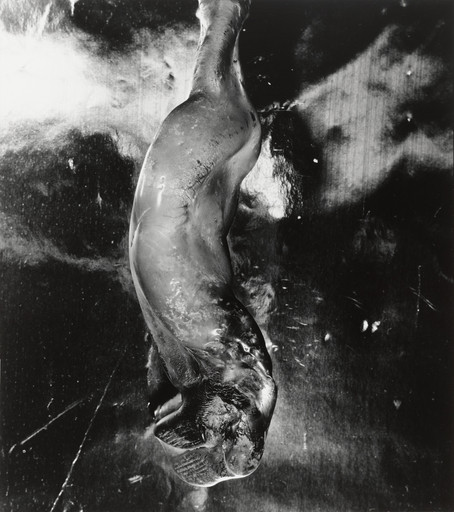
Gelatin silver print. The Museum of Modern Art, New York. Gift of the artist, 705.1978.
© 2026 Shomei Tomatsu
Image source: MoMA ↗ · Reproduced here for critical discussion.
Look at the original work
Look with a question.
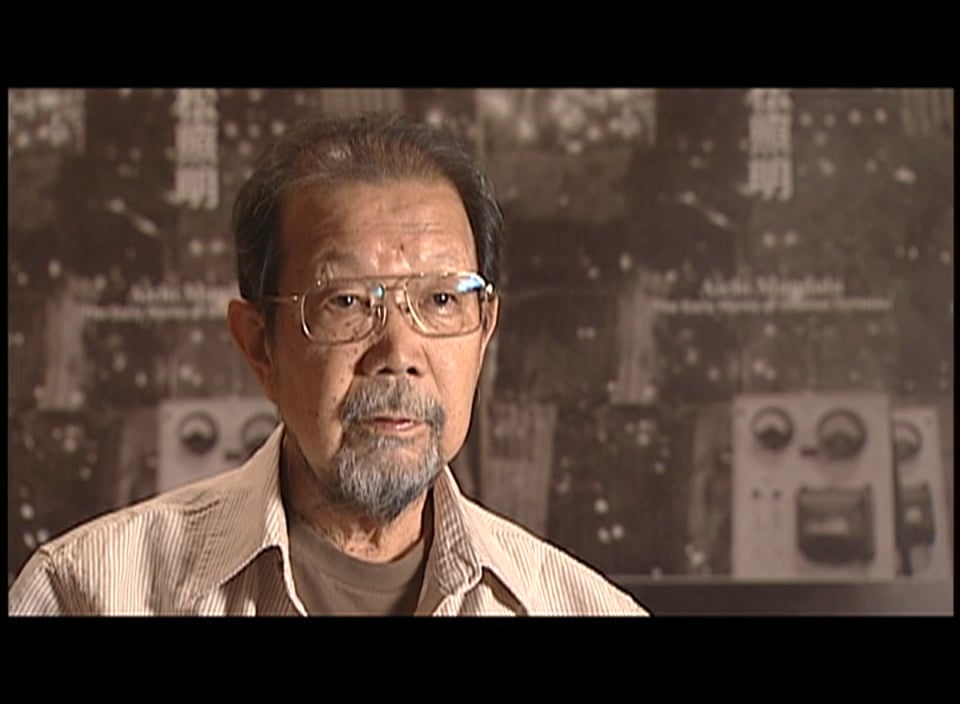
As the film moves through Pottery Town, look for the small workshops and chimneys. How does an industry become visible in the surrounding air and streets, not just in a worker's portrait?
Open the source ↗Watch the shift from Seto's coal smoke to Yokkaichi's petrochemical industry. Which visual details would tell you a place was changing if the captions were removed?
Open the source ↗In the portraits gathered as The Japanese, compare faces with surroundings. Tomatsu later connected these men of responsibility with his absent father: what changes when you know that personal stake?
Open the source ↗Look closely: Beer Bottle After the Atomic Bomb Explosion, 1961
The object above is difficult to settle into an everyday category at first glance. A narrow upper section leads into a swollen, curved body and a compressed lower end. Light makes the glass alternately cloudy, luminous and dark. The surrounding surface has its own scratches and patches, so the bottle never becomes a clean product silhouette.
Follow the continuous curve down the object. The outline suggests a body while the title insists on a bottle. That tension belongs to our experience of the photograph; it does not turn the object into a literal human figure. Tōmatsu’s framing and tonal contrasts make us look at something whose familiar manufactured shape has been violently changed.
Now return to the caption. This is a photograph made in 1961 of an object associated with the 1945 atomic bombing of Nagasaki, not a photograph taken during the explosion. The distinction is fundamental: the image records an aftermath through a surviving thing. The Smithsonian identifies the bottle within the 11:02 Nagasaki series. The date, place and identification change what otherwise might be mistaken for an exercise in texture.
Do not use its appearance as a recipe for making ordinary objects look traumatised. The lesson for local work is a responsibility to establish context. Photograph a trace, learn what it is, and let the factual caption resist a story invented for dramatic effect. A close view can intensify attention, but it cannot manufacture historical evidence.
Try the idea in Liverpool. The following practice studies are Mark C Grant’s photographs, with our editorial readings.
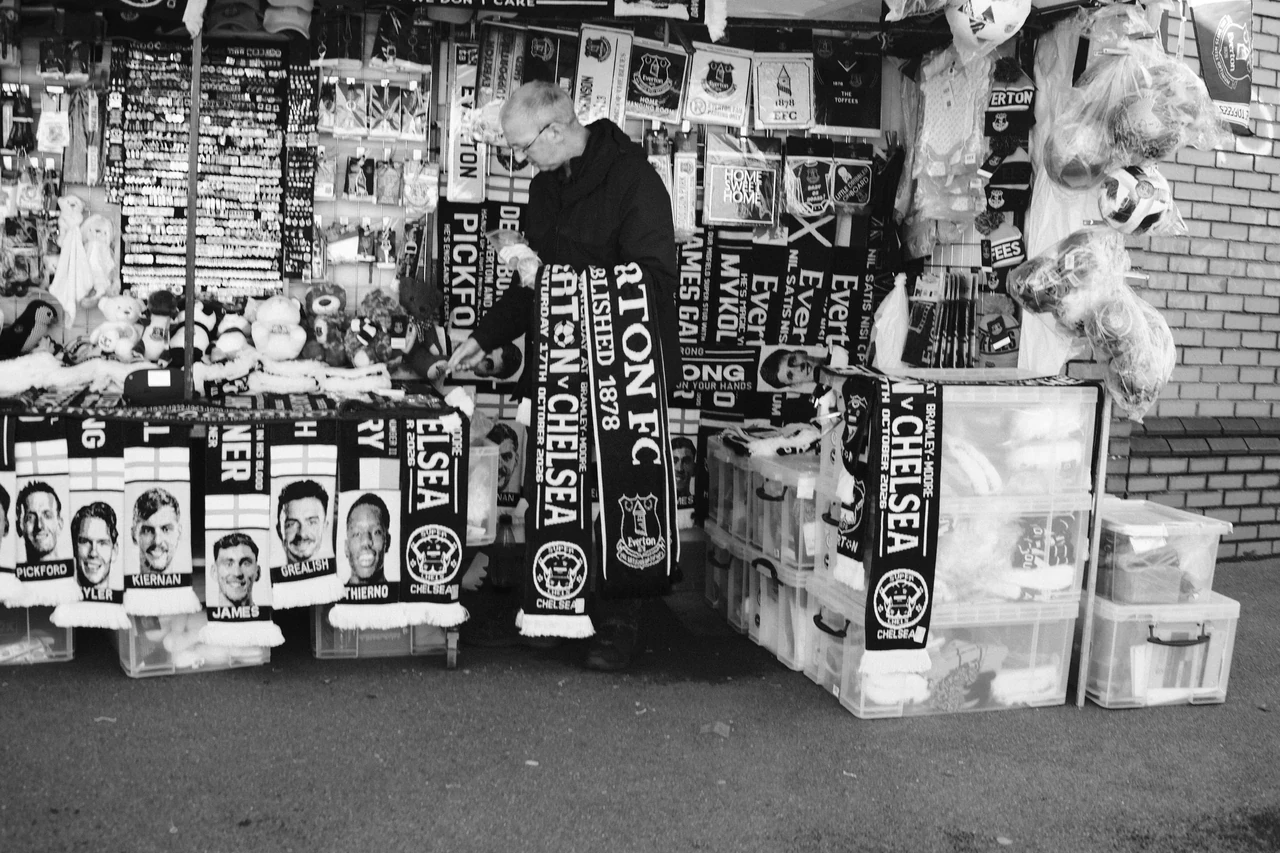
A frame full of things looking back
Printed faces and repeated scarves pack the stall with competing points of attention. Rather than searching for a single isolated subject, follow the repetition. Where does one face break the pattern? Dense pictures need relationships too; they just refuse to give you an empty wall as a favour.
Scarves and Faces · Photograph © Mark C GrantA few bearings
Shomei Tomatsu began photographing at university in the early 1950s without formal photographic training. His postwar work addressed the American military presence in Japan, Nagasaki, Okinawa and protest in Tokyo.
His 11:02 Nagasaki series includes photographs made in 1961 of a melted bottle and a watch stopped at 11:02 on 9 August 1945. These objects belong to a history of catastrophic human loss. They demand a different kind of attention from an attractive bit of weathered paint.
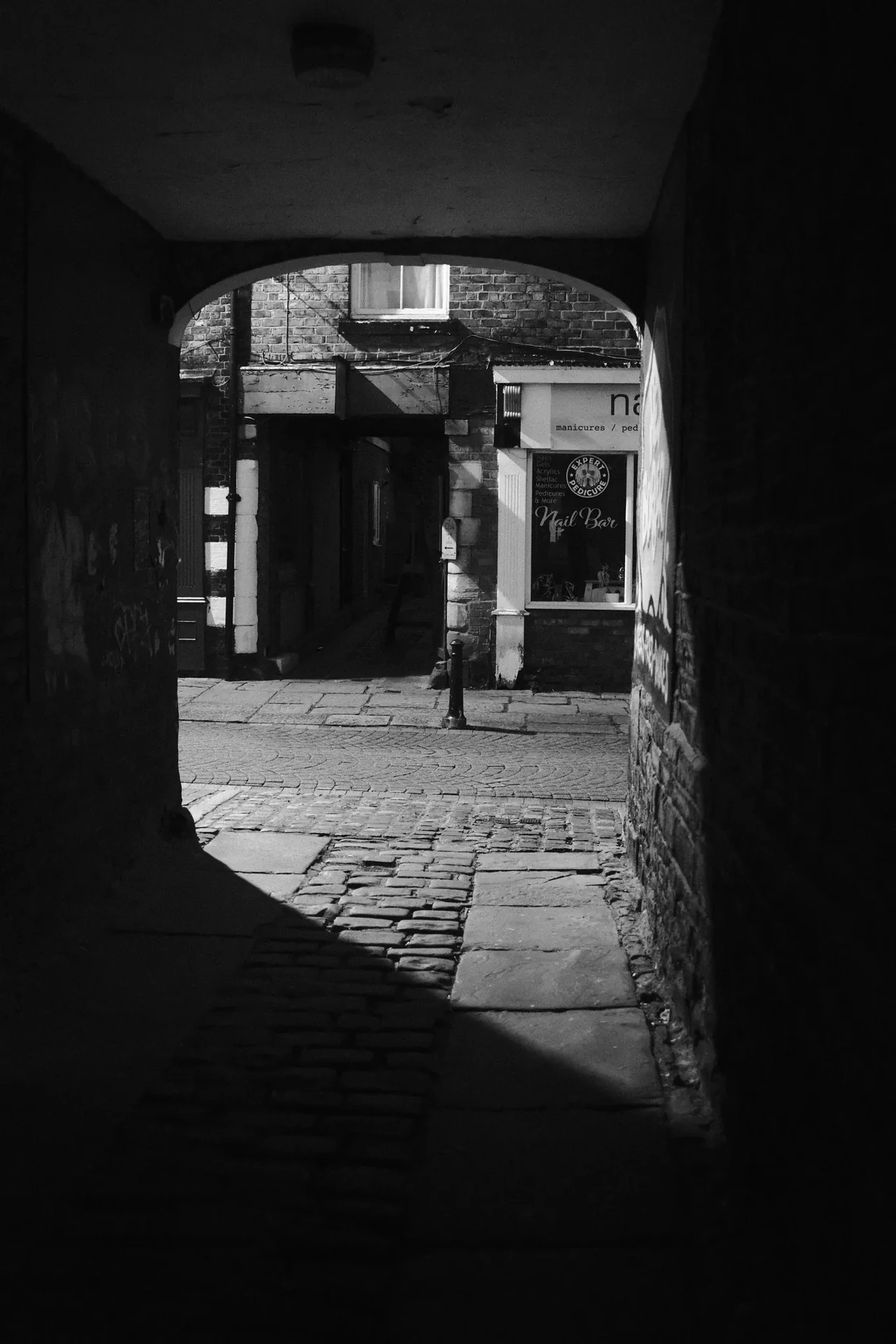
A doorway edits the street
The darkness of the passage works like a frame around the brighter doorway beyond. It removes distractions before any editing software gets involved. Watch the boundary between those tones: that edge does much of the compositional work, even when there is very little happening.
Doorway off Burscough Street · Photograph © Mark C GrantDescription is only the beginning
A photograph of a thing can carry more than its appearance. That meaning may depend on research, a caption, a sequence and the circumstances in which the object survives. If you strip all that away, you risk turning evidence into decoration.
This is an editorial reading, not a claim that every surface conceals a grand narrative. Sometimes a wall is a wall. The useful discipline is to find out before borrowing its seriousness.
What that asks of a local photographer
On your own streets, pay attention to traces: an altered entrance, a surviving sign, an object retained after its original use has gone. Establish what you actually know. Ask where the information comes from. Separate a documented fact from a story you have imagined because it suits the composition.
Build a small sequence that lets context accumulate. An overall view, a detail and a relationship with the present can work harder together than three dramatic close-ups. The method is not to make Liverpool resemble postwar Japan. It is to take the history of your own place seriously.
Sources & further looking
Facts checked 22 October 2026. The practical exercises and critical readings are this publication’s editorial interpretation.
Take this to the discussion.
A question, an example, a picture that proves us wrong. Specific beats loud.
Open the conversation ↗Keep looking
Film preview / Tate
Photographers
Daido Moriyama: the pavement does not care what your camera cost.
Fragments, proximity and a restless eye. Start with the looking; the grain can wait.
Read the piece : Daido Moriyama: the pavement does not care what your camera cost.
Film preview / Fondation Henri Cartier-Bresson
Photographers
Cartier-Bresson: the background is doing half the shift.
Timing gets the headlines. Geometry was already at work.
Read the piece : Cartier-Bresson: the background is doing half the shift.Your turn / photographs & ideas
Bring a frame. Leave a thought.
What did this make you notice? Bring your own photograph, try the exercise, or give us a considered disagreement. The camera bag can wait.
Sign in or make an account to post. Share your own work, credit your sources and keep the conversation generous. Reader photographs remain the work of their contributors.