Before skill, there is a decision
Mark C Grant’s The Art of Art begins beneath the familiar arguments about skill, style and medium. Technique enables a picture, but another set of decisions gives it purpose: what to control, what to permit, what to notice, what to leave unresolved and what someone else may discover. That is an excellent place to start a photographic walk. It is less useful as a reason to spend another hour comparing corner sharpness.
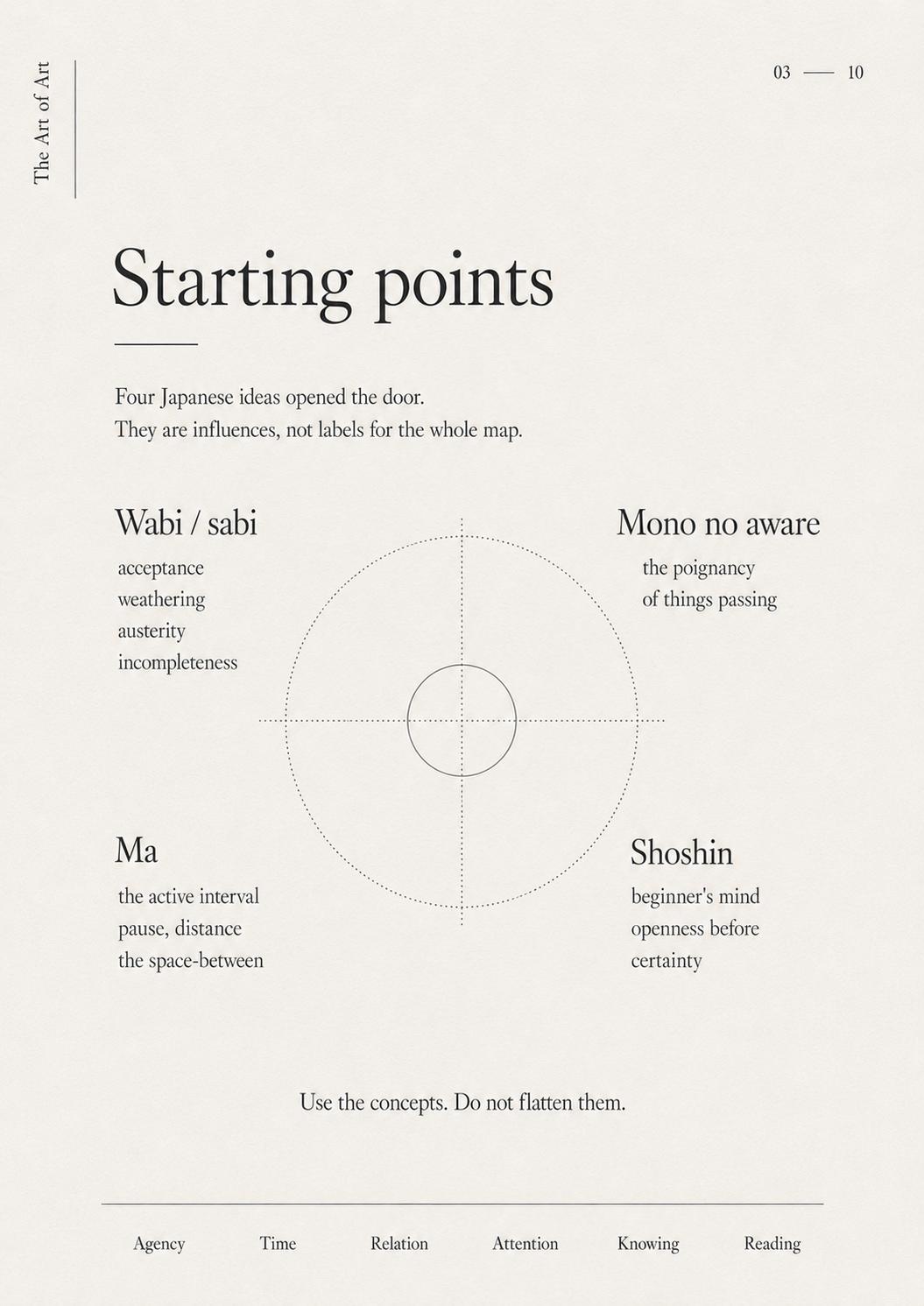
The revised ten-page paper organises those decisions through agency, time, relation, attention, knowing and reading. Its third page names four Japanese starting points—wabi/sabi, mono no aware, ma and shoshin—while explicitly saying that they do not label the whole map. This article takes that qualification seriously. We are developing Mark’s framework into photographic exercises, not presenting a universal theory of Japanese art.
Photography makes the argument wonderfully awkward. The camera brings control and contingency into the same rectangle. You can choose a position, exposure and moment; you cannot command every face, reflection, gust or passing shoulder. A photograph records that meeting. Its interest may lie in the part that declined to follow your instructions.
The space between people
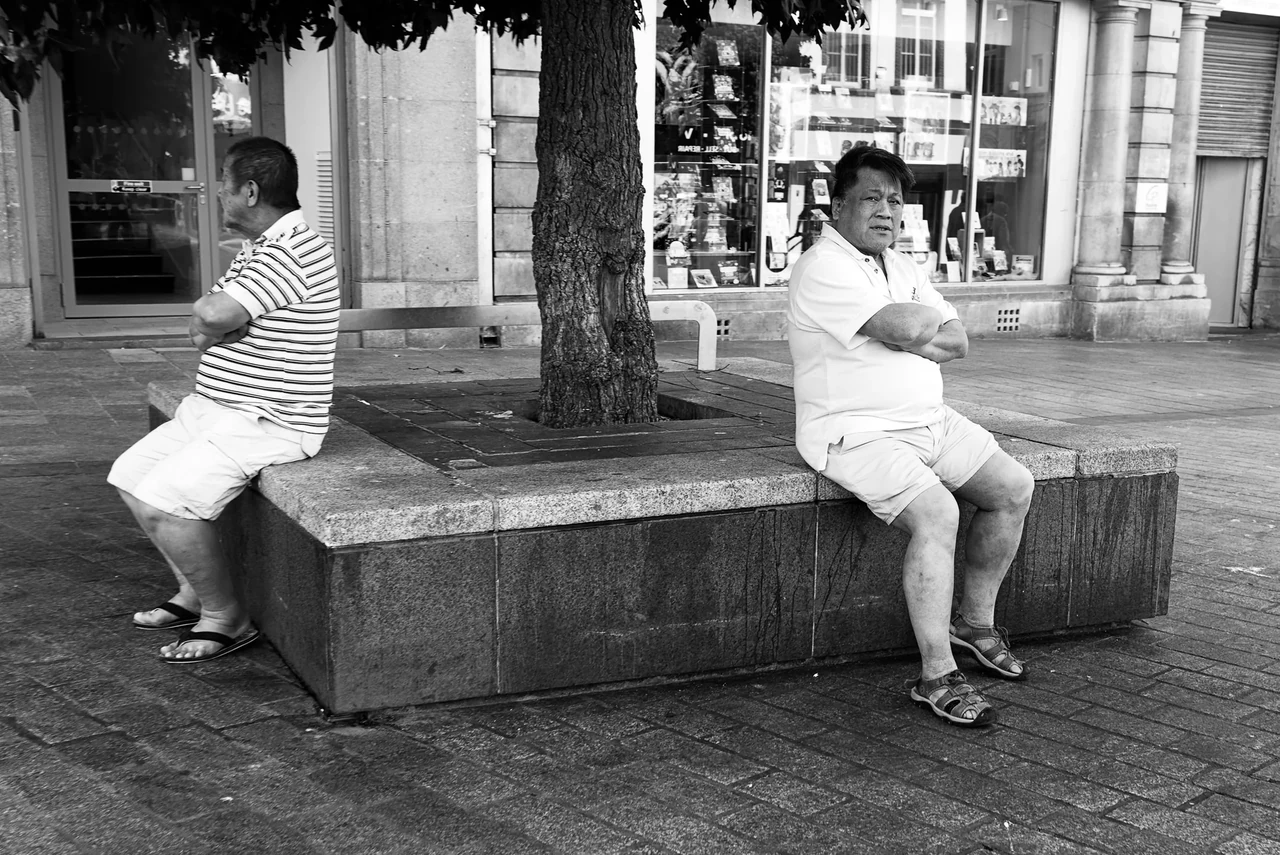
Two seated figures share a structure without becoming a single group. Read the direction of their bodies and the empty stretch between them. The gap is active information. You can describe that arrangement without claiming to know whether they are strangers or what either is feeling.
Two Seats beneath a Tree · Photograph © Mark C GrantWabi and sabi: meet the object before the slogan
Wabi and sabi have histories richer than the modern shorthand “beautiful imperfection”. In the context of tea, attention to restrained, rustic or weathered objects can make irregularity something to examine closely. The Metropolitan Museum’s history of the tea ceremony describes the changing relationships among utensils, setting and participants. The gathering matters alongside the object. A rough surface does not explain the whole experience.
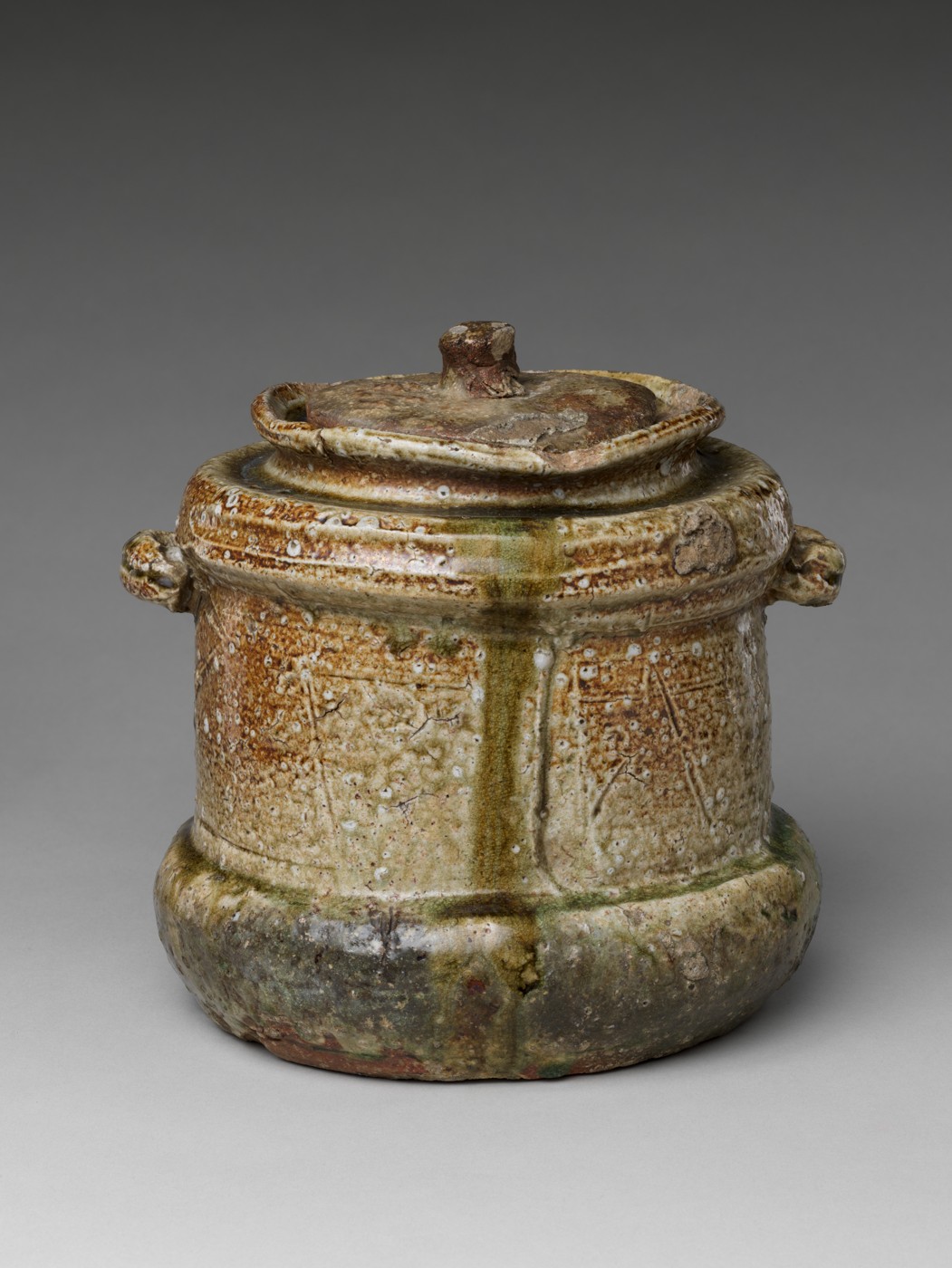
Look at the Iga-ware freshwater jar named Hotei, made around 1600 and now in the Met. The museum connects its uneven form and surface to the tastes of tea masters. Follow the shoulder, the lugs and the passages of glaze. Notice how the uneven lid meets the body. These differences give your eye work to do; the jar does not need to become geometrically regular to remain a carefully regarded object.
For photography, our proposed connection is attention rather than decoration. A worn step might show how people pass through a place. A rain-marked window might make the view a meeting between street and surface. Do not add artificial scratches and announce that you have discovered Japan. Photograph a real condition; see whether its particularity changes the picture. The kettle can have patina without requiring a manifesto.
A doorway edits the street
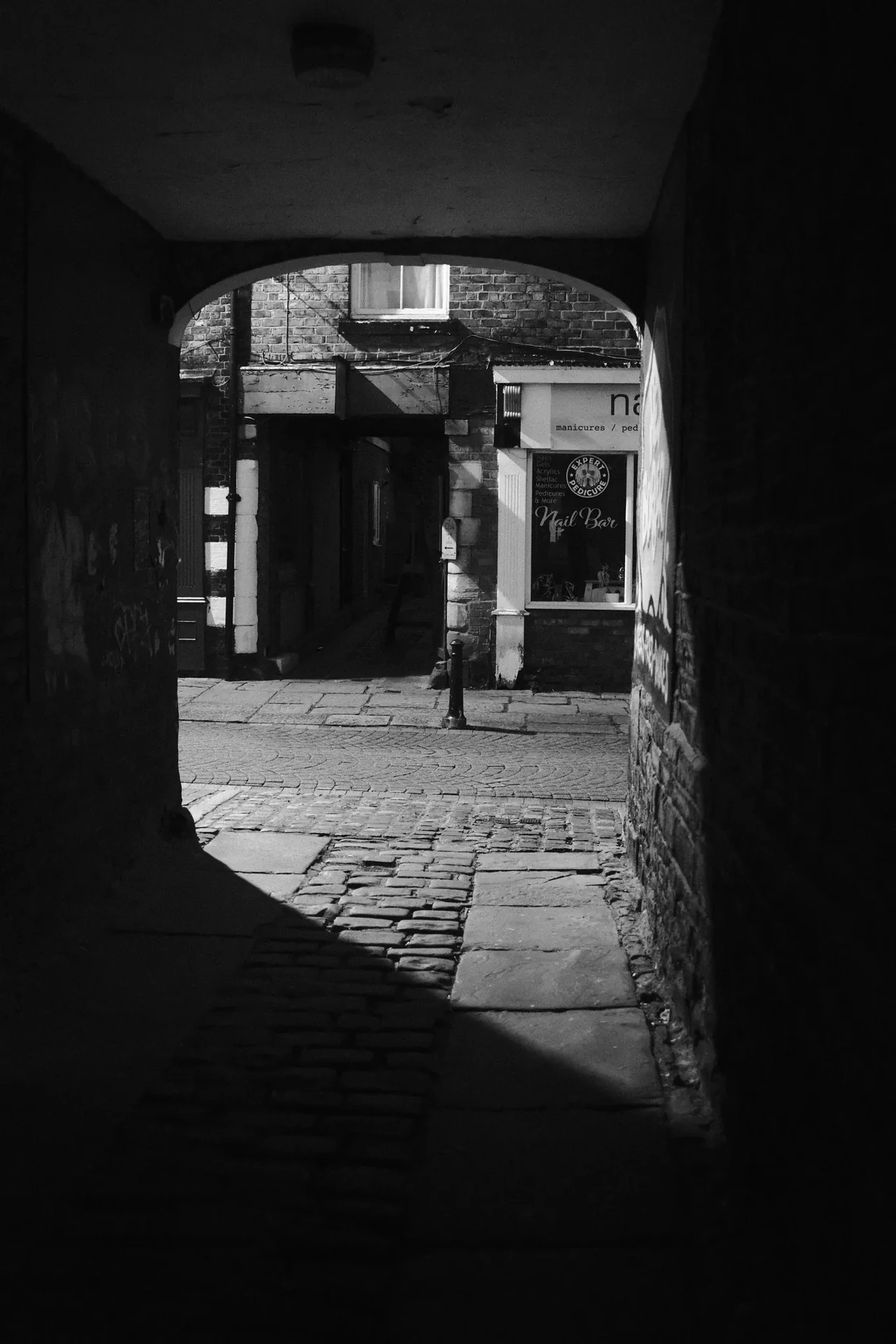
The darkness of the passage works like a frame around the brighter doorway beyond. It removes distractions before any editing software gets involved. Watch the boundary between those tones: that edge does much of the compositional work, even when there is very little happening.
Doorway off Burscough Street · Photograph © Mark C GrantWatch, then try
Japan House Shares Chawan

Japan House at the University of Illinois introduces the tea bowl. Watch the attention given to the object and its handling. Afterwards, spend two minutes with an ordinary object before deciding what belongs in the frame.
Ma: the gap is doing something
In an essay for Japan House London, designer Hara Kenya distinguishes yohaku, space around something, from ma, an interval that may be spatial or temporal. He discusses Hasegawa Tōhaku’s Pine Trees screens, where visible trees and mist invite the viewer to supply what is withheld. Open the linked essay and spend time with that work. The unpainted-looking areas are not merely vacancies awaiting more trees.
Mark’s paper gives us a compact photographic prompt: “The gap also draws.” In Two Seats beneath a Tree, look at the interval between bodies and seats before looking for expressions. Then imagine a small change of camera position closing that interval. The relationship would change even if the people remained exactly the same. Space is part of the subject.
On the street, ma can be a productive question rather than a label pasted onto every empty wall. What happens between the approaching person and the doorway? How long does a gap remain open before two silhouettes merge? Make a frame because of that relation. A sparse composition is not automatically profound, and an overcrowded one is not automatically incapable of breathing.
Mono no aware: a photograph has more than one time
The paper approaches mono no aware through the poignancy of things passing. Applied to a photograph, that suggests a quieter starting point than hunting for something spectacular. A gesture ends. Light leaves a patch of pavement. A person steps out of a waiting group. You do not have to make the scene sad to recognise that its arrangement will not last.
There is the time of the encounter, the duration described inside the image and the later time of looking. Mark’s fifth page argues that a work is met in the present even when it carries a past. A photograph makes that separation tangible: the event is gone, but the arrangement of light is available to someone encountering it now.
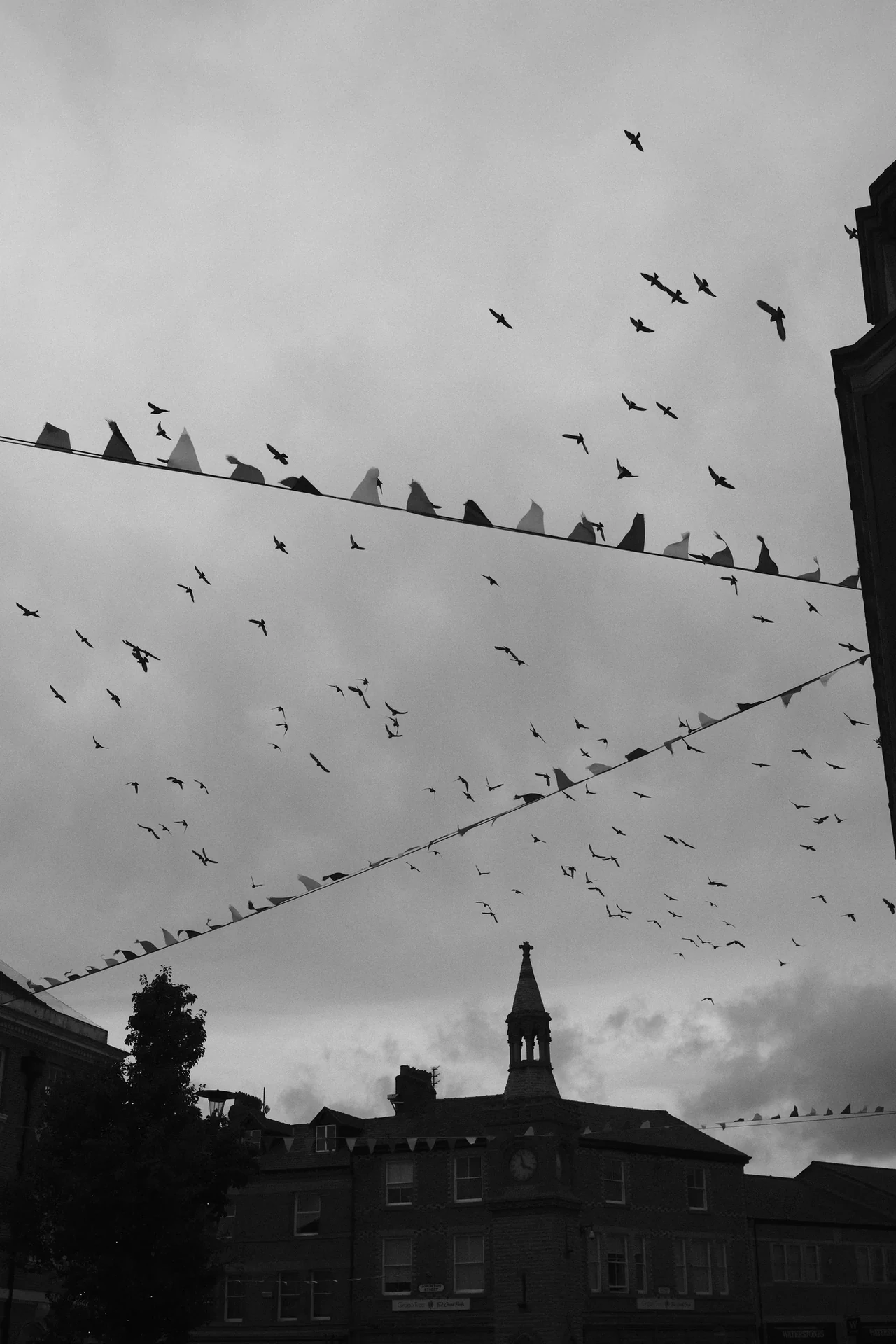
Consider Birds above the Bunting. The roofline offers something relatively stable; the birds are temporary marks in relation to it. The picture can make that difference felt without telling us the birds’ destination. Rinko Kawauchi’s museum film, included below, offers another route into close attention to small events. This is a proposed conversation between works, not a claim that her practice illustrates every term in the paper.
Shoshin: know the camera, keep meeting the street
Shoshin, often translated as beginner’s mind, has a particular home in Zen practice. Shunryu Suzuki’s teachings, preserved by San Francisco Zen Center, are a useful starting point for reading it in that setting. A photographic exercise can borrow the invitation to openness without pretending that changing camera mode constitutes Buddhist practice.
Mark’s distinction is practical: knowledge helps us work, but certainty can stop us looking. Learn your camera well enough to respond. Then notice when your expectations are choosing the photographs before you arrive. Are you waiting for every person to become a silhouette against the same bright wall? Have you stopped seeing anything that does not suit your successful trick?
Walk a familiar route with one small question: what have I been treating as background? Stay with an ordinary place for two minutes. Resist the urge to improve it by imagining a more dramatic subject. A useful discovery may be a relation between existing things. You have not forgotten your technique; you have stopped asking it to recognise the world on your behalf.
Agency includes what you keep
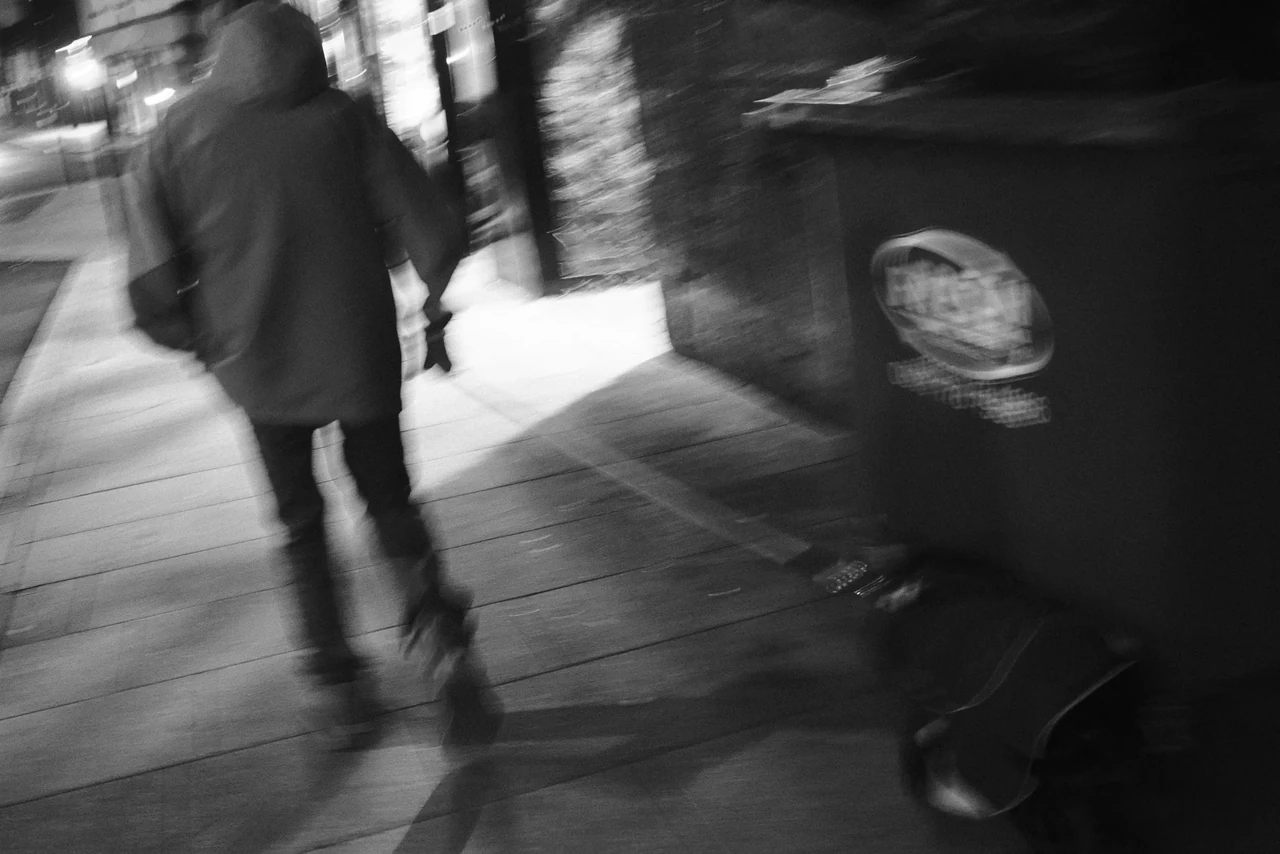
On page four, the paper places control beside contingency and correction beside keeping. Its central claim is that an accident joins the work when you choose to retain it. That is where the twelve-frame JPEG challenge becomes more than a rule about files. A fixed rendering establishes some conditions; the street contributes others; keeping the results makes you examine their meeting.
This does not make intention irrelevant. You can choose where to stand, what tone to protect and what movement to allow. Later, you can recognise that an unexpected overlap has become the centre of the photograph. The discovery is yours even if you did not storyboard it. What matters is being able to look at the result, not manufacturing a heroic account of how completely you foresaw it.
Moriyama’s Tate film offers a useful counterweight to any idea that this discussion requires serenity. His photographs can be abrasive, dense and unstable. Japanese photographic work is not one calm aesthetic. Nor should Provoke’s roughness be collapsed into tea aesthetics: it belongs to a distinct postwar photographic and political history. Our existing Provoke essay explores that history. Here, the useful question is how different kinds of incompleteness keep a viewer engaged.
Reading is a meeting, not a delivery receipt
The paper’s ninth page describes reading as an active connection between image and viewer. A photographer provides visible relationships; another person brings memory, attention and experience. You can make a picture legible without dictating every possible meaning. The distinction matters especially when a photograph includes strangers.
A figure alone beneath a lamp is visibly separated from other people in that frame. That does not establish that the person is lonely. A soft face can feel intimate to one viewer and inaccessible to another. Allow those readings, but keep factual captions within what you know. Ambiguity is an invitation to attention, not a permit to invent someone’s life.
Show three photographs without titles. Ask a viewer what they notice, where their eye stops and what they cannot decide. Afterwards, explain your intention and listen for the difference. The goal is not to win your photograph back. It is to discover what the picture actually makes available to someone who was not there.
Four doors into the next walk
Try four groups of three frames. First, photograph an ordinary surface whose wear changes how it reads. Next, make three pictures where the interval matters more than either object on its own. Then attend to a temporary arrangement: light, gesture, weather or movement. Finally, return to something you think you know and ask what you have been excluding.
These are responses to the paper’s starting points, not twelve certificates of Japanese authenticity. Keep the photographs specific to the place in front of you. Liverpool does not have to impersonate Kyoto for a question about absence or passing time to become useful. A bus shelter, a shop threshold and a wet sleeve can offer quite enough to get on with.
Review the set using Mark’s six headings: agency, time, relation, attention, knowing and reading. What did you decide? What arrived? What remains open? If you combine this exercise with 12 Moments of Truth, keep the JPEGs unchanged and write your answers beside them. Let the making end for a while. Give the looking a turn.
Watch, then try
Rinko Kawauchi contemplates the small mysteries of life

Look for a small ordinary detail that becomes strange through attention. Make a quiet three-picture sequence near home, connected by a shape or gesture rather than by identical subjects.
Watch, then try
Artist Daido Moriyama – In Pictures
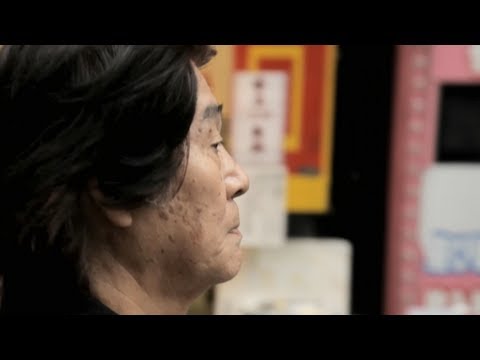
Watch the distance, the decisions and the relationship between photographer and street. Then try one idea on your own walk.
Sources & further looking
Facts checked 22 October 2026. The practical exercises and critical readings are this publication’s editorial interpretation.
- Mark C Grant: The Art of Art, revised ten-page paper ↗
- The Met: The Japanese Tea Ceremony ↗
- The Met: freshwater jar named Hotei, ca. 1600 ↗
- Hara Kenya / Japan House London: Looking behind Japanese concepts of empty space ↗
- San Francisco Zen Center: Zen Mind, Beginner’s Mind ↗
- Shunryu Suzuki: Beginner’s Mind, original talk and transcript ↗
- University of Illinois Japan House: official film series ↗
Take this to the discussion.
A question, an example, a picture that proves us wrong. Specific beats loud.
Open the conversation ↗