Begin with the turned head and the direction of the body. What makes the viewer feel noticed?
Open the source ↗Journal
Stray Dog. The photograph that became Moriyama.
Misawa, 1971: a dog looks back. How one encounter became an alter ego, and why the picture still has teeth.
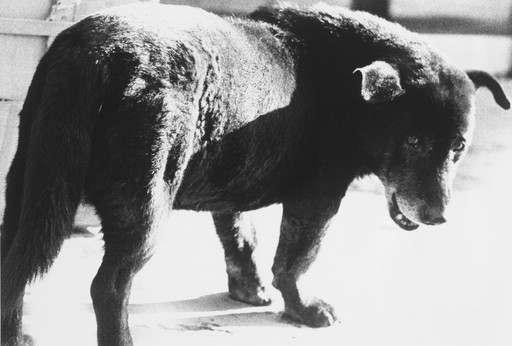
Gelatin silver print. The Museum of Modern Art, New York. Gift of the artist, 389.1977. © 2026 Daido Moriyama.
Image source: MoMA ↗ · Reproduced here for critical discussion.
Look at the original work
Look with a question.
Compare a different print. Look at cropping, orientation and tonal separation, not just the subject.
Open the source ↗Is Moriyama the stray dog?
Yes, in the sense of an alter ego. No, in the sense that this was an actual dog before it became an explanation of a photographer. Daidō Moriyama made Stray Dog, Misawa in 1971. Its later association with him is so strong that the animal can seem to stand in for the man: roaming, alert, difficult to domesticate. The picture and its maker have acquired a shared public identity.
Calling it the most famous dog in photography is a splendid opening for an argument, not a measurable world ranking. What we can establish is its place in major museum collections and the way Stray Dog became the title of SFMOMA’s 1999 retrospective and catalogue. This is a photograph whose influence extends well beyond people who know their shutter speeds.
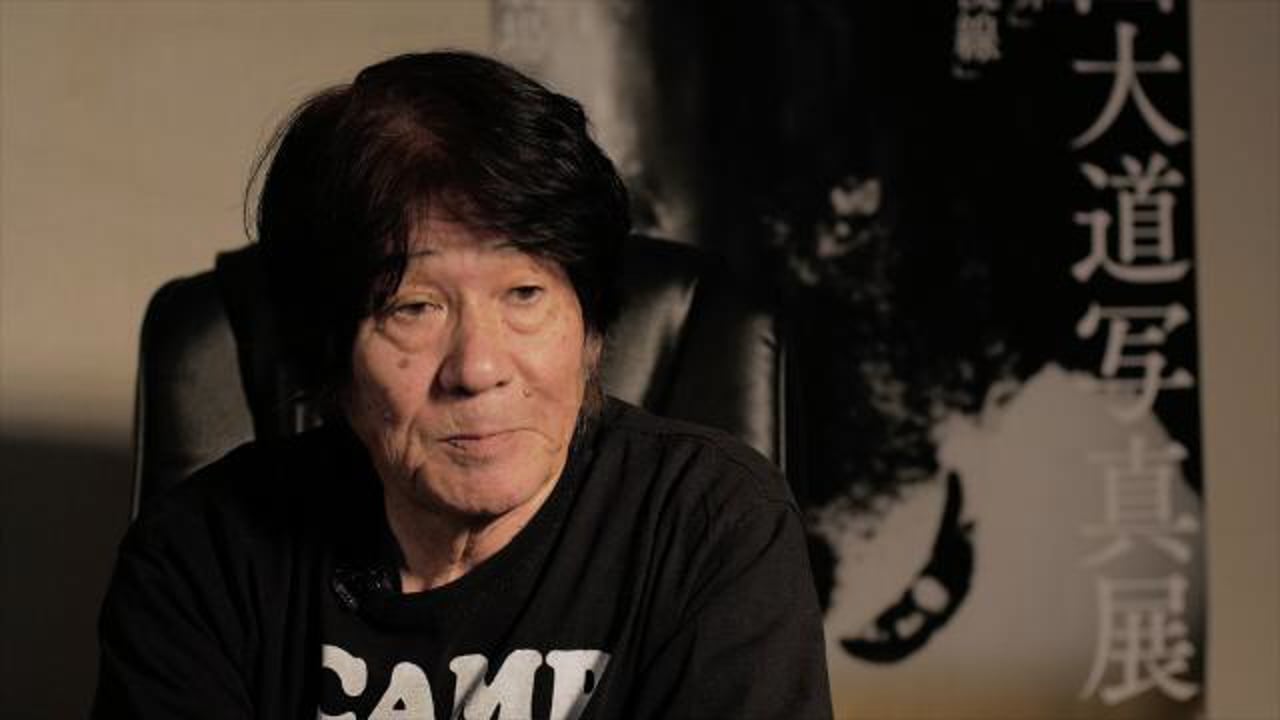
Start with the photograph above, then watch Moriyama tell the story in SFMOMA’s film below. Our Liverpool practice photographs later in this article explore related questions; they are Mark C Grant’s work, not substitutes for Moriyama’s image.
Try the idea in Liverpool. The following practice studies are Mark C Grant’s photographs, with our editorial readings.
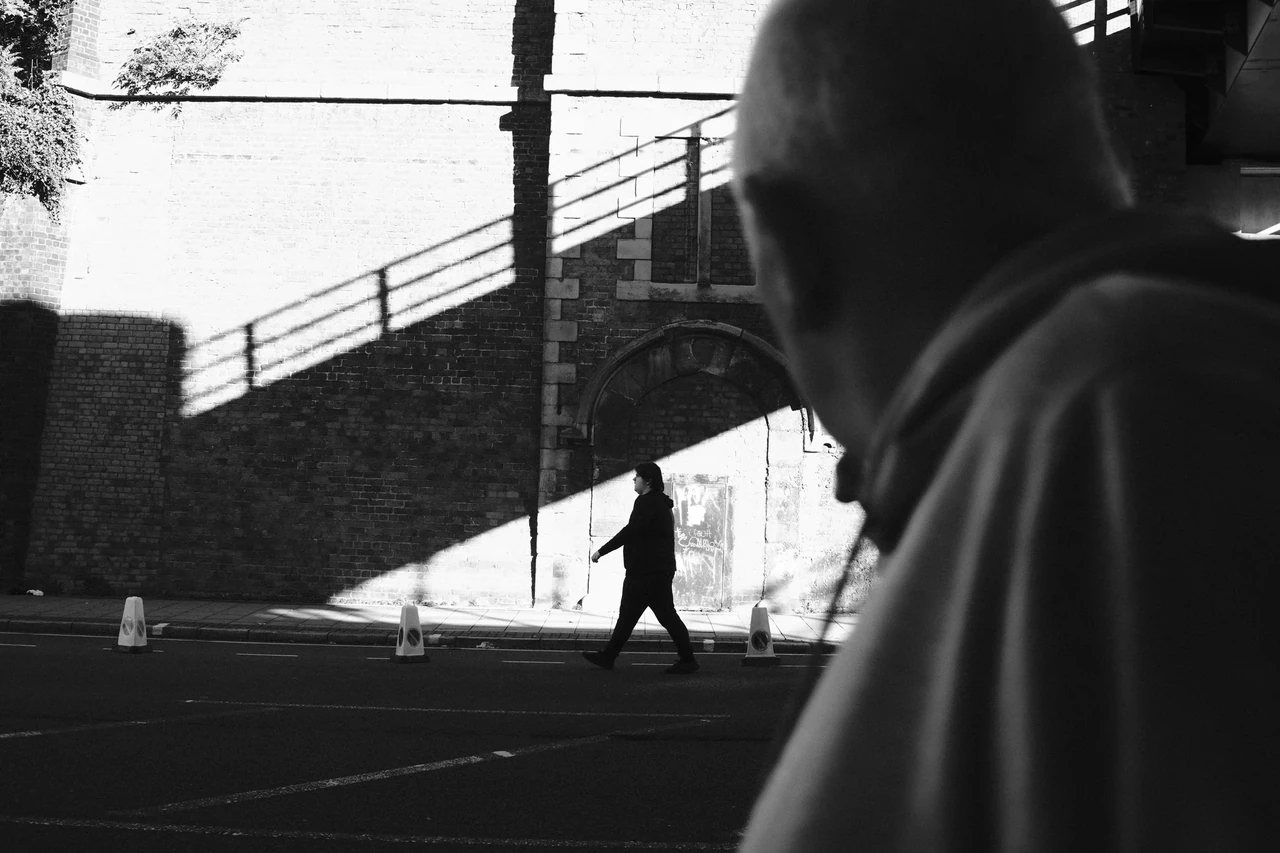
The foreground interrupts
A large, partly cut-off passer-by occupies the near edge while a smaller figure crosses the bright wedge beyond. Your eye has to negotiate two distances. The interruption makes the view feel occupied. Cover the foreground briefly and notice how much tidier—and less layered—the picture becomes.
Passing through the Frame · Photograph © Mark C GrantA body moving away; a face turning back
In the version displayed by MoMA, the dog’s body stretches across the frame and its head turns back towards us. That disagreement between body and face is the first thing to study. The animal appears both on its way and involved in a confrontation. We have interrupted something, or the photograph makes it feel that way.
The pale ground presses against the dark animal. Areas of fur become heavy masses; other patches catch light and texture. The turned head concentrates our attention without requiring a pretty background. The frame is close enough for the body to feel substantial, but it does not offer the reassuring arrangement of a pet portrait made for its owner.
Look for the eyes, mouth and stance before deciding what the dog feels. Wary, hostile, curious, defiant: these are possible readings of the image, not a veterinary report. A photograph lets us encounter a visible posture while leaving much of the animal’s situation unknown. That gap is part of its force.
Try covering the head briefly while looking at the museum reproduction, then uncover it. The body supplies weight and direction; the returned look changes the relationship. Now the viewer feels noticed. This is our close-looking exercise, not a claim that Moriyama calculated those effects in advance.
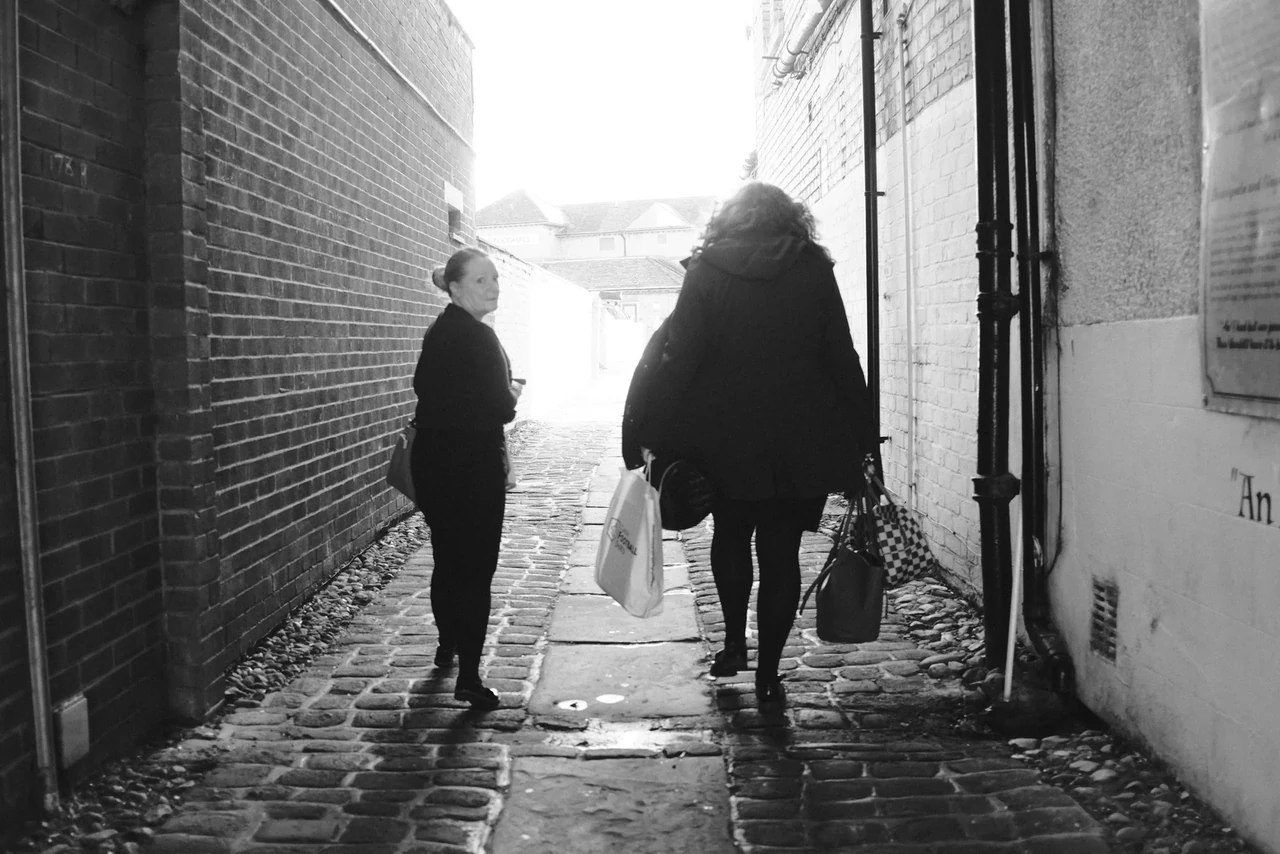
The background is already working
The bright opening pulls the eye through a darker passage. People crossing that route supply changing silhouettes and overlaps. Look at the gap between the two larger figures. You can understand the composition without knowing their destination, their names or the camera settings.
Figures in the Cobbled Passage · Photograph © Mark C GrantWatch, then try
Artist Daido Moriyama – In Pictures
Watch the distance, the decisions and the relationship between photographer and street. Then try one idea on your own walk.
Misawa is a place, not a preset
The photograph was made in Misawa in Aomori Prefecture, near a US military base. The Ackland Art Museum’s account locates the encounter there; MoMA and Tokyo Photographic Art Museum independently catalogue the image as 1971. These coordinates matter. A specific place and encounter sit underneath the later symbol.
Sandra S. Phillips’s SFMOMA essay places Moriyama’s work within postwar Japan, American cultural and military presence, restless travel and radical photographic experiment. It discusses his encounters with the work of William Klein and Andy Warhol and his participation in Provoke. That context is more demanding than a general appetite for gritty streets.
It would be too neat to make the dog a code that explains every political question of its time. It would be equally thin to strip away the place and keep only a contrast effect. A productive reading holds both: the historical setting and the stubborn particularity of a dog turning its head. Art history can add pressure without turning an animal into a diagram.
How a photograph becomes an alter ego
SFMOMA’s interview explicitly connects the photograph to Moriyama’s career. The Ackland describes its interpretation, including by the photographer, as a form of outsider self-portrait. The claim is metaphorical. A photographer can recognise something of his own movement through the world in an encountered subject without having staged a portrait of himself.
The roaming comparison works because it concerns a way of attending: being drawn onward by another street, surface or fragment. It also gives viewers a memorable character through which to approach a varied body of work. That can illuminate the photographs; it can also narrow them if every picture is expected to snarl on command.
An alter ego is not the whole person. Read beyond the famous dog. Look at Moriyama’s books, his pictures of signs and other pictures, his reworking of earlier material. A career cannot be reduced to one animal, any more than yours should be reduced to the best photograph currently pinned to your profile. Though the dog has admittedly done rather well for itself.
One negative, more than one photograph
The Ackland notes that Moriyama printed the negative in different versions, varying contrast, grain, cropping and sometimes orientation. Its own example is a 2023 archival pigment print of the 1971 image. MoMA’s collection record describes a gelatin silver print. The date of the encounter and the date or method of a particular print are different pieces of information.
Compare the museum versions with that distinction in mind. How much space surrounds the animal? Which way does the head turn on the page? How much detail remains inside the darker areas? A reproduction on a screen adds another layer of size and display conditions. There is no single contrast slider that exhausts the work.
This matters beside our twelve-frame JPEG exercise. Keeping a capture unchanged is a temporary rule designed to make you look at what happened. It is not a historical claim that Moriyama avoided cropping or reprinting. You can learn from his freedom to revisit an image and from a discipline that temporarily forbids you to do so. Exercises are tools, not constitutions.
Borrow the returned look
You do not need to find a threatening dog. The useful photographic question is what happens when a subject appears to return your attention. In Mark’s Figures in the Cobbled Passage, one person looks back while another faces away. Their different orientations complicate a simple view down an alley. In Passing through the Frame, the near and far figures make your own position feel occupied and provisional.
Those are formal comparisons proposed here, not evidence that Mark made these photographs under Moriyama’s influence. They suggest a practical task: notice direction, distance, interruption and the moment a scene ceases to feel indifferent to your presence. The strongest connection may be a relationship inside the rectangle, rather than a shared grain pattern.
Give the subject its own life. Do not corner an animal, provoke a reaction or pursue a person for the sake of the picture. Work with a consenting companion, a familiar animal whose owner agrees, or non-living subjects such as signs and reflections. An intense photograph does not require an unpleasant encounter. Your camera has no diplomatic immunity.
The challenge: presence without a portrait pose
Make six photographs on a short walk. For the first two, study a subject moving or pointing away from you. For the next two, look for something that turns attention back: a consenting person’s glance, a reflection, a face in a public sign. For the last two, make your own presence indirect through a shadow or reflection. Keep the encounters calm and the subjects undirected where possible; describe any collaboration honestly.
Choose one frame and write three lines. First, name only what is visible. Second, describe the emotional reading you bring to it. Third, state what you do not know. This separates the photograph from the story you are tempted to impose. It is an excellent antidote to announcing that every figure in a dark coat symbolises modern alienation.
Put all six on a contact sheet. Which image makes the viewer feel most involved, and what creates that involvement? A face is not the only answer. Distance, scale, occlusion or a mark at the edge may do it. Keep the originals and your notes. The aim is to discover a visual relationship that belongs to your walk, rather than recruit a local dog as an unpaid tribute act.
Sources & further looking
Facts checked 22 October 2026. The practical exercises and critical readings are this publication’s editorial interpretation.
Take this to the discussion.
A question, an example, a picture that proves us wrong. Specific beats loud.
Open the conversation ↗Keep looking
Film preview / Tate
Photographers
Daido Moriyama: the pavement does not care what your camera cost.
Fragments, proximity and a restless eye. Start with the looking; the grain can wait.
Read the piece : Daido Moriyama: the pavement does not care what your camera cost.Photograph / Mark C Grant
Journal
Contact sheets. The frame before the famous one.
How photographers choose, why the misses deserve to survive, and a practical edit that starts with everything you made.
Read the piece : Contact sheets. The frame before the famous one.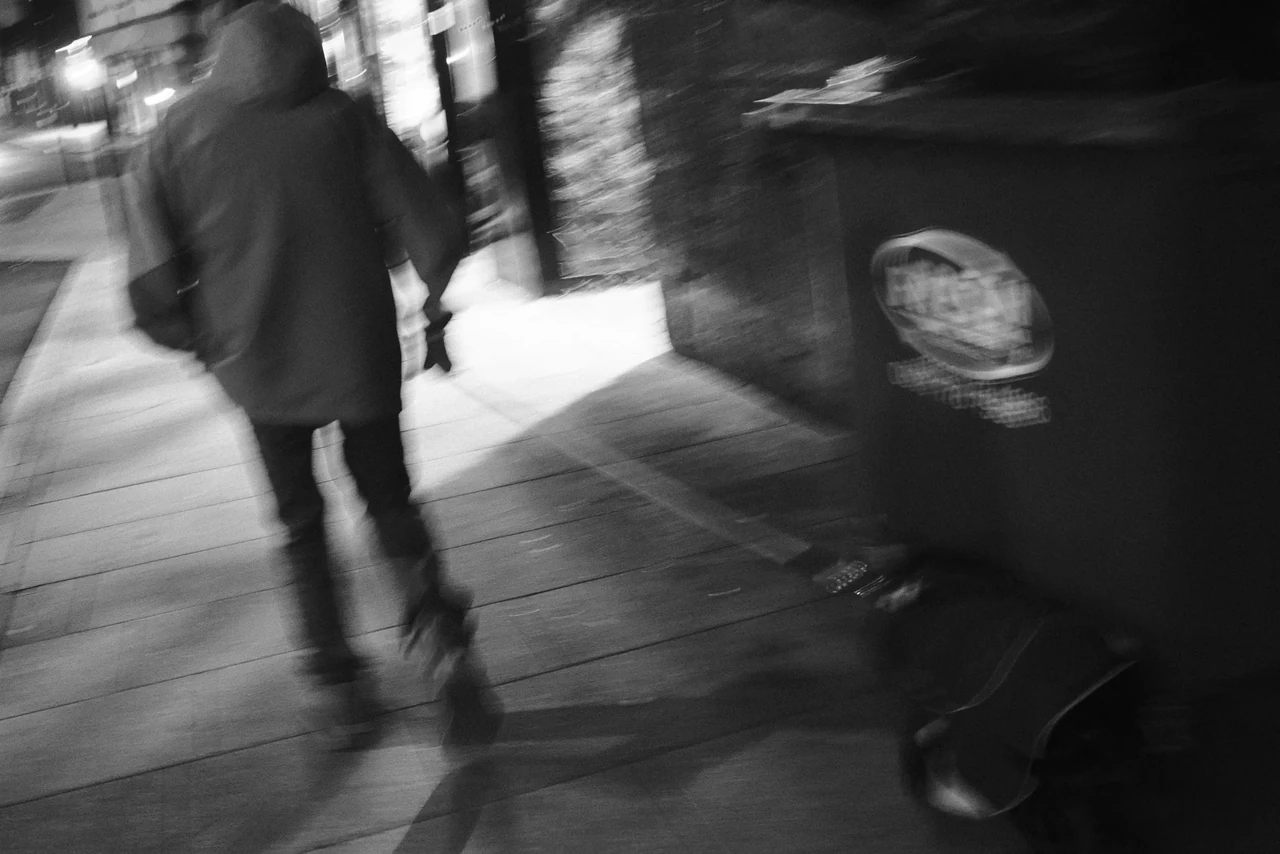
Photograph / Mark C Grant
Journal
A Moriyama-inspired Fujifilm recipe. Give the street some teeth.
A credited monochrome recipe, the settings behind its bite, and a twelve-frame walk that asks for more than heavy grain.
Read the piece : A Moriyama-inspired Fujifilm recipe. Give the street some teeth.