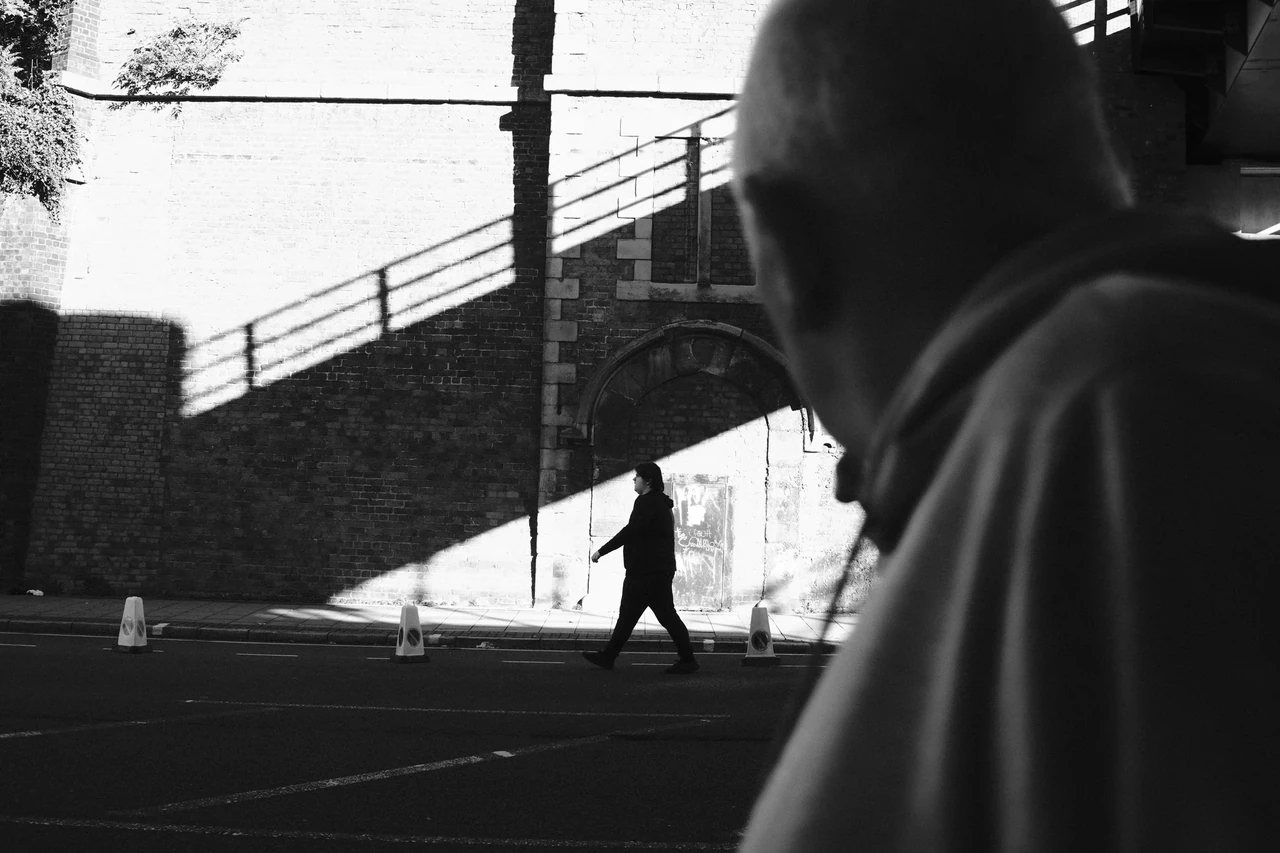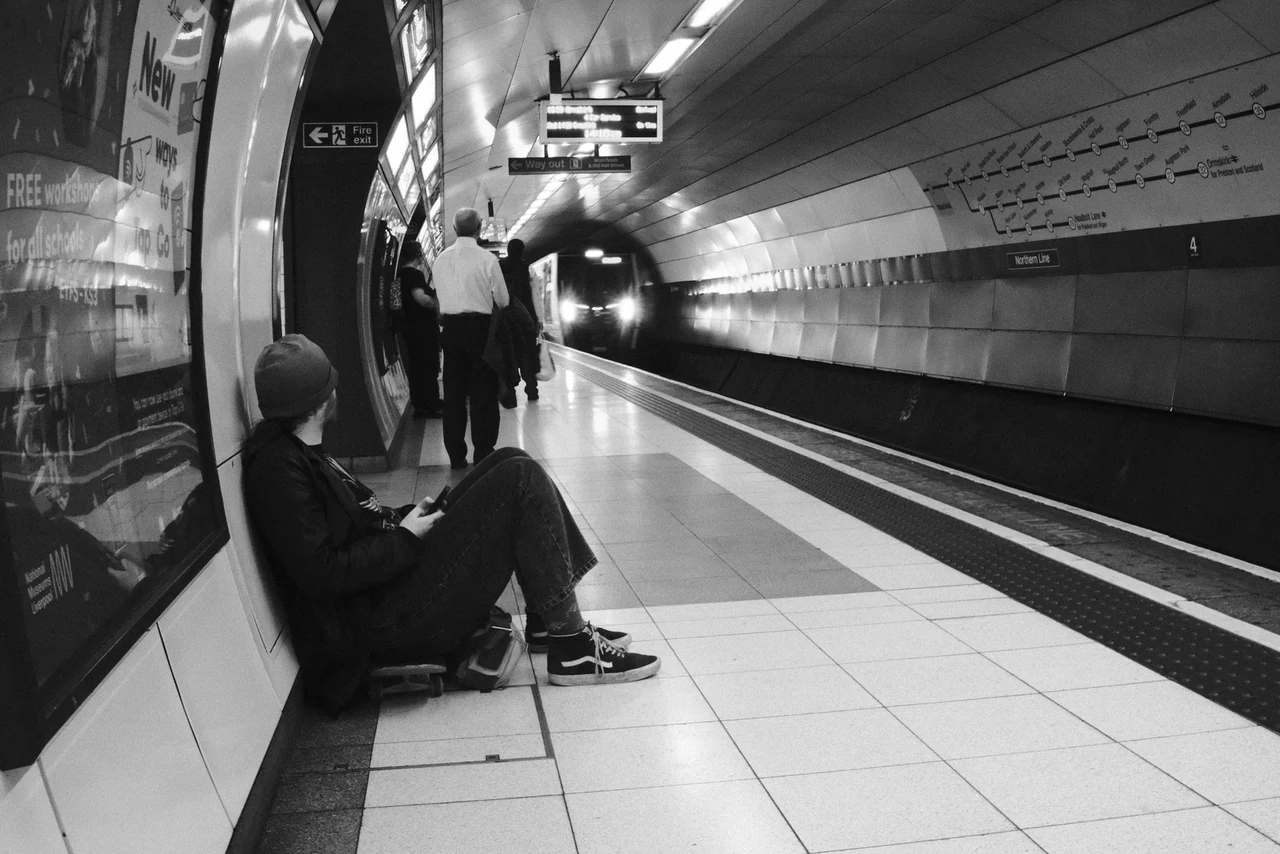
Give the walk a question
Choose a route you can revisit and one question: where people wait, how light divides a street, what changes at closing time. A question is more useful than “take some good photographs”. It gives you something to notice and something to test when you return.
Use one lens or focal length and a maximum of thirty-six exposures as a voluntary constraint. Choose the focus method and exposure approach the light requires. The limit is there to slow the scattergun habit, not to imitate a film experience you have not had.
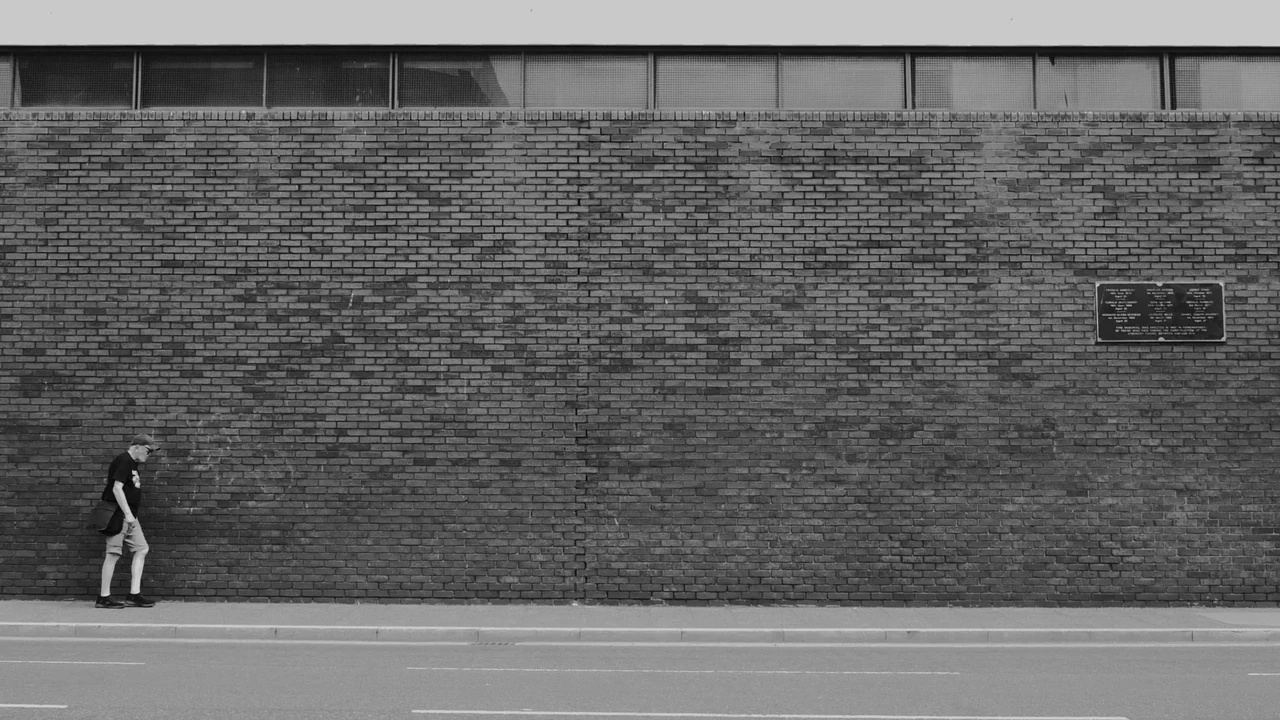
Let the wall be enormous
The pedestrian occupies very little of the picture. That is the point: the brickwork carries weight and the small figure measures it. A tighter crop would produce a more obvious subject, but it would also remove the relationship that makes this frame worth looking at.
Along the Brick Wall · Photograph © Mark C GrantMake an edit, not a trophy cabinet
Leave the pictures until tomorrow if possible. Make equally sized previews. Mark twelve on visual interest before inspecting details. Then compare near-duplicates: gesture, spacing, overlap, where the eye enters and where it leaves. Keep rejected files recoverable.
Choose six with a shared relationship. Include changes of scale and pace if they help. Your six loudest frames may fight one another. A quieter photograph can give the reader room to understand the next one. Try the Notebook’s six-picture exercise before editing your own set.
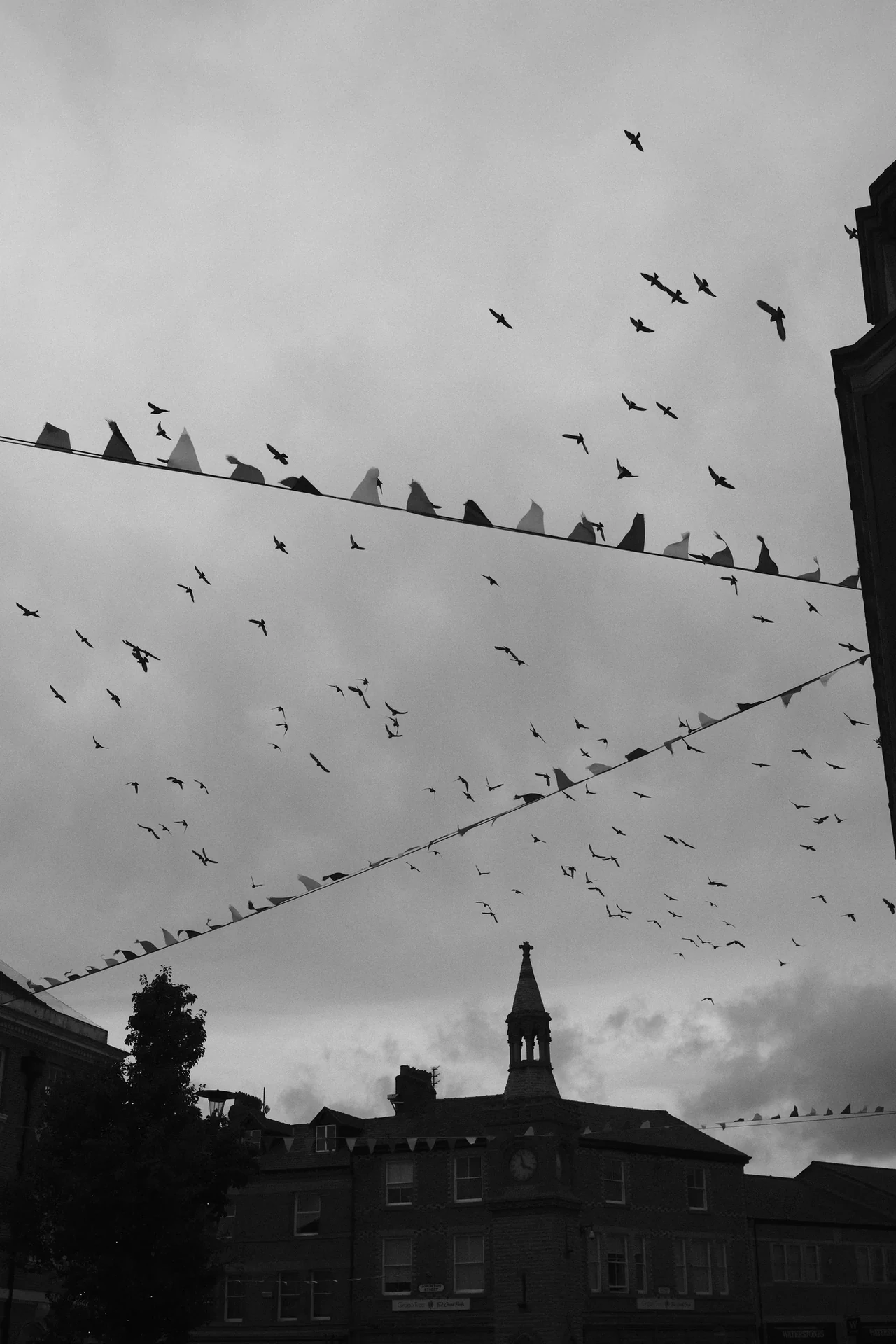
A loose line above a hard edge
Bunting, birds and the roofline make different sorts of marks against the sky. The architecture is solid; the birds are irregular and temporary. Follow that change in rhythm across the frame. Empty sky gives the small shapes room to be seen.
Birds above the Bunting · Photograph © Mark C GrantWatch, then try
Matt Stuart on Failure in Street Photography - How I See

Listen for the role of repetition and failed attempts. Choose one useful habit to repeat for a week rather than expecting every walk to produce a keeper.
Sequence creates an argument
Start with an image that invites entry, place something that complicates it, and find an ending that leaves a useful echo. Then scramble the order. Does a different story appear? There is no sacred formula, but order is never neutral.
Do not imply that archive photographs document one continuous event if they do not. Our city-in-six-frames essay is explicitly an editorial arrangement from Mark’s archive. Apply the same honesty to your own dates, locations and captions.
Make the final page
Export six images at a consistent viewing size. Keep full compositions unless a crop is a deliberate decision, and retain the originals. Add a short title and factual captions. Share only work you have the right to publish and review the context for people depicted.
Ask one other person a specific question: where did the sequence lose your attention, which transition felt forced, or what did you understand about the place? “Do you like it?” invites kindness. A precise question gives the work a chance to improve.
Return with a decision
Write three short notes: the strongest visual relationship, the most persistent technical miss and one behaviour to change next time. A successful course does not leave you with a certificate for owning a rangefinder. It leaves you with a clearer next walk.
Revisit the route. Keep the question or deliberately change it. Put the two six-picture edits side by side. Improvement may look like fewer frames, less theatrical contrast and a better gap between two ordinary people. That is plenty to be getting on with.
Review your photographs
- Do the six pictures share a question without repeating one another?
- Does the order create a relationship you can explain?
- Are captions accurate and the people treated thoughtfully?
- Can you name one concrete change for the next walk?
If it is not working yet
If the edit is six variations of one picture, return for another scale or moment. If it feels scattered, remove the frame that belongs to a different question—even if it is your favourite.
Practical guidance from Captured Moment. Starting points to test in your own work, not universal camera settings.
Take this to the discussion.
A question, an example, a picture that proves us wrong. Specific beats loud.
Open the conversation ↗