The passer-by gets in the way
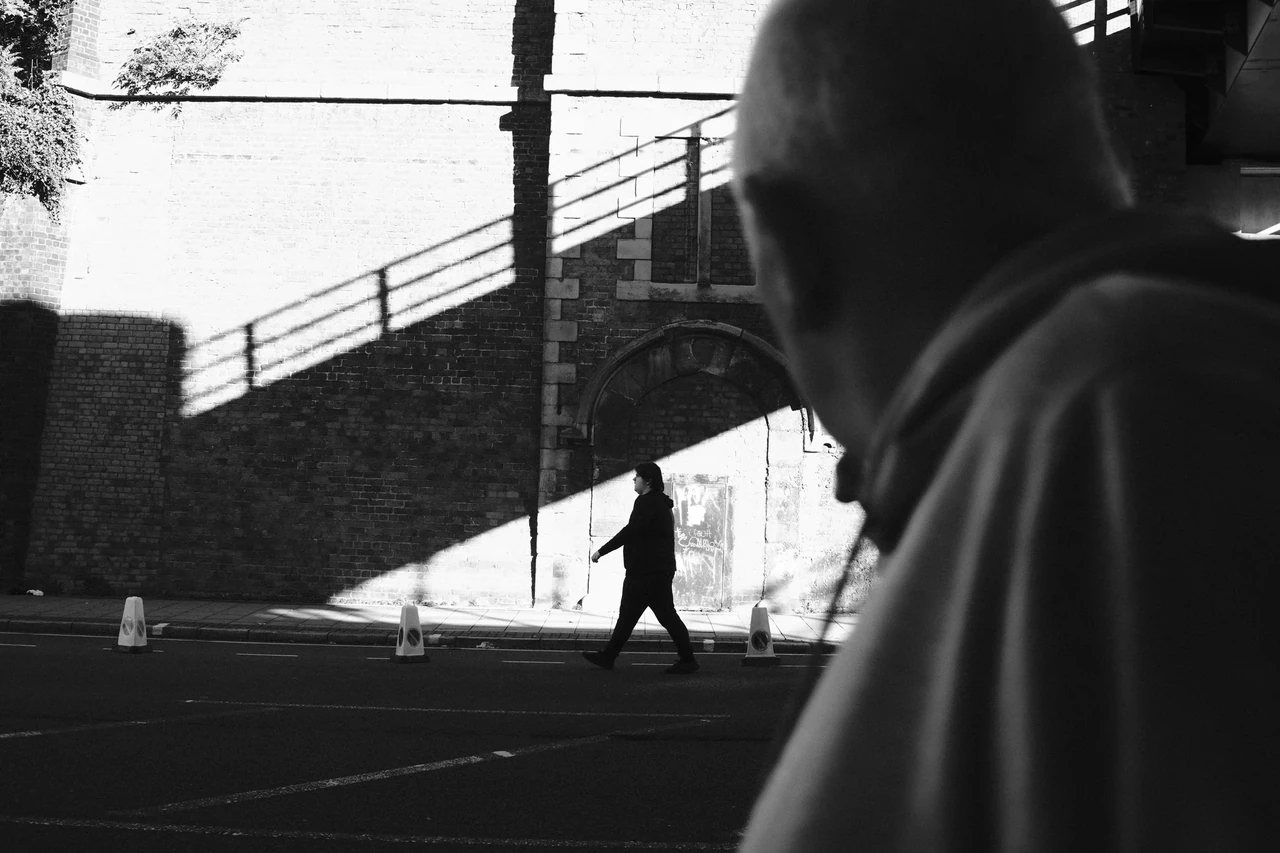
In Mark’s Passing through the Frame, a head and shoulder take up much of the right-hand side. Across the road, another figure walks through the light beneath a brick stairway. The near body interrupts the orderly arrangement of rails, shadows and wall. It also makes the photograph. We have to look around somebody to see somebody else.
A tidier image is easy to imagine: remove the foreground figure, straighten the arrangement, let the distant walker have the stage. But the interruption places us on a pavement among other people. It gives the picture an encounter to work with. Its interest depends on the relationship between what the photographer could arrange and what the street supplied.
That relationship may acquire a different value as invented images become increasingly convincing. If an attractive scene can be produced without anybody visiting it, a photograph offers another reason to care: this arrangement of bodies and light was available to a person, in a place, for a little while. The claim needs care, but it is a meaningful claim.
A possible resurgence, carefully described
Here is the proposition: generative imagery may encourage a renewed appetite for photography that stays close to experience. People may become more interested in the walk, the meeting, the imperfect family picture, the print kept in a drawer. Classical photography, in this sense, is a practice of attention and selection. It does not require a particular decade of equipment.
There is evidence of renewed camera demand. CIPA reports about 9.44 million digital cameras shipped worldwide in 2025 by participating manufacturers, up 11.2% on 2024. Built-in-lens models rose 29.6%. These are shipments, not a count of committed photographers, and they tell us nothing directly about film use. They certainly do not establish that generative AI caused the increase.
CIPA’s earlier account of the 2024 recovery points to demand for higher-quality social-media content and younger creators, among other factors. It also discusses AI-based subject recognition as a benefit in cameras. The same broad term therefore covers tools that help someone photograph a real encounter and tools that invent a scene. A simple story about photography defeating AI leaves too much out.
The more interesting question is cultural rather than a sales forecast. What will we value in a photograph when appearance alone becomes less useful as evidence of how it was made? A resurgence in looking is possible even without a spectacular resurgence in camera purchases. It would show itself in what people do with the equipment they already own.
The picture and the occasion are different gifts
An invented image can be moving, funny or formally accomplished. Its value does not have to depend on an event having occurred. A photograph can do those things too, while also keeping a relationship with an occasion. Consider an ordinary picture of somebody you knew. Another image could be more elegant and still fail to replace it.
The awkward hand, the dated wallpaper, a person looking elsewhere: these details may matter because they belong to a shared history. We sometimes discover their importance much later. A frame made to record a birthday becomes a record of the room; a picture of a friend preserves a shop that has disappeared. The photographer did not have to anticipate every future reason for looking.
This is one reason to resist tidying away every incidental thing. Some distractions really do weaken a picture. Others are the part that time will make interesting. Before removing a sign, a stray object or an inconvenient person, ask whether you are improving a composition or changing what the photograph can tell somebody later. Keep the original either way.
What the photograph does not know
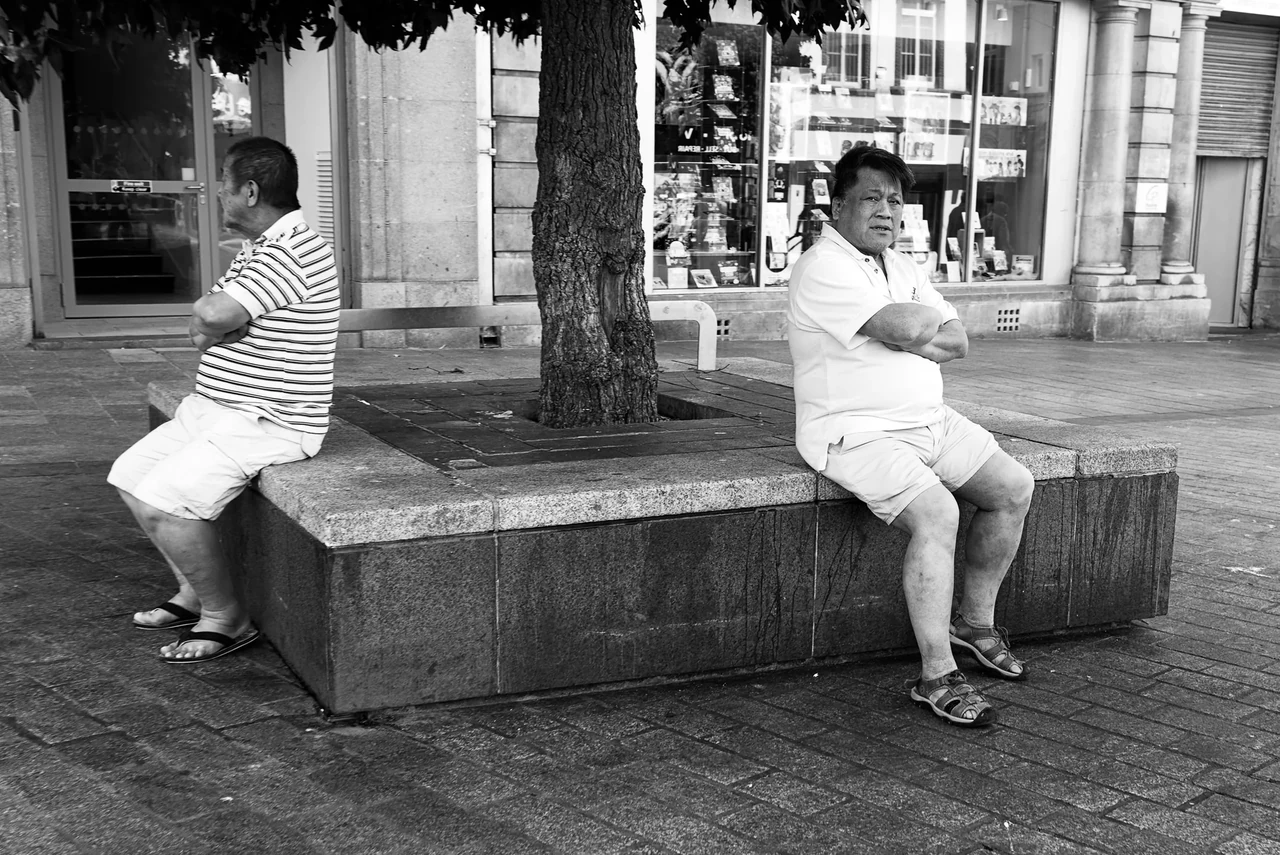
Look at Two Seats beneath a Tree. Two seated men face different directions, their folded arms echoing one another across the trunk. The resemblance invites a story. We might imagine an argument, a friendship, a long wait. The frame does not establish any of those explanations. It gives us posture, spacing, clothes, pavement and a moment of attention towards the camera.
Being made with a camera does not turn an image into a complete account. A photographer chooses where to stand, when to expose and what to exclude. A staged scene can be photographed faithfully. An accurate picture can acquire a misleading caption. A narrow crop can conceal the detail that would change our understanding.
A renewed regard for witnessed photographs should therefore come with better habits of description. Say what you know about the place and occasion. Separate observation from interpretation. If a portrait was arranged, describe it as arranged. A modest, accurate caption is more useful than a dramatic one that borrows certainty from the camera.
The space between people
Two seated figures share a structure without becoming a single group. Read the direction of their bodies and the empty stretch between them. The gap is active information. You can describe that arrangement without claiming to know whether they are strangers or what either is feeling.
Two Seats beneath a Tree · Photograph © Mark C GrantClassical is a way of working
Film, a digital camera and a phone can all support patient observation. They offer different constraints and pleasures, but none grants its owner a monopoly on presence. A person returning to the same corner with a phone may be looking more closely than somebody carrying an expensive camera from one recognised view to the next.
Nor does computation automatically sever a photograph’s connection with a scene. Google’s HDR+ research describes aligning and merging a burst of camera exposures to reduce noise and improve dynamic range. That is a different operation from asking a system to invent the people and street. Individual tools need to be understood by what they do, rather than sorted by a reassuring label.
The useful discipline is to know which decisions you are making. Exposure, focus, tone and crop shape a reading. Replacing a sky or generating an absent figure changes the event being represented. There is room for imaginative transformation, but a transformed picture should not quietly inherit the documentary claim of its source. Keep versions and describe substantial alterations when that claim matters.
Grain is not proof of honesty. Blur is not proof of spontaneity. Both can be expressive choices, and both can become costumes. If everything has been made to resemble a half-remembered photograph from 1963, perhaps the next useful decision is to look at the light outside today.
A history for the file, a responsibility for the caption
There are practical attempts to make the history of an image inspectable. Leica’s 2023 M11-P announcement introduced Content Credentials at capture for that camera. The C2PA standard records signed, tamper-evident provenance: information about creation and subsequent changes that a compatible system can verify.
This can help us assess where a file came from. It cannot, by itself, establish that a scene was unstaged or that a caption tells the whole story. Those are questions about conduct and context. Credentials can also be separated from an image, so their absence should not be treated as proof of fabrication. Older family photographs deserve better than that test.
Most of us can begin with simpler practices. Retain the original file or negative. Keep capture dates and useful notes. Store an edited copy separately. Name the place when appropriate and safe, and record what was arranged. A small sequence or contact sheet can provide context for a selected frame, although it is still a selection. Trust grows through consistent care as well as technical tools.
Waiting is part of the work
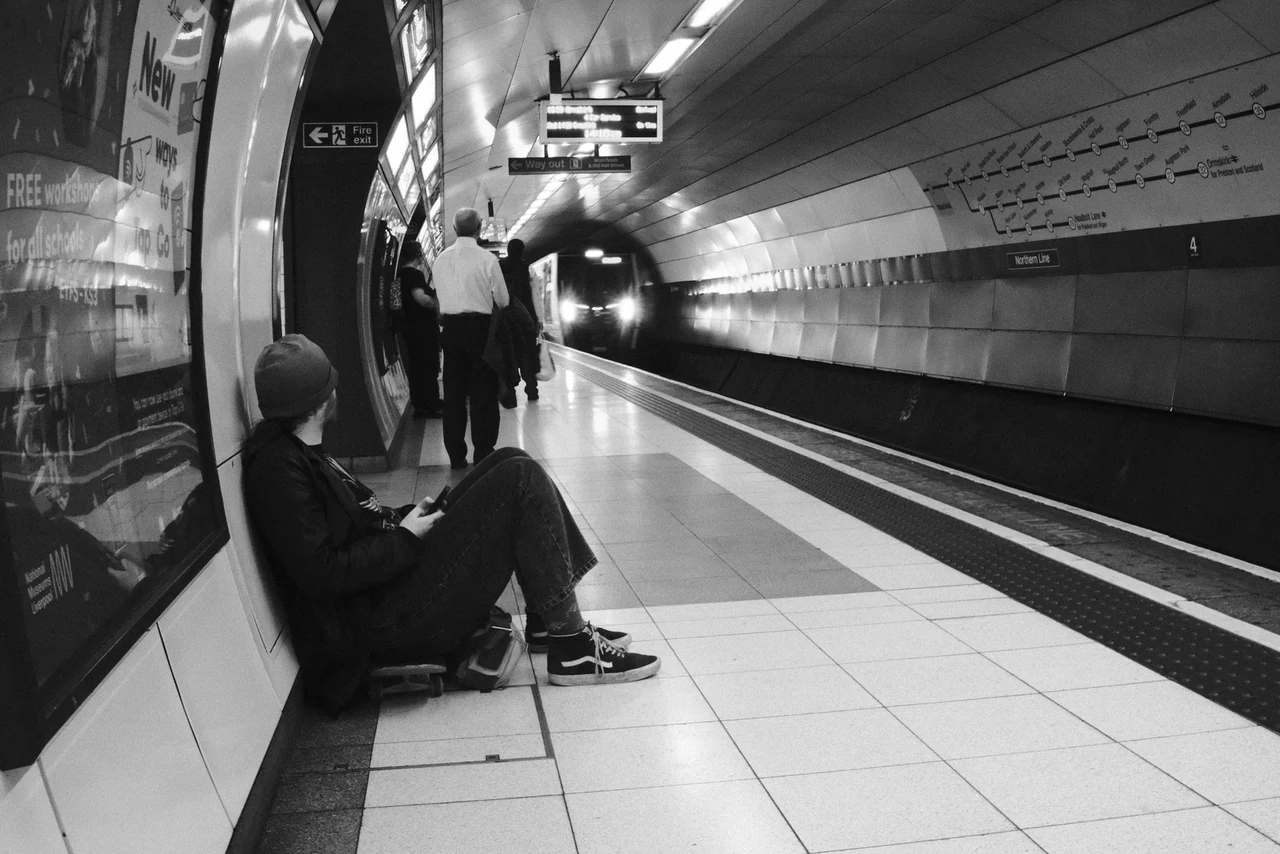
In Waiting at Moorfields, the seated passenger occupies the near left of the picture while the train’s lights emerge down the platform. Other figures, ceiling panels, route map and floor lines pull towards the arrival. There is a particular interval here: the train has become visible, but the ordinary business of boarding has not yet filled the foreground.
We cannot recover the passenger’s thoughts from the photograph, or claim that everybody experienced the wait in the same way. We can attend to how the frame makes different kinds of waiting visible. The seated body and the approaching lights hold still together in a way they did not in life.
For a photographer, getting such a frame involves accepting time spent without a result. Walking, pausing, missing something, noticing something else: these are part of the activity. An invented picture may satisfy a visual intention quickly. Going out with a camera can change the intention through an encounter. That is a reason to keep doing it, even when no impressive picture comes home.
A still figure, an approaching light
The seated passenger and the approaching train set up different kinds of time. One holds still while the other advances. The platform lines connect them. Notice how little information the dark tunnel needs to contain: the approaching light already gives that darkness a purpose.
Waiting at Moorfields · Photograph © Mark C GrantWatch, then try
#LeicaConversations - Street Photography and Beyond with Matt Stuart

Compare the discussion of London street pictures with the longer community project. What changes when a photographer returns and gets to know a place?
Keep something ordinary
Try this over a week. Choose one ordinary, accessible place and visit it on three different days. Make no more than four photographs on each visit. Use the device you have, keep the full originals, and avoid asking strangers to perform a feeling for your theme. Look for a change in light, use, spacing or gesture. Stay considerate and out of the way.
The following week, put all twelve frames in capture order. Choose one that records something specific you would otherwise have forgotten. Write two sentences: one containing only what you know about the occasion, the other explaining what holds your attention. If the second sentence claims to know somebody else’s private thoughts, revise it.
Make a small print if you can, or keep a clearly named digital copy with the notes. Return to it in a month. The test is not whether it defeats a generated picture in a contest of visual polish. Ask what the photograph lets you remember, notice or question that would otherwise have gone missing.
Our earlier essay, Someone was there, considers the connection made by street photography. This is a next step: keeping that connection useful over time. AI may help renew interest in classical photographic practice; the evidence does not yet entitle us to announce that as the cause of a revival. We can still act on the underlying idea. Go somewhere, pay attention, make a photograph, and take care of what it records.
Sources & further looking
Facts checked 26 October 2026. The practical exercises and critical readings are this publication’s editorial interpretation.
- CIPA: worldwide digital camera shipments, January–December 2025 ↗
- CIPA: 2024 results and 2025 outlook, 27 February 2025 ↗
- Google Research: Burst photography for high dynamic range and low-light imaging on mobile cameras ↗
- Leica: M11-P announcement, 26 October 2023 ↗
- C2PA: Content Credentials and provenance explained ↗
Take this to the discussion.
A question, an example, a picture that proves us wrong. Specific beats loud.
Open the conversation ↗